Art of Ruq'ah Through the Eyes of A Kurdish Calligrapher
Self-taught calligrapher Adnan Kakeyi recalls learning with reed pens and books in the late 1990s and explains why Ruq'ah is seen as a gateway to calligraphy.
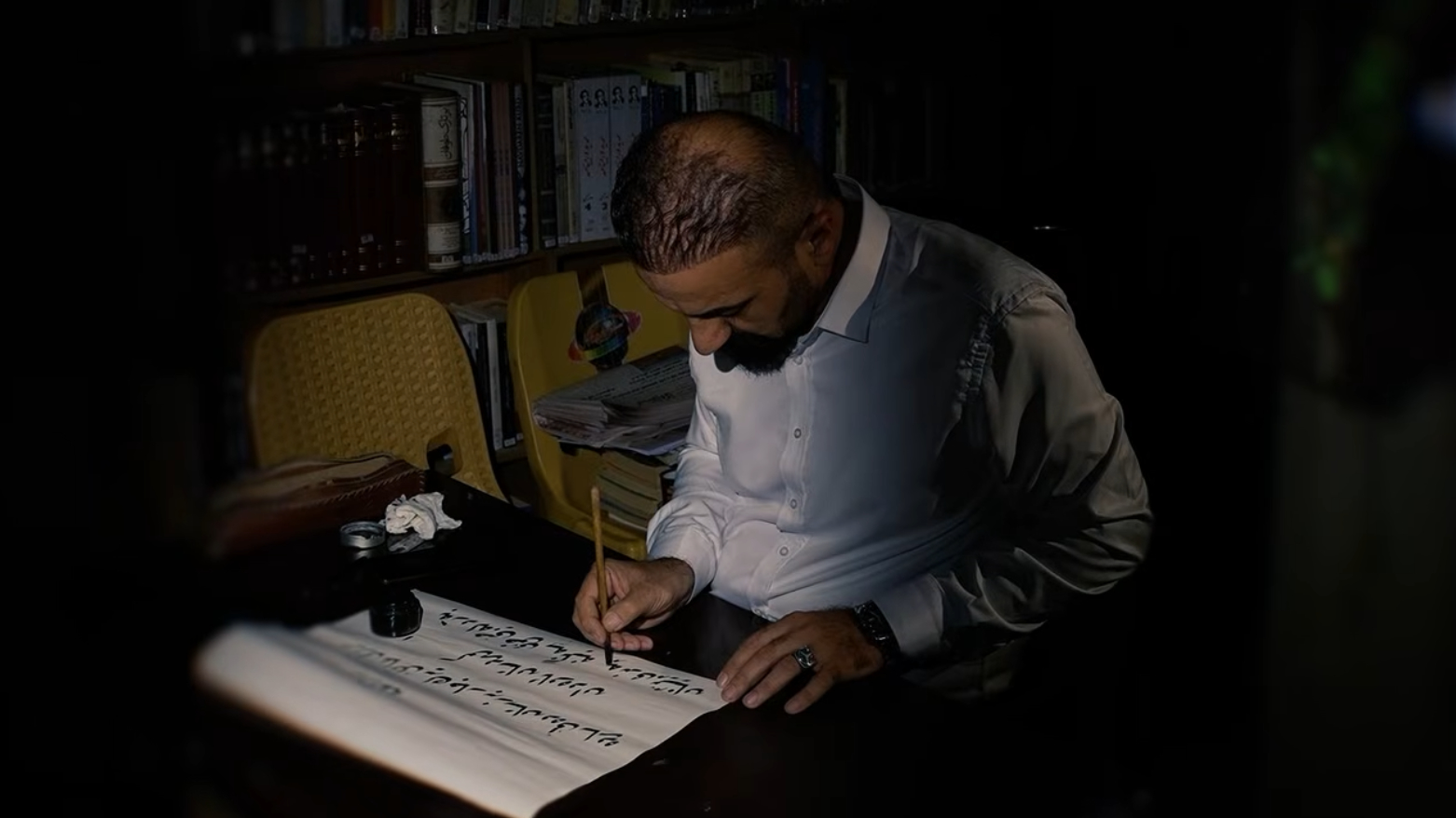
ERBIL (Kurdistan24) - When Adnan Kakeyi decided to become a calligrapher in the late 1990s, there was no teacher guiding his hand. He began with books by established calligraphers, ink and reed pens, teaching himself a craft in which the shape of a single letter can demand patience and precision.
The decision came in 1998, or close to 1999, he recalled. Kakeyi gathered whatever materials he could find, including manuals by Hashim Baghdadi and Yusuf Danun, and started studying the scripts on his own.
"I wanted my script to be beautiful, to become a famous calligrapher," he said.
His account of those beginnings is straightforward: he wanted to write well, found examples worth studying and began practicing without formal instruction. For someone approaching calligraphy from outside a classroom, the books and tools provided both the starting point and a way to work toward his ambition.
Kakeyi's interest extends beyond the appearance of lettering. He also explains why particular scripts developed and how their construction affects the person holding the pen. One of the scripts he discusses is Ruq'ah, which he describes as the most accessible of the major styles.
To explain its place in calligraphy, Kakeyi looks back to the Ottoman period. He dates the development of Ruq'ah's rules to around 1862 or 1863, when, in his account, government departments needed a quicker way to produce handwritten records.
The established alternatives, including Kufic, Naskh and Thuluth, were available, but their elaborate forms required more time to write. Officials needed something suited to the demands of routine administration rather than the slower work associated with other styles, he explained.
Kakeyi credits Mumtaz Bek with introducing Ruq'ah and setting out its rules. He says Mehmed Izzet subsequently refined those rules, helping develop a script defined by economy of movement.
For Kakeyi, that practical origin is essential to understanding why Ruq'ah is still an approachable starting point. Among what he describes as roughly 10 to 12 principal scripts, Ruq'ah stands out because its letters can be written with fewer interruptions.
"In other scripts, each letter requires lifting your hand 2, 3, or 4 times," he explained. "But Ruq'ah is all in one go."
The difference may sound small, but to a beginner learning to control a reed pen, the number of times the hand must stop and begin again changes the task. Kakeyi describes Ruq'ah as a style whose writing flows in a single movement, rather than requiring repeated lifts of the pen.
He calls it "the key to calligraphy," a description that reflects both its relative simplicity and its value to newcomers trying to understand the relationship between hand, pen and letter.
Kakeyi's story also makes clear that an accessible script is not the same as an effortless craft. His own entry into calligraphy required him to seek out manuals and materials and learn without the corrections a teacher might have supplied.
What began with reed pens and books in the late 1990s has given him a language for explaining the art to others. In his telling, Ruq'ah's appeal lies not in elaborate ornamentation, but in the discipline of making writing clear, quick and continuous.