Ocalan Urges Democratic Reforms as PKK Vacates Khwakurk Shelters
Turkish sources say the PKK evacuated 14 more Khwakurk shelters as disarmament advances, while Ocalan urges legal guarantees for Türkiye's peace process.
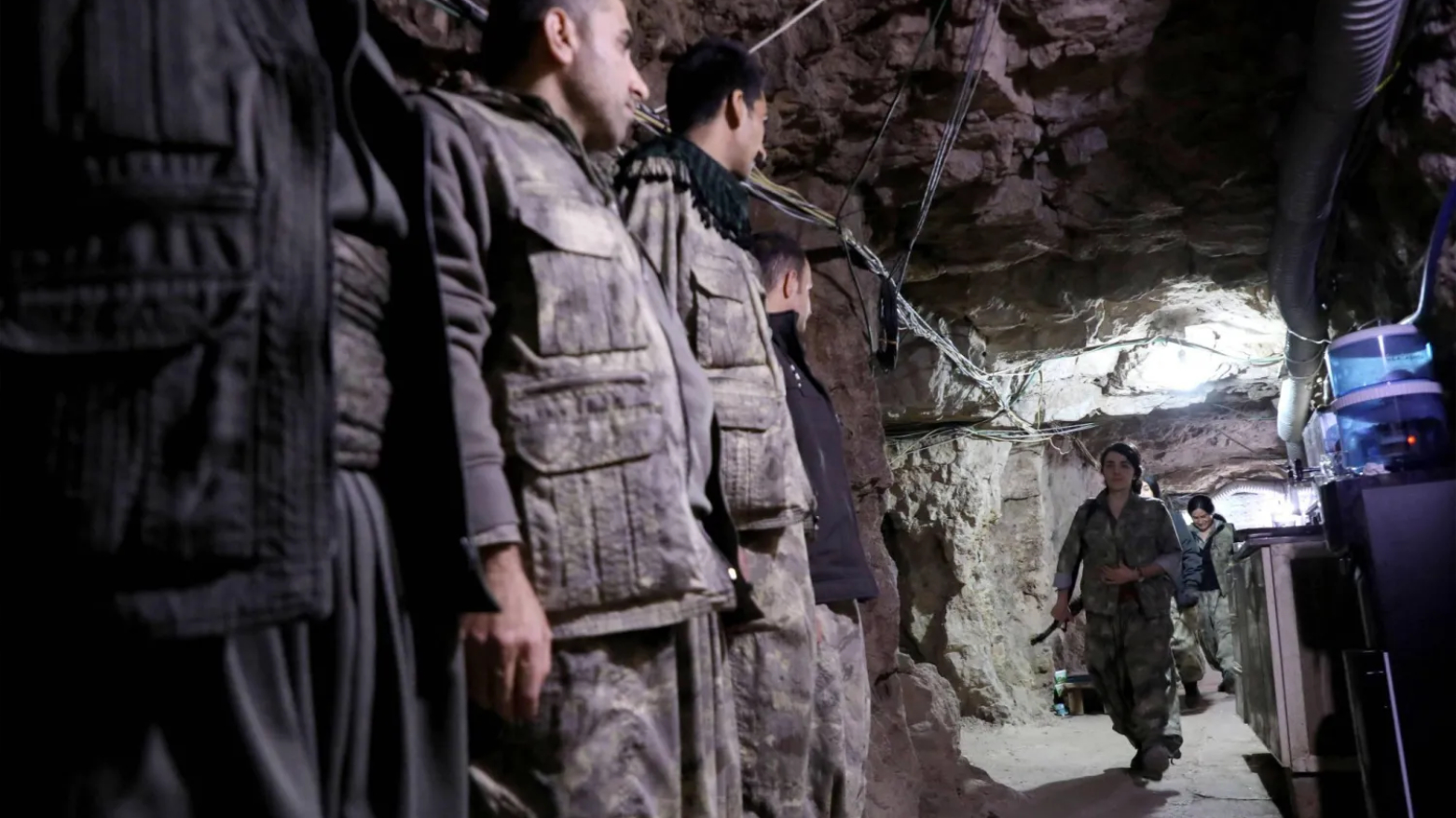
ERBIL (Kurdistan24) - The Kurdistan Workers' Party (PKK) has withdrawn from 14 additional shelter areas in Khwakurk, according to Turkish security sources, in a development Ankara is presenting as evidence of progress in the disarmament phase of its peace process with the Kurdish group.
The Turkish Ministry of National Defense subsequently destroyed caves and shelters at the evacuated sites, rendering them unusable, the sources said in remarks carried by state broadcaster TRT on Monday, Nov. 23. They said the latest withdrawals had been completed by Nov. 18.
The announcement came as a delegation from Türkiye's pro-Kurdish Peoples' Equality and Democracy Party (DEM Party) released a new message from imprisoned PKK leader Abdullah Ocalan, who urged that the process be strengthened through democratic law and political participation.
Together, the statements highlighted two parallel strands of the peace initiative: the removal of armed infrastructure and the unresolved legal and political questions surrounding a lasting settlement.
Withdrawals, 14 New Locations
According to the Turkish security sources, the latest evacuations followed the PKK and Kurdistan Communities Union (KCK) withdrawal from four shelter areas in the Bazi section of Metina on Oct. 8. Those earlier locations were identified as Hebat, Yazhk, Sabri and Sason.
The 14 Khwakurk sites were identified as Ciger Tepe, Sherif, Alisher, Kendekola, Pajk, Baran Ammunition Depot, Hinere/Hospital, Terzekhane, Mazlum Dogan, Pratik Yönetim, Ammunition Depot, Yusuf-Asayish, Hemen and Jasur.
The descriptions suggest that the abandoned facilities included not only shelters but also sites associated with ammunition storage and other organizational functions, although the statement did not detail their previous use.
Turkish officials characterized the evacuations as part of efforts to remove locations they considered potential flashpoints for renewed fighting. The sources said the destruction of caves and shelters was intended to prevent those positions from being used again.
The statement did not specify how many PKK members had left the areas, whether arms were surrendered during the withdrawals or how the individual evacuations were verified. Its account of the demolitions was presented through Turkish security sources rather than independent access to the sites.
The sources argued that the latest steps demonstrated movement toward completing disarmament and could contribute to security and political stability beyond Türkiye.
They also emphasized that the process depended on concrete, verifiable developments on the ground, rather than declarations alone, particularly as the peace initiative enters a stage in which military withdrawals and legal provisions are increasingly connected.
Ocalan's Call
The developments coincided with the DEM Party's account of a meeting with Ocalan on Imrali Island on Sunday, Nov. 22. The delegation comprised Turkish Parliament Deputy Speaker Pervin Buldan, lawmaker Mithat Sancar and lawyer Ozgur Faik Erol.
In its statement the following day, the delegation said Ocalan had been moved to a different location within the prison, describing the change as an improvement in his living and working conditions.
It urged authorities to provide communication arrangements that would allow him to explain publicly his work on peace between Turks and Kurds.
The delegation also called for the bodies established under the peace legislation to begin operating with a clear legal basis. Summarizing Ocalan's remarks, it said he considered Türkiye to be approaching a historic turning point requiring both sustained work and awareness of potential setbacks.
Ocalan cautioned against allowing political debate to become confined to a cycle of pressure, provocation and reaction. He argued that excluding political participation could create opportunities for anti-democratic actors and maintained that the Kurdish question should be addressed as a matter of democracy, with rights and recognition extending to all identities.
"The most effective measure against these is to strengthen the process through democratic law and free politics," he said, according to the delegation's account.
He also criticized deaths in prisons, canceled conditional releases and differing practices between prisons, describing such developments as provocations against the peace initiative.
The delegation's statement did not announce a new agreement with the Turkish authorities.
Disarmament
The connection between disarmament and legal change became clearer in comments on Nov. 21 by Feti Yildiz, deputy chair of the Nationalist Movement Party (MHP).
Yildiz said 2,800 of the 4,897 people imprisoned over PKK and KCK-related allegations or convictions could potentially benefit from the peace framework.
He stressed that the measure was not an immediate or unconditional release. Those implicated in murder, shootings targeting soldiers, bombings against civilians or offenses carrying life imprisonment would be excluded, he said, with even an existing investigation or prosecution sufficient to bar eligibility in certain cases.
For those covered, he outlined suspensions lasting five years for sentences of up to 15 years and 10 years for longer sentences. New offenses committed during the suspension period could reactivate proceedings or sentences.
The 12-article law, approved by Türkiye's Parliament on Aug. 10 and published on Aug. 18, requires confirmation that the PKK, KCK and affiliated structures have ended their operational existence and handed over weapons and ammunition.
Under the process described by Yildiz, the National Security Council must endorse the verification, with its decision published in the Official Gazette before the measures become operational.
Turkish security sources said the National Consensus and Social Unity Coordination Body and its subcommittees were overseeing developments relevant to possible reintegration under the law.
They also linked a successful settlement to the prospect of redirecting resources toward economic prosperity.
Test of Implementation
The present initiative dates to an Oct. 22, 2024, call by MHP leader Devlet Bahceli.
Ocalan called on the PKK to disarm and dissolve on Feb. 27, 2025. The organization decided to end its armed struggle at a congress held May 5-7, announced that decision on May 12 and carried out an initial symbolic disarmament step that July.
More recently, Türkiye's interior minister met governors from eight provinces on Nov. 20 to discuss the process, while five independent UN experts urged Ankara to strengthen judicial safeguards and oversight in related legislation.
The latest Khwakurk announcement therefore represents another reported physical withdrawal, not the completion of the broader political and legal process. Whether the verified disarmament requirements are ultimately met will determine when the provisions affecting prisoners and returnees can be applied.
Kurdistan24 correspondent Ebidulselam Tûtincî contributed to this report.