US strongly opposes new Russian missiles in Syria
On Monday, Russian Defense Minister Sergei Shoygu announced that Moscow would supply Syria with a sophisticated air defense system—the S-300—within two weeks.
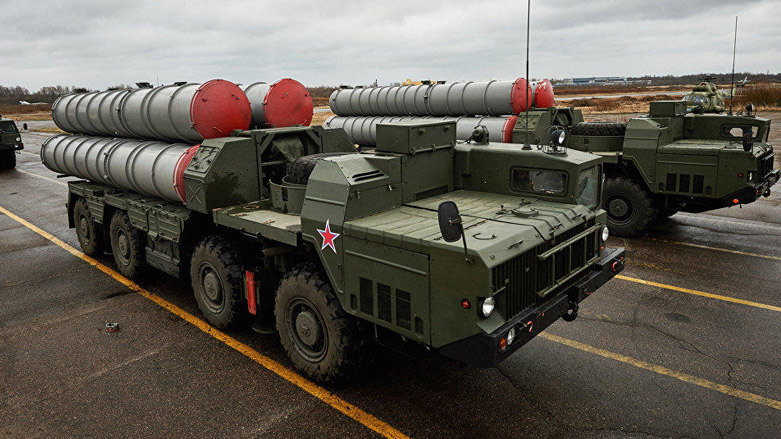
WASHINGTON DC (Kurdistan 24) — On Monday, Russian Defense Minister Sergei Shoygu announced that Moscow would supply Syria with a sophisticated air defense system—the S-300—within two weeks.
The Trump administration responded with sharp warnings against such a move.
White House National Security Adviser John Bolton told reporters later on Monday that the introduction of the S-300 would be a “significant escalation” and “something that we hope” the Russians “will reconsider.”
The Russian announcement follows an incident last Monday, in which Syria, using its older air defense system, the S-200, shot down a Russian reconnaissance plane, killing 15 Russian servicemen, after an Israeli bombing raid in the northwest of the country struck weapons-manufacturing systems which Iran planned to transfer to Hezbollah.
The Syrians—whom Jerusalem accused of firing wildly and recklessly—hit the Russian plane believing it was an Israeli plane.
When the Russian military intervention in Syria began, in September 2015, the Russian Air Force established a deconfliction line with its Israeli counterpart.
As part of that understanding, Moscow did not interfere with Israeli attacks on Iranian targets in Syria. Subsequently, Israel conducted over 200 such strikes. The arrangement seemed to be working—until last Monday.
Subsequently, an Israeli military delegation visited Moscow to explain what had happened and re-establish a working relationship. However, the Russians appear to have rudely rebuffed the Israelis.
On Sunday, the Russian Defense Ministry issued what the Israeli newspaper, Ha’aretz, described as a “scathing report,” blaming Israel, rather than Syria, for the loss of the Russian plane and crew.
Moscow accused the Israeli Air Force of being “criminally negligent, at the very least.” It claimed that the Israeli planes had given only a one-minute warning they would be flying in the area, not enough time for the Russian plane to move out of the danger zone, and then, that Israeli planes hid behind the Russian plane, drawing Syrian anti-aircraft fire to the doomed aircraft.
Israel has vehemently denied Moscow’s account, affirming that it gave the Russians ample warning and that its planes were already in Israeli airspace when Syria struck the Russian plane.
Shoygu also announced that Russia would start jamming the radars of military planes approaching Syria from the Mediterranean sea, further complicating Israel’s task of defending itself.
A State Department official expanded on US concerns to Kurdistan 24, explaining that “the Russian delivery of further enhanced air defenses to the Assad regime will only raise the risk of escalation in an already dangerous environment.”
He noted that such a weapons transfer will also “increase the risk to US and partnered forces” conducting military operations in eastern Syria against the so-called Islamic State (IS), while he stressed that it “reconfirms Russia’s continued protection of the Assad regime” and its “ultimate responsibility for the regime’s actions.”
The State Department official blamed two parties for the “unfortunate incident.” One was Syria, which had engaged in the “unprofessional and indiscriminate firing of missiles.”
The other was Iran, and he called on Tehran to “end its provocative transit of dangerous weapon systems through Syria which are a threat to the region.”
Previously, Israel had adopted an accommodating position toward Russia, partly to ensure its continued freedom of action in Syria.
Israeli Prime Minister Benjamin Netanyahu was a frequent visitor to Moscow and cultivated a personal relationship with Russian President Vladimir Putin.
Following Moscow’s use of the sophisticated nerve agent, novichok, in the attempted murder of former Russian spy, Sergei Skripal, in Britain, the US led an international effort to expel Russian diplomats (many were spies under diplomatic cover.) Over 20 countries joined the US in doing so, but Israel was not among them.
Former Israeli Foreign Minister and leader of the parliamentary opposition, Tzipi Livni, joined other Israeli lawmakers in criticizing Netanyahu for focusing on a limited “tactical” coordination with Moscow to deal with the danger posed by Iranian activities in Syria.
“We must define a shared strategic goal, including with the [US],” Livni affirmed, for “an international initiative that will prevent the terror state Iran from turning Syria into a forward base for destabilizing the region.”
That, indeed, is US policy, particularly as Bolton and Secretary of State Mike Pompeo have taken charge, and it is a major goal for Amb. James Jeffrey, who was recently appointed as Pompeo’s Special Envoy for Syrian Engagement.
Editing by Nadia Riva