Trump Advisor Warns Baghdad: Disarm Militias or Face ‘Severe’ Penalties and Embargoes
Trump advisor Gabriel Soma warns Iraq to disarm militias or face severe penalties and embargoes, citing risks of civil war and threats to U.S. interests.
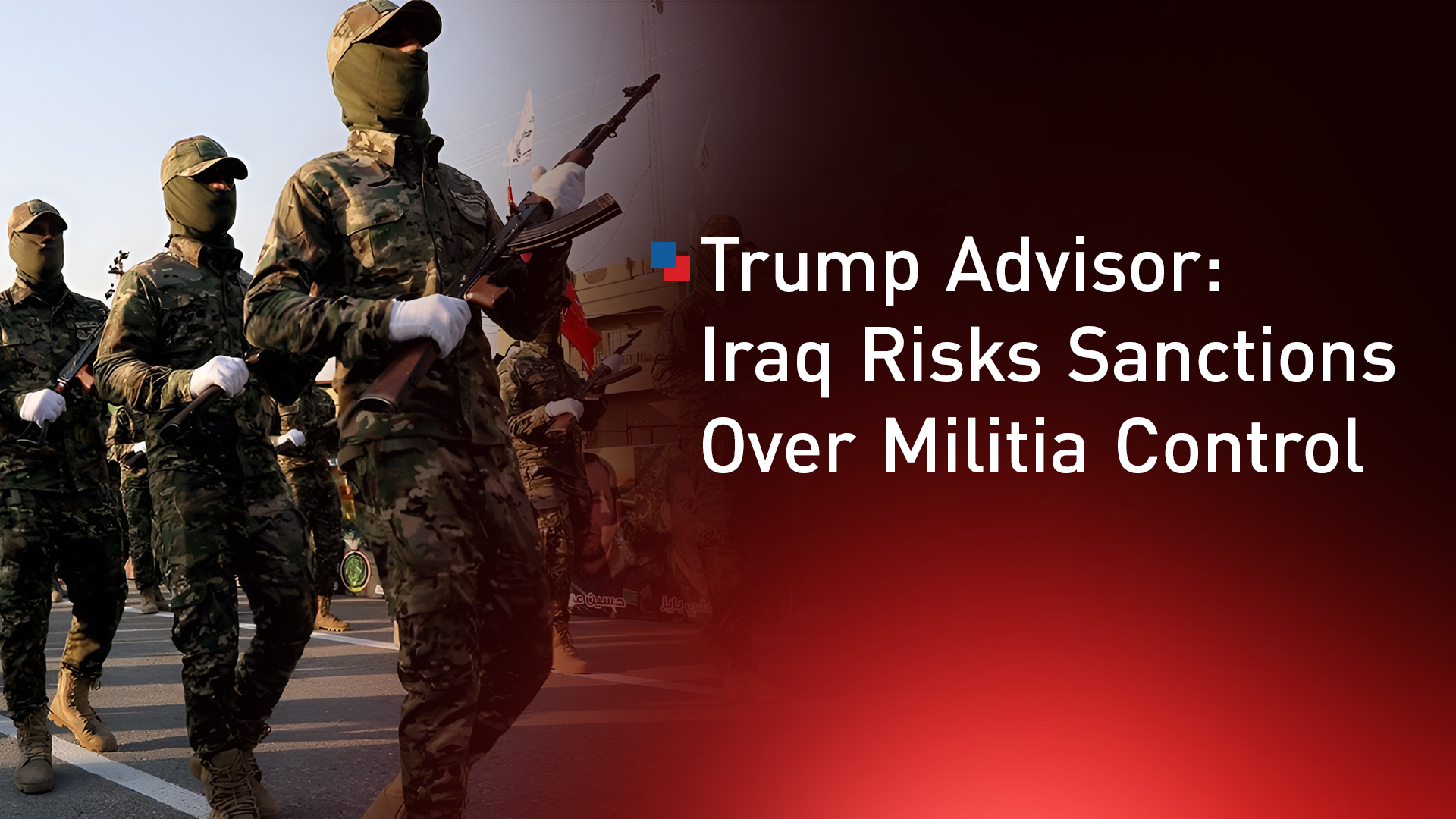
ERBIL (Kurdistan24) – The United States has issued a stark and uncompromising ultimatum to the government in Baghdad, warning that the continued proliferation of armed militias operating outside the control of the state could trigger "severe action," including the potential imposition of economic embargoes and penalties against the Iraqi government itself.
In a wide-ranging interview with Kurdistan24 on Monday, Gabriel Soma, a member of the advisory board to U.S. President Donald Trump, articulated a hardening of Washington's policy, making clear that the disarmament of these factions is no longer merely a diplomatic request but a prerequisite for avoiding punitive measures and ensuring the survival of the Iraqi state against the specter of civil war.
Soma’s comments reflect a significant shift in the strategic calculus of the White House, signaling that the era of tolerating parallel military structures within Iraq is coming to a definitive end.
The advisory board member outlined a scenario in which the United States, having invested heavily in the Iraqi military and financial systems, is prepared to leverage its immense influence to force a restructuring of Iraq’s security architecture.
The core of this new posture is a refusal to accept the status quo where weapons remain "among the hands of the people" rather than under the exclusive purview of the government.
According to Soma, the State Department and the President are unified in their demand that Iraq must "disarm these groups and take out their weapons from them," a directive that places the burden of action squarely on the shoulders of Baghdad’s political leadership.
The potential consequences for failing to meet these demands were laid out with chilling clarity.
Soma noted that while the United States possesses a range of diplomatic tools, it is prepared to escalate to its most potent economic weaponry if necessary.
"The most severe action would be to... to impose embargo or face some sort of penalties on Iraq, on the Iraqi government," Soma stated, explicitly linking these potential sanctions to the government’s willingness to use its own forces to disarm the militias.
This threat of an embargo represents a severe escalation in rhetoric, suggesting that Washington views the militia issue not as a peripheral security concern, but as a central obstacle to the bilateral relationship that could imperil Iraq’s economic standing.
To contextualize the gravity of the situation, the presidential advisor drew a direct parallel to the geopolitical crisis currently unfolding in Lebanon, framing the Iraqi militia problem as part of a broader regional struggle against non-state actors that challenge national sovereignty.
Soma pointed to Hezbollah’s dominance in Beirut as a cautionary tale of what happens when a militia eclipses the state.
"As you know, Hezbollah is in charge, and they have a lot of weapons. The United States is forcing the Lebanese government also to disarm Hezbollah," Soma explained.
By equating the situation in Baghdad with that of Beirut, the administration is signaling that it views the disarmament of Iraqi factions as part of the same strategic imperative: restoring the monopoly on violence to the central government.
"Iraq is facing the same situation," he added, underscoring that the policy applied to the Levant is now being applied with equal force to Mesopotamia.
The rationale behind this aggressive push for disarmament is rooted in a grim assessment of Iraq’s future should these groups remain unchecked.
Soma offered a sobering prediction that the continued existence of armed militias poses an existential threat to the nation’s cohesion, warning that "if the United States allow Iraq to keep militias armed—then probably one day in the future you might have a civil war."
This invocation of civil conflict serves as the dark backdrop to U.S. policy; the administration views the removal of these weapons not just as a security preference, but as the only way "to avoid all these confusions, to avoid all these mishaps that could happen anytime."
In the U.S. view, the militias constitute a direct "threat to Iraq, to the national security of Iraq, to the people of Iraq," making their disarmament the "first important issue" for the government to address.
Despite the severity of the warnings, the interview also highlighted the United States' continued commitment to supporting the Iraqi state, provided it moves toward the rule of law.
Soma emphasized the substantial investments Washington has already made in the country’s security infrastructure. "The United States has been helping Iraq a lot militarily... with weapons and whatever they ask, and also financially," he noted.
This aid was predicated on the understanding that the Iraqi military would be the sole protector of the nation, defending it from "interference from terrorist organizations, from other governments such as Iran."
The advisor reaffirmed that the United States is "willing to protect its interests in Iraq," a stance that requires the Iraqi government to ensure that rogue elements do not "mess with the government and not to mess with the... Iraqi military."
Soma’s assessment of the Iraqi political landscape was notably nuanced, acknowledging the distinct nature of the country’s governance while expressing optimism about its trajectory.
He conceded that "the democracy in Iraq, it’s not the same as the democracy in the United States," but affirmed that "they are building a good democracy over there."
Pointing to the functional separation of powers—the judiciary, the executive cabinet, and the legislature—he argued that the Iraqi state possesses the necessary institutional mechanisms to legally mandate disarmament.
"They could legislate in anything they want to do, including the matter of disarmament," he asserted, rejecting the notion that the government is powerless to act.
This institutional capacity is viewed by the White House as the key to unlocking Iraq’s immense potential. Soma described Iraq as a "wealthy country" with a "great past," indicating that the United States sees a prosperous future for the nation if it can overcome its security challenges.
"The United States would be willing to help the Iraqi government, the President, the Prime Minister, and the Chief of the Army with whatever is needed to protect the Iraqi people and to do the disarmament," he promised.
This offer of assistance is the "carrot" accompanying the "stick" of potential sanctions: full U.S. backing for a sovereign Iraq that asserts control over its own territory.
Central to the implementation of this policy is the role of Mark Savaya, the U.S. envoy whose position Soma described as transcending that of a traditional diplomat. "Mark Savaya... has a very important role because he is not just an ambassador. He represents the President of the United States," Soma clarified.
The distinction is critical; it implies that Savaya’s words carry the direct authority of the Oval Office, bypassing typical bureaucratic layers. "Whatever he says is... represents the... the full support of the... the ideas and the orders of the President of the United States."
This elevation of the envoy’s status is designed to ensure that Baghdad understands the messages being delivered are not mere suggestions from the State Department, but directives from the President himself.
The relationship between Washington and Baghdad currently hinges on the leadership of the Prime Minister, whom the Trump administration appears to view as a viable partner for the future.
In a significant endorsement of the current leadership, Soma revealed that there is "good faith in the Iraqi government, especially with the Prime Minister."
Going further, he stated, "I think the... the United States would like to see him for another term to be the Prime Minister of Iraq." This preference for continuity suggests that Washington believes the current administration in Baghdad is capable of undertaking the difficult task of disarmament, provided it has the political will to do so.
Soma also addressed the historical context of the militias, acknowledging that their rise was a symptom of state failure. "The reason these militias are there [is] because there was no prosperity, no peace, no stability in the country," he observed.
However, he argued that this historical justification has expired.
With a government being formed, a President, a Prime Minister designate, a parliament, and a standing army, the vacuum that militias once filled no longer exists. "I don't think there is a need for militias to exist in Iraq. The army could take care of any instability," he concluded.
The path forward, as outlined by the presidential advisor, relies on a "good coordination" between the U.S. Congress, the State Department, the White House, and the Iraqi government.
Soma expressed confidence that Congress has "good information about the situation in Iraq," which informs the legislative pressure regarding weapons supplies and security funding.
The funding, he noted, is contingent on its effective use; if funds are used to "increase the military men" and "empower the government of Iraq in establishing orders," then the investment is deemed "worth it."
Ultimately, the message delivered by Gabriel Soma to Kurdistan24 is one of a pivotal moment in U.S.-Iraq relations.
The United States is willing to help the Iraqi people "stand on their feet and normalize the relationship," but that normalization is strictly conditional on the reassertion of state sovereignty.
The warning is clear: the time for accommodation is over. Iraq must choose between a future secured by a national army and supported by American partnership, or a path of continued militia dominance that risks isolation, economic ruin, and civil war.