Trump Says Iran 'Totally Defeated and 'Wants A Deal'
The U.S. President Donald Trump said Saturday that Iran “wants a deal,” while reiterating that the United States had carried out major strikes on Iranian military targets on Kharg Island.
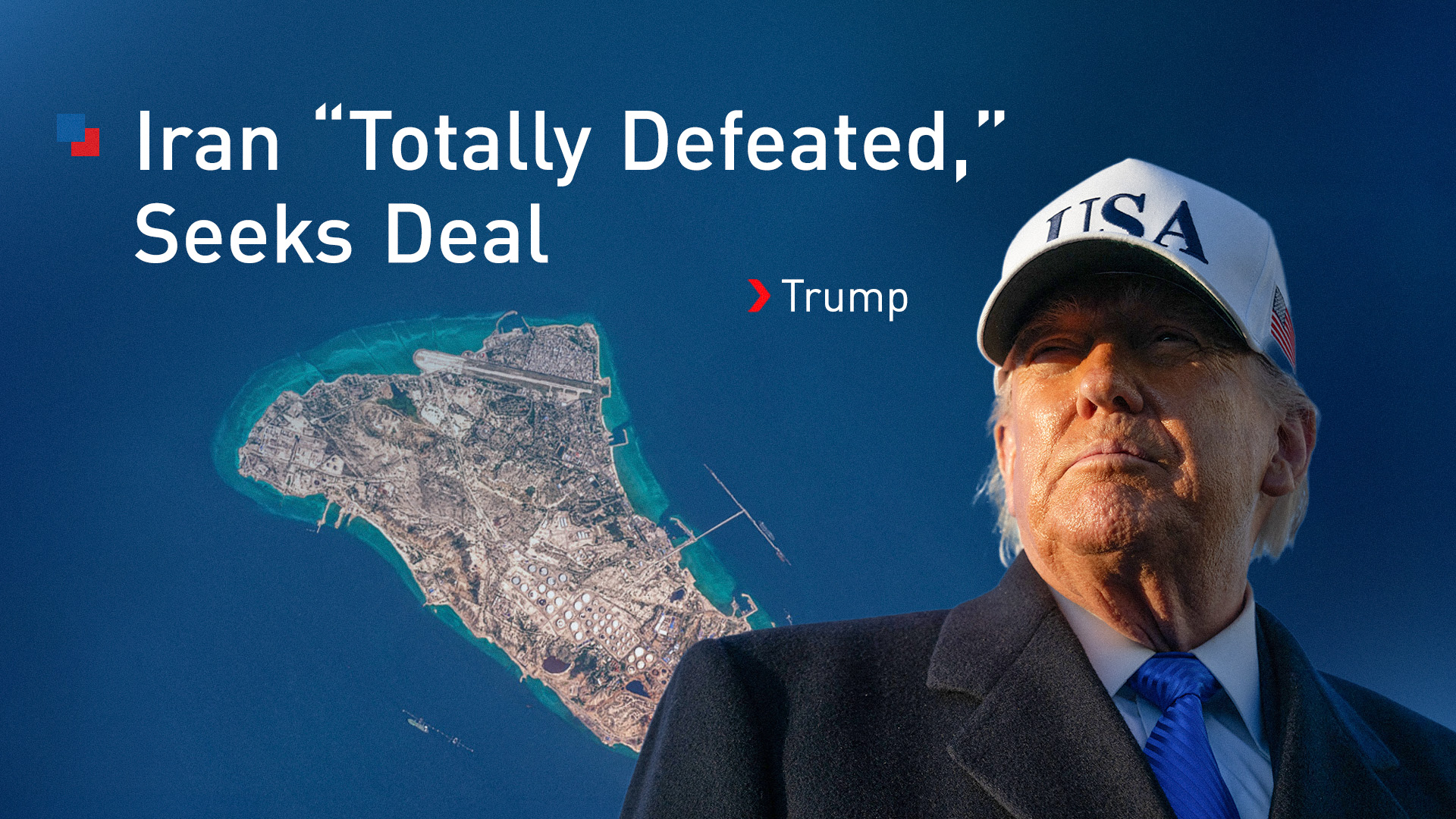
ERBIL (Kurdistan24) - U.S. President Donald Trump said Saturday that Iran “wants a deal” following recent U.S. military actions against the country, writing on his Truth Social platform that Iran was “totally defeated,” while also reiterating earlier claims about U.S. strikes targeting Iranian military facilities on Kharg Island amid the ongoing Middle East conflict.
“The Fake News Media hates to report how well the United States Military has done against Iran, which is totally defeated and wants a deal — But not a deal that I would accept!” Trump wrote on Truth Social on Saturday, March 14, 2026. “Thank you for your attention to this matter. President DJT.”
The message followed another post by Trump the previous day in which he wrote that Iran’s regional ambitions had collapsed. “Iran had plans of taking over the entire Middle East, and completely obliterating Israel. JUST LIKE IRAN ITSELF, THOSE PLANS ARE NOW DEAD!” he said in a Friday statement on the same platform.
Trump’s comments come after he announced that U.S. forces had carried out a major bombing raid against Iranian military targets on Kharg Island, a key hub for the country’s oil exports located in the Persian Gulf.
In a separate Truth Social statement, Trump said the operation was conducted by U.S. Central Command and described it as one of the most powerful bombing raids carried out in the region.
“Moments ago, at my direction, the United States Central Command executed one of the most powerful bombing raids in the History of the Middle East, and totally obliterated every MILITARY target in Iran’s crown jewel, Kharg Island,” Trump wrote.
He said U.S. forces had deliberately refrained from striking the island’s oil infrastructure but warned that such restraint could change depending on Iran’s actions in the Strait of Hormuz.
“Our Weapons are the most powerful and sophisticated that the World has ever known but, for reasons of decency, I have chosen NOT to wipe out the Oil Infrastructure on the Island,” Trump wrote. “However, should Iran, or anyone else, do anything to interfere with the Free and Safe Passage of Ships through the Strait of Hormuz, I will immediately reconsider this decision.”
Trump also reiterated his longstanding position that Iran should not acquire nuclear weapons, writing that Iran “will NEVER have a nuclear weapon, nor will it have the ability to threaten the United States of America, the Middle East or, for that matter, the World.”
Despite Trump’s claims about the destruction of military targets on the island, Iranian media reported that there had been no damage to Kharg Island’s oil infrastructure following the U.S. strike, according to Agence France-Presse (AFP).
Kharg Island hosts Iran’s primary oil export terminal and plays a central role in the country’s energy sector.
The developments come during an intensifying regional conflict that has expanded beyond Iran and Israel and has disrupted energy flows through the Persian Gulf.
According to AFP, the Middle East war has severely disrupted oil and gas flows from the region, particularly through the Strait of Hormuz, a narrow maritime passage that normally carries a significant share of the world’s seaborne oil shipments.
Traffic through the strait has been largely halted since the conflict began, contributing to a surge in global oil and gas prices, AFP reported.
The conflict began on Feb. 28 when the United States and Israel launched military operations against Iran, according to AFP. Since then, waves of airstrikes, missile attacks, and drone operations have expanded across the region.
AFP reported that oil prices have risen sharply since the beginning of the war, reflecting the central role of the Persian Gulf in global energy markets.
The escalation has also led to warnings from Iranian military officials that further attacks on the country’s energy infrastructure could trigger retaliatory strikes on oil facilities connected to the United States or its allies.
Iran’s armed forces said that oil and energy infrastructure linked to U.S. companies would be “immediately be destroyed and turned into a pile of ashes” if American forces targeted Iran’s oil facilities, AFP reported, citing Iranian media.
The warning followed Trump’s remarks suggesting that the United States might consider striking Iranian oil infrastructure if Iran interferes with shipping through the Strait of Hormuz.
According to AFP, Iranian officials have also threatened to target oil tankers passing through the strait, which carries roughly one-fifth of the world’s traded oil.
The maritime route is a key transit corridor for crude oil and liquefied natural gas exports from the Gulf region, with most shipments destined for Asian markets.
The broader conflict has already affected shipping traffic and energy markets globally.
U.S. Interior Secretary Doug Burgum said Saturday that the United States could provide “reliable” energy supplies to Asia-Pacific countries amid disruptions to Middle Eastern oil exports, according to AFP.
Speaking at an energy forum in Tokyo attended by representatives from 17 countries, Burgum said Washington’s energy strategy was aimed at ensuring stable supplies for international partners.
U.S. President Donald Trump’s policy of “energy dominance” seeks to ensure that the United States has sufficient energy resources both for domestic consumption and for export to allied countries, Burgum said.
“That ensures the region has a ‘reliable, affordable and secure’ energy supply that can’t be interrupted by a terrorist regime,” Burgum said at the forum, according to AFP.
The meeting brought together government officials and energy companies seeking to expand cooperation in energy production and supply chains.
Countries including Japan, South Korea and Thailand were expected to announce energy and minerals deals with the United States worth at least $30 billion, according to Bloomberg, AFP reported.
Japan, which imports the majority of its oil from the Middle East, signed a memorandum of understanding with the United States aimed at financing strategic infrastructure projects in emerging markets.
Separately, several energy companies announced partnerships focused on nuclear energy development and liquefied natural gas supply agreements.
The regional conflict has also expanded militarily across multiple countries in the Middle East.
AFP reported that more than 1,200 people have been killed in Iran since the beginning of the U.S.-Israeli military campaign, citing figures from Iran’s health ministry that could not be independently verified.
The United Nations refugee agency has estimated that up to 3.2 million people have been displaced inside Iran since the war began, according to AFP.
U.S. and Israeli forces have carried out extensive air operations across the country.
According to the Pentagon, the United States and Israel have struck more than 15,000 targets in Iran since the start of the war, AFP reported.
Israel’s military said it had conducted approximately 7,600 strikes, many aimed at Iran’s missile program.
Despite the large number of strikes, Iran has continued to launch missile and drone attacks targeting Israel and several Gulf states.
AFP reported that Iranian projectiles have been intercepted over multiple countries in the region, including Qatar and Saudi Arabia.
Authorities in Qatar said Saturday that two missiles were intercepted over the capital, Doha, after explosions were heard in the city, according to AFP journalists on the ground.
Saudi Arabia’s defense ministry also said its air defenses intercepted dozens of drones launched toward the kingdom on Friday.
Türkiye reported that NATO forces intercepted a ballistic missile launched from Iran during the conflict, marking the third such interception during the war, AFP said.
The fighting has also spread to neighboring countries and allied militant groups.
In Lebanon, Israeli airstrikes targeting Iran-backed Hezbollah have killed hundreds of people, according to Lebanese authorities cited by AFP.
Lebanese officials reported that at least 773 people had been killed by Israeli attacks, while large numbers of civilians have been displaced.
The conflict has also affected Iraq.
A drone strike targeted the U.S. Embassy compound in Baghdad on Saturday, according to an Iraqi security official and another security source cited by AFP.
An AFP journalist saw smoke rising from the complex following the attack.
The strike occurred shortly after two Iran-backed fighters were reportedly killed in separate attacks in Baghdad, according to multiple sources cited by AFP.
Separately, The Associated Press reported that a missile struck a helipad inside the U.S. Embassy compound in Baghdad, with footage showing a column of smoke rising above the facility.
The embassy complex, one of the largest U.S. diplomatic installations in the world, has previously been targeted by rockets and drones fired by Iran-aligned militia groups, according to the Associated Press.
Amid the ongoing conflict, the United States has continued to move military assets toward the region.
The Associated Press reported that the amphibious assault ship USS Tripoli and elements of the 31st Marine Expeditionary Unit have been ordered to the Middle East, citing a U.S. official who spoke on condition of anonymity.
The deployment includes roughly 2,500 Marines and adds to an existing U.S. naval presence in the Arabian Sea that already includes multiple warships and an aircraft carrier.
Marine Expeditionary Units are capable of conducting amphibious operations and can also assist with embassy security, civilian evacuations, and humanitarian missions.
The Associated Press reported that the USS Tripoli had been operating in the Pacific before being redirected toward the Middle East.
The ship was previously observed by satellite imagery sailing near Taiwan, placing it more than a week away from waters near Iran.
U.S. Defense Secretary Pete Hegseth said that more than 15,000 targets have been struck in Iran since the beginning of the campaign, the Associated Press reported.
The conflict has also raised concerns about the security of global energy supplies.
Iran has repeatedly warned that any attack on its oil infrastructure could trigger retaliation against energy facilities belonging to companies with U.S. connections across the region.
Iranian military spokesman Ebrahim Zolfaghari said Iranian forces would target “all oil, economic, and energy infrastructures belonging to oil companies across the region that have American shares or cooperate with America,” according to the Associated Press.
The continued escalation has also led to widespread humanitarian consequences.
Large-scale airstrikes, missile attacks and drone strikes have displaced millions of people across the region, according to AFP.
The war began after U.S. and Israeli forces launched military operations against Iran in late February, setting off a cycle of retaliatory strikes involving multiple countries and armed groups.
Trump’s latest statements on Truth Social, including his assertion that Iran now seeks a deal, come amid the ongoing military campaign and heightened tensions surrounding global energy supplies and maritime traffic through the Strait of Hormuz.
The conflict has continued to expand across the Middle East with sustained military operations, threats against energy infrastructure, and disruptions to international oil shipping routes.