In the Mountains of Kurdistan, Squirrels Emerge as Accidental Foresters
Squirrels in Kurdistan's Gazna village planted a 10,000-tree walnut forest over a century, creating a communal livelihood harvested by local clans.
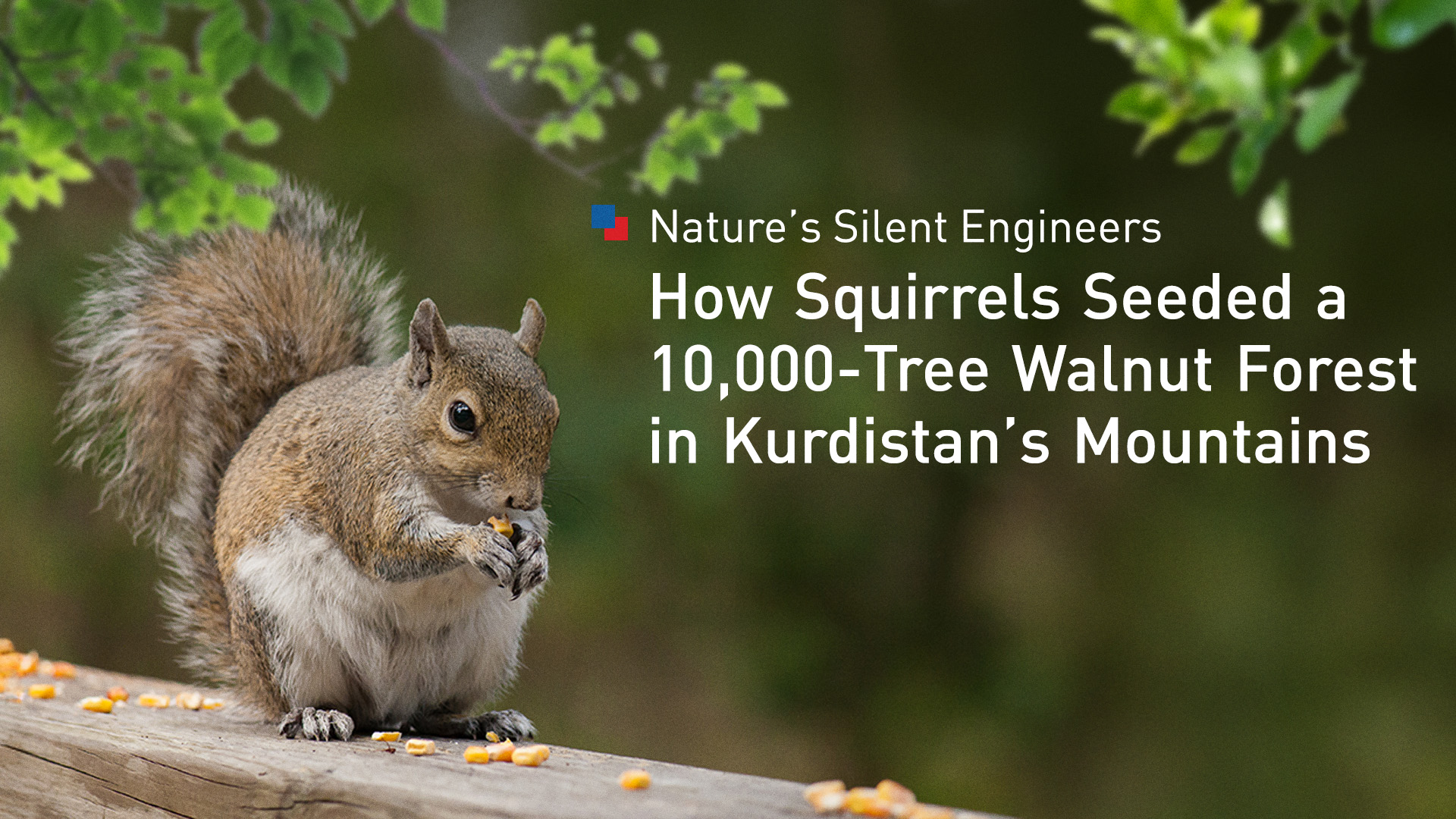
ERBIL (Kurdistan24) – In the rugged, snow-capped topography of the Balakayati region, an extraordinary ecological partnership has quietly flourished for more than a century, defying the conventional narratives of agriculture which typically position humanity as the deliberate cultivator of the land. In the village of Gazna, located within the Smilan sub-district, a dense and sprawling walnut forest has taken root not through the planned intervention of foresters or the labor of farmers, but through the instinctual, winter-prepping habits of the local squirrel population.
This rare natural phenomenon, where a wild animal has unwittingly assumed the duty of "gardener," has gifted the local community an economic and environmental legacy comprising more than 10,000 trees, a bounty that the residents now harvest as the legitimate heirs of a workforce they never hired.
The origins of this unique woodland lie in the intersection of geography and animal behavior.
The Balakayati region is characterized by a cold, snowy climate and a landscape rich in fertile soil and fresh water, creating one of the most suitable environments in the Middle East for the growth of walnut trees.
This specific ecological niche also serves as an ideal arena for the life cycle of the squirrel, an active and industrious rodent whose survival strategy has inadvertently reshaped the local topography. By their nature, these animals spend the harvest season engaging in a frenetic collection of walnuts and acorns, burying them underground in scattered locations to create food caches for the harsh winter months.
However, the squirrels often forget the precise locations of their hiding spots, or the nuts simply remain undiscovered due to shifting natural conditions. These forgotten provisions do not go to waste; instead, they germinate in the fertile earth, sprouting into saplings that have, over decades, coalesced into a natural, self-grown forest.
According to the accounts of Gazna village residents, this forest has evolved into a defining feature of their village's identity, providing a unique landscape that stands as a testament to nature's capacity for regeneration. Sulaiman Ghafur, a resident of the village who spoke to Kurdistan24, indicated that the scale of this animal-made woodland is immense.
He described a forest that spans approximately 3 kilometers, stretching from the edge of their village all the way to the Bradost border. In the valley that cradles their community, there are more than 10,000 walnut trees, many of which have reached record sizes due to their advanced age.
The physical dimensions of this legacy are staggering; some of these trees are over 100 years old, reaching towering heights of 20 meters. Their trunks, described by locals as having a "waist diameter" of up to 3.5 meters, serve as massive, living monuments to the deep historical roots these trees have struck in the soil, anchoring the ecosystem and the community alike.
For over a century, the residents of the area have functioned not as planters, but as consumers, benefiting from the fruits of these animals' labor in a relationship that has fundamentally altered the social and economic fabric of the village. The abundance of the harvest has given rise to a distinct social and cooperative tradition that governs the distribution of this natural wealth.
Mushir Abdulwahid, a native of Gazna, provided historical context to Kurdistan24, noting that the organized harvesting of these trees dates back to well before 1974. In those earlier decades, the entire village population would head to the forest collectively to harvest the walnuts, a community-wide event that reinforced social bonds.
This collective effort was—and remains—governed by an ancient village system designed to ensure equity. According to Abdulwahid, the harvest was distributed equally among the village's four main clans, a mechanism that prevented disputes and ensured that the squirrel's legacy benefited the entire populace rather than a select few.
He stated that this tradition remains intact today, with generation after generation of residents benefiting from the assets the squirrels have left for them. This continuity of custom highlights how a natural phenomenon can become the bedrock of social stability, creating a shared resource that requires cooperative management.
The realization that their environment and livelihood are owed to the tireless work of a small rodent has fostered a profound sense of affection and loyalty among the residents of Gazna toward the "little gardener."
This sentiment is perhaps best exemplified by the story of Muhammad Mushir, a young man from the village who recounted a personal interaction with the species that sustains his community.
Mushir told Kurdistan24 that one day, while returning from school, he discovered an injured squirrel that had fallen from a tree. Viewing the creature not as a pest, but as a benefactor, Mushir decided to intervene. As a reward for the benevolence of this animal—which had unknowingly contributed to the village’s prosperity—he took the squirrel home to treat its injuries.
Mushir’s decision to care for the animal until it fully recovers and grows up is driven by a desire to return it to the embrace of nature. His intention is for the squirrel to continue the cycle of life that has enriched the region for a hundred years, ensuring that the process of planting and renewal continues for the next generation.
This act of individual conservation reflects the broader ethos of Gazna, where the boundary between the human community and the natural world is blurred by mutual dependence.
The story of Gazna serves as a compelling case study in unintentional rewilding and the potential for harmonious existence between human settlements and local wildlife.
In a world where human intervention often leads to deforestation and environmental degradation, the squirrels of Balakayati have provided a counter-narrative, engineering a dense, productive ecosystem that supports human life without human interference. The sheer volume of the forest—10,000 trees strong—and the longevity of the practice demonstrate the sustainability of this natural cycle.
As the residents of Gazna look toward the future, the forest remains their most valuable inheritance. It is a source of livelihood, a provider of beauty, and a physical barrier against the erosion of the soil.
The squirrels, in their instinctual drive to survive the winter, have constructed a cathedral of green that shelters the valley, proving that nature, when left to its own devices, can be the most proficient architect of all.
The legacy of the squirrels is not just in the walnuts that fill the villagers' storerooms, but in the enduring lesson that even the smallest creatures can leave a mark on the land that lasts for centuries, shaping the geography and the culture of a region in ways that human engineering struggles to replicate.