Iraqi PM Asserts Sovereignty in Ending Coalition Mission as Leaders Urge Strong Government Formation
Sudani declares end of Coalition/UNAMI missions a mark of sovereignty, while Ammar al-Hakim warns against political vacuums, proposing a 3-stage government reform plan.
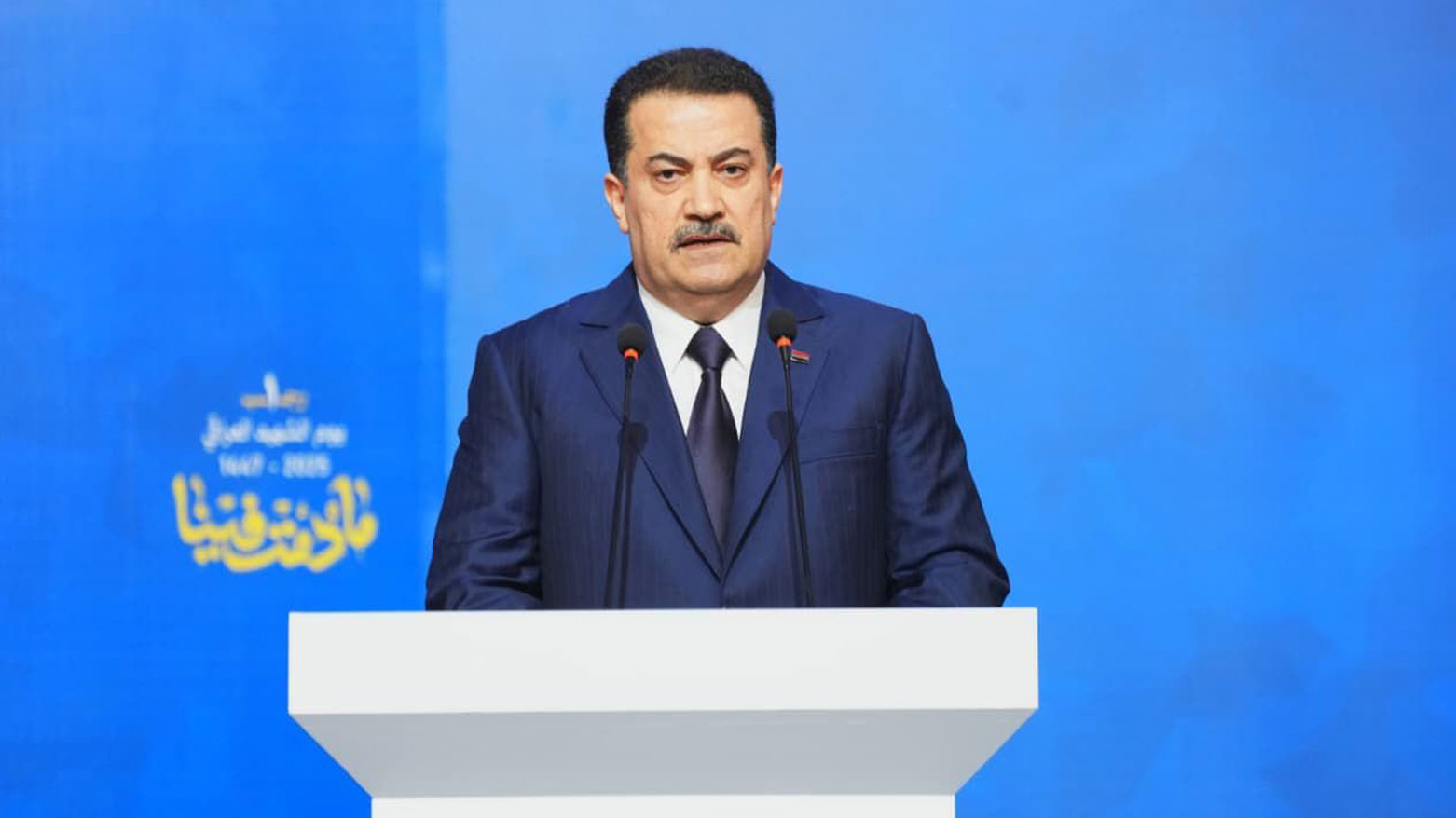
ERBIL (Kurdistan24) — Iraqi Prime Minister Mohammed Shia al-Sudani declared on Saturday that the conclusion of the missions of the International Coalition Against ISIS and the United Nations Assistance Mission for Iraq (UNAMI) stands as a definitive testament to the nation’s restored sovereignty and independent political decision-making.
Speaking at a high-profile commemoration ceremony in Baghdad, the Prime Minister framed the departure of international entities not merely as a procedural conclusion but as a reflection of Iraq's capability to maintain its own stability through strong constitutional institutions.
The Iraqi Prime Minister’s remarks, delivered during the annual ceremony commemorating the martyrdom of Mohammed Baqir al-Hakim, coincided with urgent warnings from other senior political figures regarding the domestic political landscape.
Ammar al-Hakim, Head of the National al-Hikma Movement, utilized the same platform to caution that a "political vacuum" poses a danger far greater than mere partisan disputes, calling on the nation’s factions to establish a "strong, not shaky" government capable of executing a rigorous multi-stage reform program.
Sovereignty and International Relations
Addressing a gathering of government officials and party leaders organized by the National al-Hikma Movement, Prime Minister al-Sudani emphasized that the government has proactively moved to strengthen its relationships with both the regional and international communities.
However, he stipulated that these engagements are now predicated on the status of Iraq as a "fully sovereign country."
Al-Sudani argued that the justification for the continued presence of the International Coalition and UNAMI has been superseded by the competence of the Iraqi state.
"Ending the mission of the International Coalition Against ISIS and the United Nations Assistance Mission for Iraq (UNAMI) is a strong reflection of Iraq's sovereignty and the independence of political decision-making," al-Sudani stated.
He further elaborated on the security apparatus, asserting that the nation now possesses "strong constitutional institutions and armed forces capable of maintaining the country's stability."
This confidence in the domestic security forces serves as the cornerstone of the administration's push to transition away from reliance on international security assistance.
According to the Iraqi Prime Minister, the international community has formally acknowledged the significance of the successes Iraq has achieved in rebuilding the country, validating the government's response to the demands of its people.
Post-Election Mandate and Political Responsibility
Turning to the domestic front, al-Sudani offered an analysis of the recent Iraqi parliamentary election, interpreting the voter turnout as a direct endorsement of his administration’s performance.
He characterized the participation of voters as "the people's response to the government's work and the implementation of its priorities," specifically citing the principles of rebuilding the country and "placing Iraq before everything else."
The Iraqi Prime Minister suggested that the electorate’s engagement has solidified the nation's democratic trajectory.
"The rate of effective participation of citizens in the election created a proper turning point in consolidating the democratic path in the coming stages," he noted.
Building on this perceived mandate, al-Sudani issued a call to action for Iraq's various political parties and factions.
He urged them to act out of a sense of responsibility toward the "country's supreme interests" and to move swiftly to finalize the "constitutional achievements" of the election—a reference to the necessary parliamentary procedures required to form the new government and legitimize the state's legislative agenda.
Warnings Against Political Vacuums
While the Iraqi Prime Minister focused on sovereignty and electoral mandates, the host of the event, Ammar al-Hakim, focused his address on the mechanics of governance and the perils of political stagnation.
As the Head of the National al-Hikma Movement, al-Hakim’s comments underscored the fragility of the current political phase.
"In this current phase, Iraq needs political unity and precise decisions that protect the people," al-Hakim said in his speech.
He issued a stern warning regarding the delays that often plague Iraqi government formation, stating clearly that a "political vacuum is more dangerous than disputes."
Al-Hakim emphasized that the country requires a government that is "strong, not shaky," advocating for "courageous dialogue" among political parties to bridge divides.
His comments reflect a concern that prolonged negotiations or weak coalition building could undermine the stability that Prime Minister Al-Sudani touted in his address.

A Three-Stage Roadmap for Governance
Moving beyond general warnings, al-Hakim proposed a detailed, structured policy framework for the incoming government.
He suggested that the government’s program should be built upon "three temporal stages," offering specific benchmarks for success over periods of 100 days, one year, and four years.
The first stage, covering the initial 100 days, would focus on "urgent accomplishments." al-Hakim argued that during this brief window, the public would measure the government's seriousness by its ability to address immediate, tangible issues that affect daily life.
He specifically listed "electricity, water, unemployment, the flow of services, integrity measures, and the ranking of financial priorities" as the critical files to be addressed immediately.
The second stage, described by al-Hakim as a "year of reform for administration and governance," would target the structural inefficiencies of the state.
He called for a comprehensive overhaul to complete structural reforms, specifically by "preventing red tape, reforming tax and expenditure systems, developing administration, and establishing the principles of transparency in contracts and projects." This phase aims to modernize the bureaucratic machinery of the Iraqi state.
The third and final stage outlined by the Head of the National al-Hikma Movement would extend for four years, coinciding with a full parliamentary term.
The objective of this long-term phase is "sustainable development." Al-Hakim defined the metrics for success in this stage as the state's ability to "create job opportunities, attract investment, improve infrastructure, and build a diversified economy."
Convergence of Visions
The commemoration ceremony in Baghdad served as a convergence point for these two distinct but complementary visions for Iraq’s future.
While Prime Minister al-Sudani focused on the external markers of statehood—the departure of foreign missions and the assertion of sovereignty—al-Hakim focused on the internal necessity of efficient, transparent governance.
Both Iraqi leaders agreed on the necessity of moving forward without delay. For al-Sudani, the imperative is to leverage the "effective participation" of voters to finalize constitutional processes.
For al-Hakim, the imperative is to avoid a dangerous political vacuum and implement a rigorous timeline of reform that delivers services to the citizenry.