Trump Announces New ‘Trump Class’ of Warships and Vision for ‘Golden Fleet’ to Counter Global Threats
Trump announces "Trump Class" warships and "Golden Fleet" to restore naval dominance. Critics question cost and utility, while the plan aims to revitalize US shipbuilding.
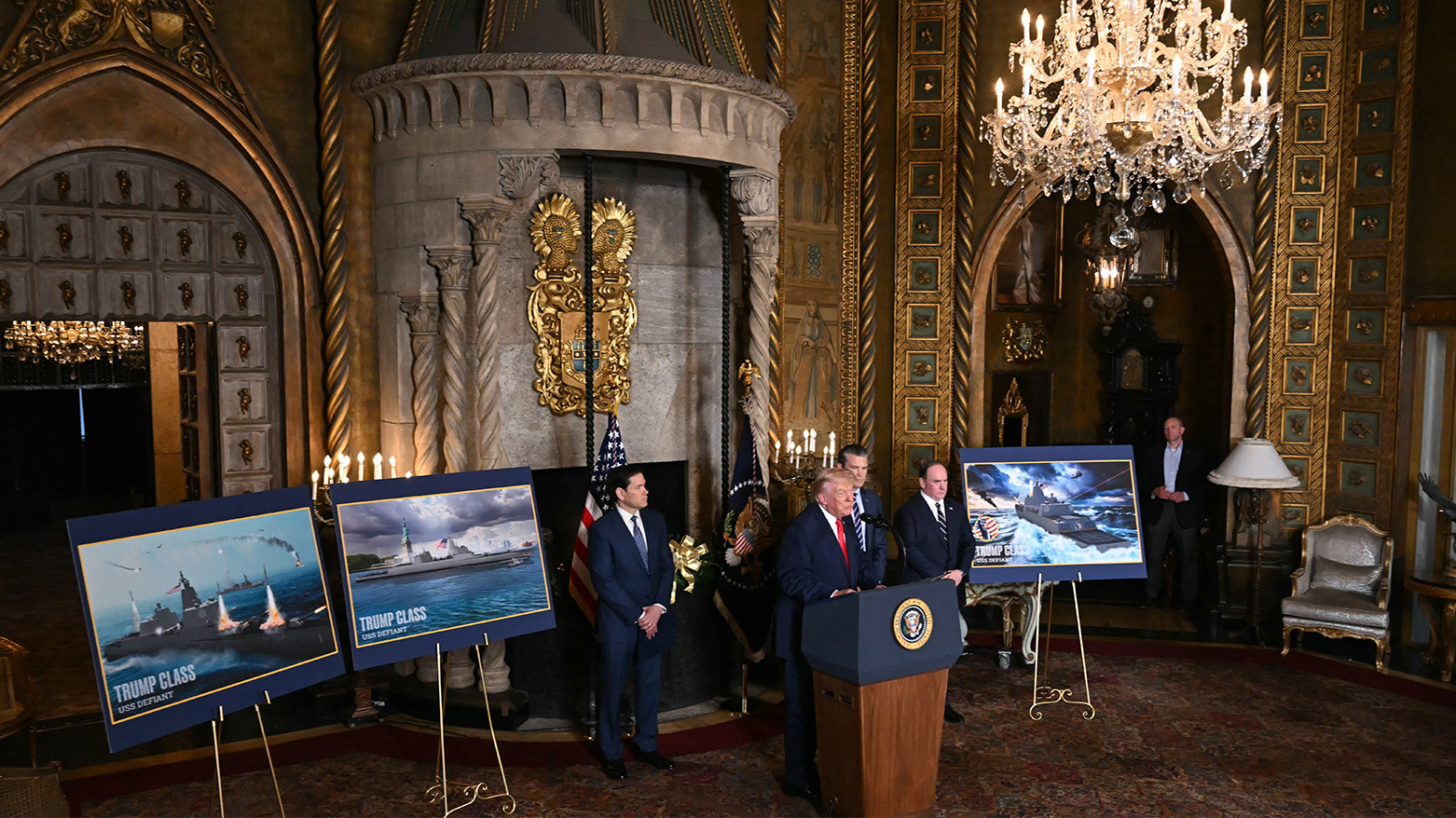
ERBIL (Kurdistan24) — The U.S. President Donald Trump has unveiled ambitious plans for a massive naval expansion, announcing the construction of a new line of heavy warships dubbed the “Trump Class.” The announcement, made on Monday at his Mar-a-Lago estate in Florida, outlines a vision for a revitalized American armada referred to as the “Golden Fleet,” designed to project power and secure technological supremacy.
According to reports from The New York Times, The Wall Street Journal, AFP, and The Associated Press, the initiative seeks to overhaul what the President described as an "old and tired" naval force through the introduction of massive "battleships" and updated frigates.
The "Trump Class" and the "Golden Fleet"
In a presentation flanked by Secretary of State Marco Rubio, Secretary of Defense Pete Hegseth, and Secretary of the Navy John Phelan, President Trump declared that the new vessels would be the "largest battleship in the history of our country," according to AFP. The President stated that the first of these ships would be named the USS Defiant.
The Wall Street Journal reported that the "Golden Fleet" initiative is the product of months of planning by a White House and Navy team aimed at creating a force better suited to counter rivals like China, manage the Western Hemisphere, and address other emerging threats.
The centerpiece of this fleet, the "Trump Class" battleship, represents a significant departure from modern naval doctrine, which has largely moved away from heavy armor and large guns in favor of aircraft carriers and long-range missile destroyers.
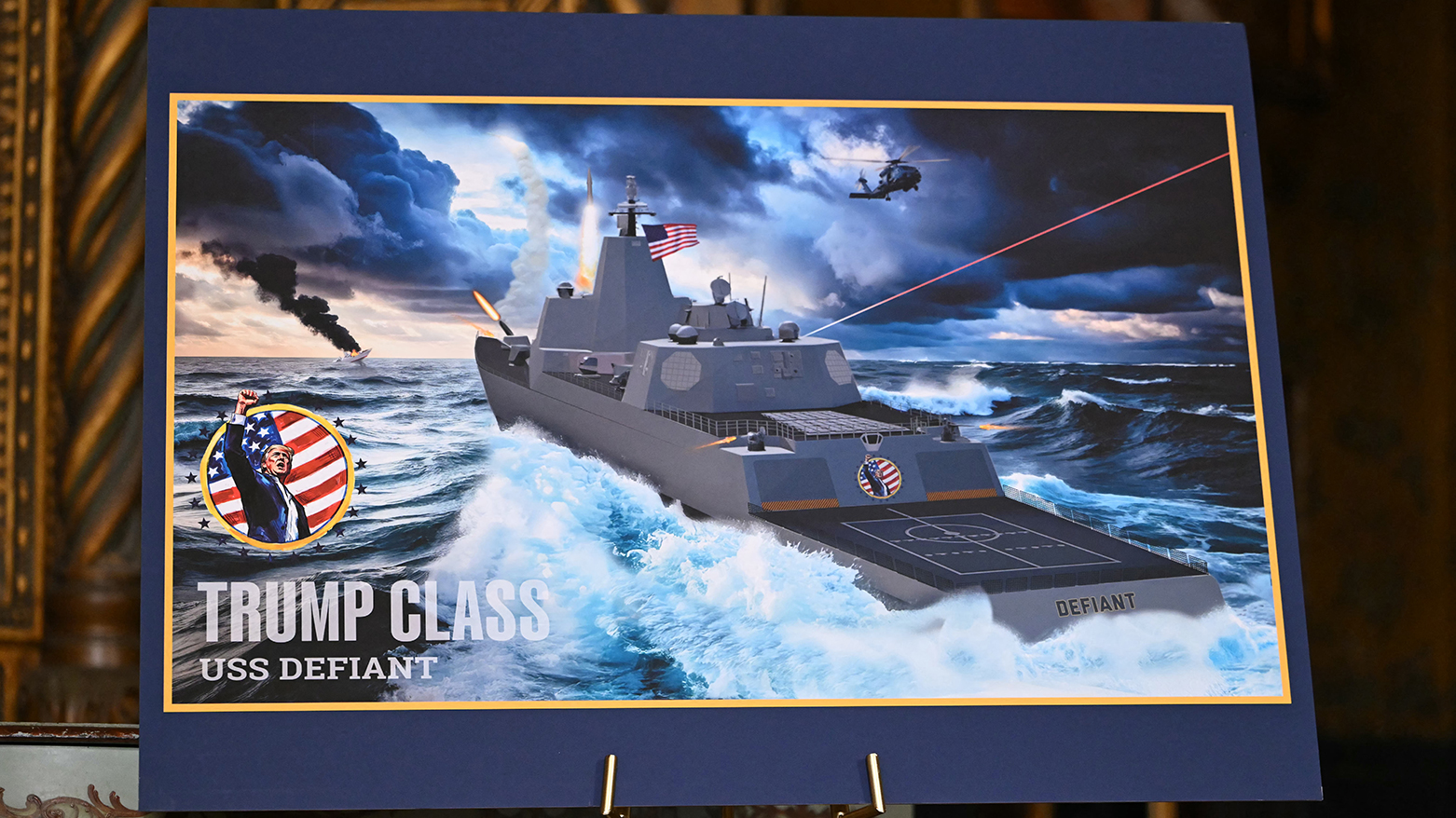
The New York Times noted that the new vessels are expected to displace more than 35,000 tons—more than twice the size of the Navy’s current largest surface combatants, the Arleigh Burke-class destroyers.
However, despite the "battleship" designation, these ships would differ significantly from the historic Iowa-class vessels used in World War II.
The Associated Press reported that while the new ships would be roughly the size of the Iowa-class, they would weigh only about half as much and be operated by a significantly smaller crew of between 650 and 850 sailors.
President Trump claimed the new ships would be "100 times more powerful than any battleship ever built," The Associated Press noted. The proposed armaments include technologies currently in various stages of development, such as hypersonic missiles, nuclear-armed cruise missiles, electromagnetic rail guns, and high-powered lasers.
Strategic Rationale and "Aesthetic" Overhaul
President Trump’s rationale for the new fleet combines strategic necessity with a desire for a visual and psychological overhaul of the U.S. military.
"We’re desperately in need of ships," Trump said, as quoted by The New York Times. "Our ships are — some of them have gotten old and tired and obsolete and we’re going to go in the exact opposite direction."
The President has long expressed dissatisfaction with the appearance of the current fleet. The Associated Press reported that Secretary Phelan told senators during his confirmation hearing that Trump had texted him "numerous times very late at night, sometimes after one in the morning," complaining about "rusty ships or ships in a yard."
This focus on aesthetics is a driving force behind the new design.
"The U.S. Navy will lead the design of these ships along with me, because I’m a very aesthetic person," Trump said, according to The Associated Press.
The Wall Street Journal added that the President has been personally involved in crafting plans for the Golden Fleet, echoing his previous interventions where he criticized the look of destroyers and unsuccessfully advocated for returning to steam-powered catapults on aircraft carriers.
The branding of the "Trump Class" continues a trend of the President imprinting his name on federal institutions.
The New York Times reported that the announcement follows the renaming of the John F. Kennedy Center for the Performing Arts to include Trump’s name, as well as the U.S. Institute of Peace.
The "Golden" nomenclature also extends to missile defense; The New York Times noted that Trump has ordered the development of a "Golden Dome" missile defense shield, a project that experts warn faces logistical and financial hurdles.
Capabilities and Technological Ambitions
The technical specifications of the "Trump Class," as outlined in the provided reports, rely heavily on advanced weaponry.
The New York Times reported that the ships would notionally have the ability to launch hypersonic missiles—which the Navy calls Conventional Prompt Strike—and carry more munitions overall than current vessels.
However, The Associated Press highlighted the challenges in fielding these technologies.
The Navy spent more than 15 years and hundreds of millions of dollars attempting to develop an electromagnetic railgun before abandoning the effort in 2021.
Similarly, while laser technology has been deployed on some destroyers to disable drone sensors, its application remains limited. Furthermore, The Associated Press noted that developing or deploying nuclear cruise missiles on surface ships could potentially violate non-proliferation treaties signed with Russia.
Despite these hurdles, the administration is projecting a swift timeline. President Trump stated that construction on the first ships would begin "almost immediately" and could be completed within two and a half years, The Wall Street Journal reported.
However, this timeline contradicts information from a U.S. official who spoke to The Associated Press on condition of anonymity, stating that design efforts are currently underway with construction planned to begin in the early 2030s.
Industrial and Economic Implications
The administration views the "Golden Fleet" as a means to revitalize the American industrial base. "We’re going to restore America as a major shipbuilding power," President Trump said, according to AFP. "We’re going to ensure the USA has the most powerful fleet anywhere in the world."
The plan has been welcomed by major defense contractors.
The Wall Street Journal reported that HII’s Ingalls Shipbuilding and General Dynamics’ Bath Iron Works, the two primary shipyards for destroyers, expressed support.
HII President and Chief Executive Chris Kastner stated that their distributed shipbuilding network is creating capacity to meet these requirements, while Charles F. Krugh of Bath Iron Works affirmed their capability to design and build the vessels.
In addition to the massive battleships, the "Golden Fleet" plan includes a significant restructuring of the Navy’s frigate program.
The Wall Street Journal reported that the Navy has canceled the Constellation-class frigate program after years of delays and will instead commission a new class of frigates based on the Coast Guard’s Legend-class National Security Cutter.
These smaller ships are intended to complement the larger battleships, though critics note they lack certain high-end capabilities like the Aegis ballistic defense system.
Criticism and Strategic Concerns
The announcement has drawn skepticism from defense analysts and experts who question the utility of such large vessels in modern warfare.
Mark Montgomery, a retired rear admiral and senior fellow at the Foundation for Defense of Democracies, told The New York Times that the new ships were "behemoths ill-suited to confront China." He argued that the Navy instead needs a dispersed fleet of minimally manned or unmanned ships.
"These ‘battleships’ will achieve none of these tactical goals," Montgomery said, as quoted by The New York Times.
Speaking to The Wall Street Journal, Montgomery added that the ships, estimated to cost at least $5 billion each, are "exactly what we don’t need," characterizing the project as focused on the President's desire for a "cool-looking ship" rather than tactical lethality.
The New York Times also cited a Pentagon official who noted that while the new ships are meant to augment the fleet, the design forgoes large-bore guns in favor of missile complements already fielded across the Navy.
The report further highlighted that the "Trump Class" would fail to meet specific congressionally mandated requirements for providing fire support to Marines ashore, a capability gap that has existed since the retirement of the Iowa-class battleships in the 1990s.
Geopolitical Context
The push for a more aggressive naval posture comes amidst heightened global tensions. While AFP reported that President Trump claimed the new fleet is "a counter to everybody" and not specifically China, The Wall Street Journal noted that the planning was driven by the need to deter Beijing.
Additionally, The New York Times reported that the announcement coincides with active military operations closer to home. The administration is currently pursuing a legally debated military campaign in the Caribbean, where the U.S. Coast Guard has been targeting ships carrying Venezuelan oil in an effort to pressure President Nicolás Maduro.
As the administration moves forward with the "Golden Fleet," the ambitious proposal faces the dual tests of technological feasibility and budgetary reality.
With the President promising to meet with defense contractors in Florida to accelerate production and penalize slow-moving companies, the coming months will determine whether the "Trump Class" becomes a reality or remains a conceptual vision.