Prime Minister Masrour Barzani Joins World Leaders at 56th World Economic Forum in Switzerland
PM Masrour Barzani joins world leaders at the 56th World Economic Forum in Switzerland to discuss global cooperation under the theme "The Spirit of Dialogue," amidst geopolitical and technological shifts.
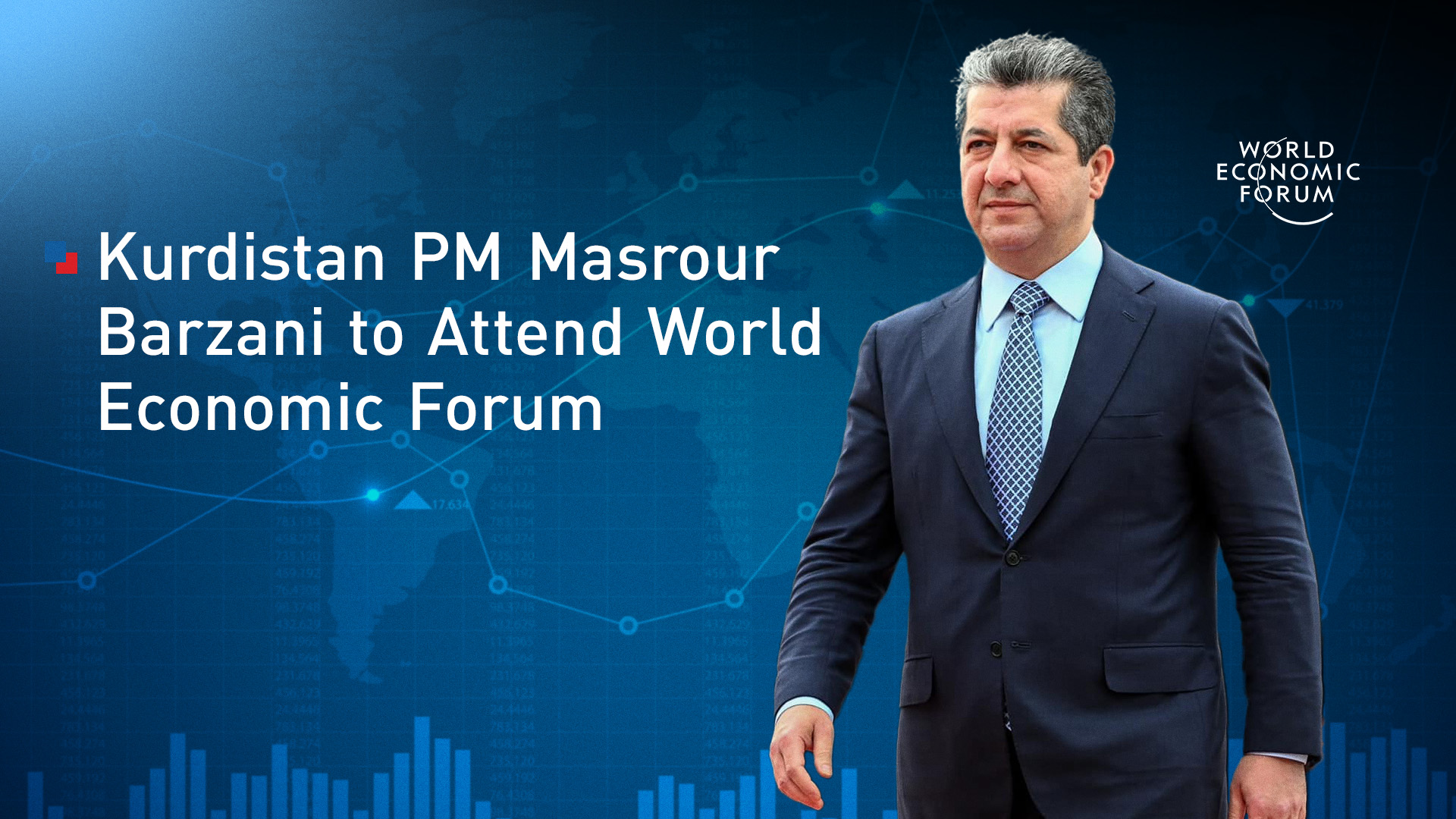
ERBIL (Kurdistan24) - Kurdistan Region Prime Minister Masrour Barzani is scheduled to participate in the 56th World Economic Forum, joining a historic assembly of heads of state, corporate executives, and civil society leaders. The forum, which serves as a primary venue for high-level international diplomacy and economic strategy, is scheduled to run from January 19 through January 23, 2026.
Organizers have convened this year’s gathering under the theme "A Spirit of Dialogue," aiming to foster cooperation during a period characterized by profound geopolitical, technological, and social shifts.
Prime Minister Barzani’s participation places the Kurdistan Region’s leadership within a broad network of decision-makers. The forum is expected to host nearly 3,000 leaders from more than 130 countries, representing a diverse cross-section of sectors and industries.
According to released attendance data, this year’s event has recorded a record level of government participation.
Approximately 400 top political leaders are expected to be present in Davos, a contingent that includes about 65 heads of state and government. Notably, the gathering will include six leaders from the G7 nations, underscoring the event's significance in shaping global policy.
The agenda for the 2026 annual meeting is designed to serve as a neutral platform for dialogue and action.
For more than five decades, the World Economic Forum has functioned as a bridge between the public and private sectors, bringing together voices from business, government, international organizations, and academia.
The stated objective for the 56th edition is to understand current global challenges and collectively move the world forward. Organizers have emphasized that the sessions are intended to provoke new ideas, reveal long-term solutions to complex challenges, and open opportunities for growth, resilience, and impact.
Prime Minister Barzani joins a roster of political figures that reflects the changing landscape of global governance.
From the Americas, the list of participating leaders includes Donald Trump, President of the United States of America; Mark Carney, Prime Minister of Canada; Javier Milei, President of Argentina; Gustavo Petro, President of Colombia; and Daniel Noboa, President of Ecuador.
This heavy representation from the Western Hemisphere is matched by significant attendance from European leadership.
Key European figures slated to attend include Friedrich Merz, Federal Chancellor of Germany; Emmanuel Macron, President of France; Ursula von der Leyen, President of the European Commission; Pedro Sánchez, Prime Minister of Spain; Bart De Wever, Prime Minister of Belgium; Alexander Stubb, President of Finland; and Kyriakos Mitsotakis, Prime Minister of Greece.
The delegation of world leaders also includes prominent figures from the Middle East and Asia, highlighting the forum's global reach.
Mohammed bin Abdulrahman Al Thani, Prime Minister and Minister of Foreign Affairs of Qatar, and Isaac Herzog, President of Israel, are among the attendees.
The Levant and surrounding regions are further represented by Mohammad Mustafa, Prime Minister of the Palestinian National Authority, and Ahmed al-Sharaa, President of Syria.
Additionally, the forum will host Ilham Aliyev, President of the Republic of Azerbaijan; Vahagn Khachaturyan, President of the Republic of Armenia; and Aziz Akhannouch, Head of Government of the Kingdom of Morocco.
Asian and Eastern European leadership will be represented by figures such as He Lifeng, Vice Premier of the People's Republic of China; Prabowo Subianto, President of Indonesia; Mian Muhammad Shehbaz Sharif, Prime Minister of Pakistan; Tharman Shanmugaratnam, President of Singapore; and Volodymyr Zelensky, President of Ukraine.
Other notable heads of state include Félix Antoine Tshisekedi Tshilombo, President of the Democratic Republic of the Congo; Daniel Francisco Chapo, President of Mozambique; Guy Parmelin, President of the Swiss Confederation; Aleksandar Vučić, President of Serbia; Micheál Martin, Prime Minister of Ireland; Dick Schoof, Prime Minister of the Netherlands; and Karol Nawrocki, President of Poland.
Beyond national governments, the forum will serve as a convening point for major international organizations.
The United Nations and its various agencies will be represented by high-ranking officials, including Secretary-General António Guterres. Of particular note for the region, Barham Salih is attending in his capacity as the United Nations High Commissioner for Refugees (UNHCR).
Other key international officials include Alexander De Croo, Administrator of the United Nations Development Programme (UNDP); Tedros Adhanom Ghebreyesus, Director-General of the World Health Organization (WHO); and Doreen Bogdan-Martin, Secretary-General of the International Telecommunication Union (ITU).
The global security architecture will be represented by Mark Rutte, Secretary General of the North Atlantic Treaty Organization (NATO), and Jassem Al-Budaiwi, Secretary General of the Gulf Cooperation Council (GCC).
Financial stability and economic policy will be addressed by leaders of the world’s primary financial institutions, including Ajay S. Banga, President of the World Bank Group; Kristalina Georgieva, Managing Director of the International Monetary Fund (IMF); Ngozi Okonjo-Iweala, Director-General of the World Trade Organization (WTO); and Mathias Cormann, Secretary-General of the Organisation for Economic Co-operation and Development (OECD).
The private sector’s involvement is substantial, with nearly 1,700 business leaders expected to attend.
This group includes approximately 850 Chief Executive Officers and world chairpersons from members and partners of the World Economic Forum. A significant focus of this year’s gathering is technology and innovation, evidenced by the attendance of nearly 100 leaders from "Unicorn" companies and designated "Technology Pioneers."
The technology delegation features the heads of major artificial intelligence and computing firms. Attendees include Satya Nadella of Microsoft, Jensen Huang of NVIDIA, Demis Hassabis of Google DeepMind, and Dina Powell McCormick of Meta.
The forum will also host innovators at the forefront of AI models and robotics, such as Sarah Friar of OpenAI, Dario Amodei of Anthropic, Arthur Mensch of Mistral AI, Alex Karp of Palantir Technologies, Bret Taylor of Sierra, and Peggy Johnson of Agility Robotics.
Investment and technology integration will be further represented by Khaldoon Khalifa Al Mubarak of Mubadala and Peng Xiao of G42.
Civil society, labor, and religious organizations will also play a central role in the discussions, ensuring a diversity of perspectives.
Humanitarian and human rights leaders participating include David Miliband, President and CEO of the International Rescue Committee (IRC); Amitabh Behar, Executive Director of Oxfam International; Comfort Ero, President and CEO of the International Crisis Group; and Oleksandra Matviichuk, Nobel Peace Prize Laureate and Head of the Center for Civil Liberties of Ukraine.
Environmental and health advocacy will be led by Kirsten Schuijt, Director General of the World Wide Fund for Nature (WWF International); Sania Nishtar, CEO of the Vaccine Alliance (Gavi); and Peter Sands, Executive Director of The Global Fund. Additionally, Aulani Wilhelm, President and CEO of Nia Tero, will represent Indigenous Peoples' rights.
The forum has also prioritized the inclusion of religious and labor leaders to address broader social dimensions of global change. Participants include Mohammad Issa, Secretary General of the Muslim World League; Pinchas Goldschmidt, President of the Conference of European Rabbis; and Luc Triangle, General Secretary of the International Trade Union Confederation (ITUC).
The intellectual framework for the discussions will be supported by academic figures and researchers such as Yoshua Bengio of the University of Montreal, Yuval Harari of the Center for the Study of Existential Risk, and Eric Xing of the Mohamed bin Zayed University of Artificial Intelligence.
The forum’s organizers have stated that the 2026 agenda is designed to explore how coordination can be renewed amidst "conflicting methods, tense alliances, and lost trust." The sessions will examine how new models of cooperation can create opportunities even as traditional assumptions regarding security, sovereignty, and global integration are challenged.
Discussions are expected to move from analyzing geopolitical risks and economic uncertainty to identifying practical, solution-oriented paths that support resilience and competitiveness.
A central component of the dialogue will be the responsible application of transformative technologies, specifically generative artificial intelligence, and the human dimensions of these rapid changes. As industries evolve, the forum will highlight strategies for governments and businesses to invest in human capital, build a resilient workforce, and support skill transformation.
Furthermore, leaders will debate how to rebuild prosperity within planetary boundaries by promoting protected energy systems, natural conservation, and water security.
To ensure these discussions reach a global audience, more than 200 media outlets and news agencies will be present. The forum has also integrated an open digital media experience, live-streamed sessions, and an "Open Forum" for community engagement, allowing the debates to extend beyond the physical borders of Davos.
Young leaders from the "Global Shapers" community are also scheduled to present futuristic ideas, ensuring that the next generation’s perspective is integrated into the high-level decision-making process.