The Unfinished Dream: Remembering The Republic of Kurdistan in Mahabad, 80 Years On
Eighty years after its declaration, the 11-month the Republic of Kurdistan in Mahabad remains a defining symbol of Kurdish political aspiration, cultural revival, and enduring national consciousness.
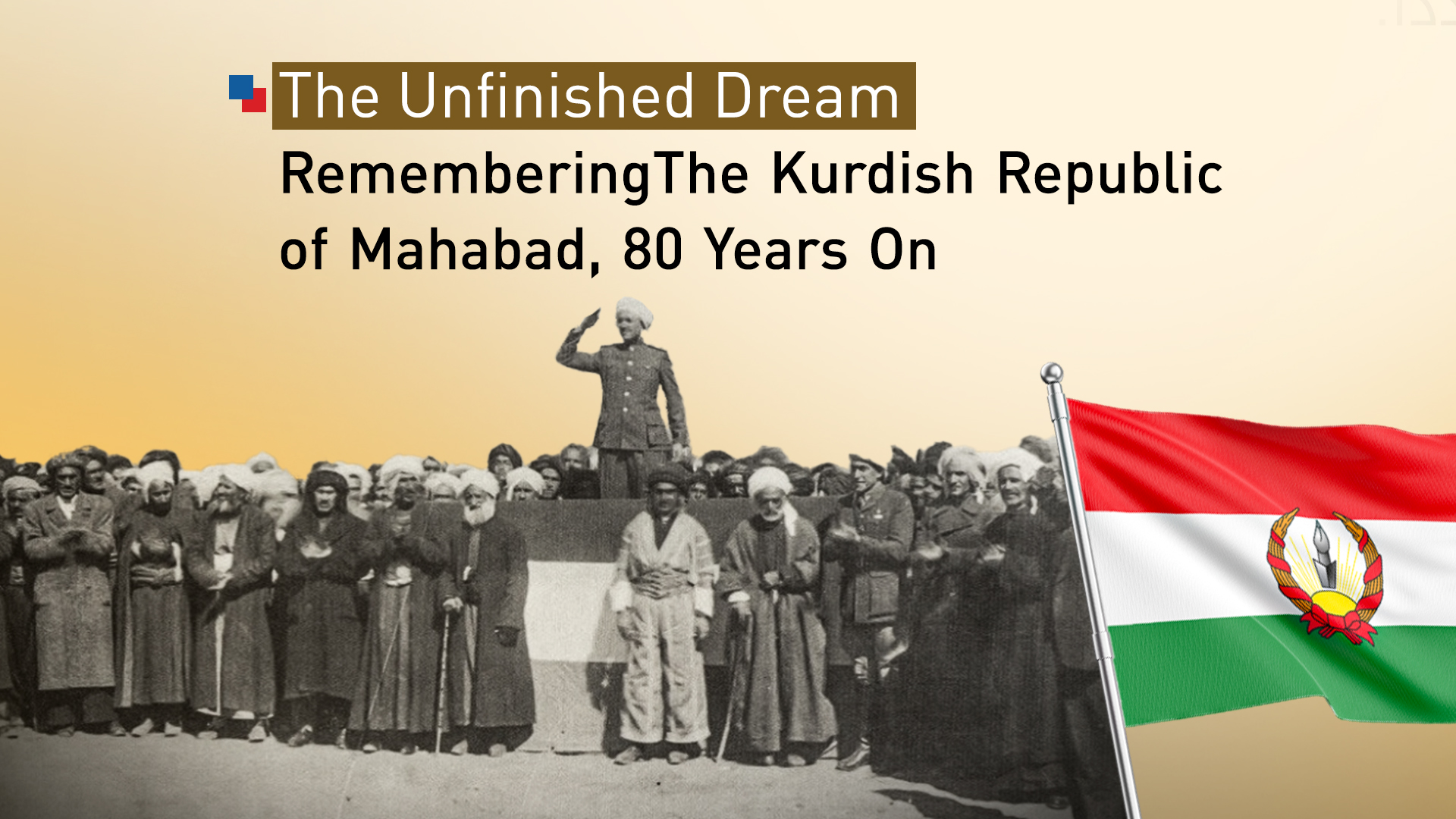
ERBIL (Kurdistan24) - On a cold winter day in January 1946, more than 20,000 people gathered in Charchra Square in the city of Mahabad. Farmers, tribal leaders, clerics, intellectuals, and ordinary residents stood shoulder to shoulder as a Kurdish flag was raised above the crowd. In that moment, history shifted—briefly but decisively. The Republic of Kurdistan had been declared.
Eighty years later, on January 22, 2026, Kurds across generations continue to look back at that day as a rare moment when aspiration took political form. The republic would survive for only eleven months, but its legacy has endured far longer, shaping Kurdish political consciousness and cultural identity to this day.
The declaration came on January 22, 1946, when Qazi Muhammad, widely known by the honorific Pêşewa (leader), was named president of what became known as the Republic of Kurdistan, or the Republic of Kurdistan in Mahabad. The announcement, made in the same square where Qazi Muhammad would later be executed, marked the first modern Kurdish republic in history.
Despite its brief existence, the republic moved swiftly to establish the foundations of governance. A Kurdish national flag was raised over state institutions. A national army was formed, and for the first time in Kurdish history, its fighters were formally named Peshmerga—a term that would later become synonymous with Kurdish armed struggle. “Ey Reqîb” was adopted as the national anthem, and Kurdish was declared the language of education and administration.
In Mahabad, printing presses were brought into the city, producing newspapers and four magazines, including Gurugal, a publication dedicated to children. Kurdish poetry, literature, and storytelling flourished, and the first Kurdish-language theatrical performance—Dayikî Niştiman (Mother Homeland)—was staged. A radio station began broadcasting in Kurdish, amplifying a cultural revival that had long been suppressed.
The republic also addressed social issues. Women’s organizations were established, and women were encouraged to pursue education. These efforts unfolded alongside attempts to organize political and economic life, including the introduction of a tax system to fund the new administration.
Beyond Mahabad, the republic sought external relations. Political and economic ties were established with the Soviet Union and the Republic of Azerbaijan, and Kurdish agricultural products were exported to Soviet territories. The young state, structured with a president, prime minister, parliament, and a national army, mirrored elements of the Soviet model.
One of the most significant chapters in the republic’s short history was the involvement of the Barzanis. Sheikh Ahmed Barzani and Kurdish forces led by Mullah Mustafa Barzani played a central role in defending the republic. The first martyr of the Republic of Kurdistan in Mahabad was a Peshmerga from southern Kurdistan, now the Kurdistan Region of Iraq. As the republic faced collapse, Qazi Muhammad entrusted the Kurdish flag to Mullah Mustafa Barzani as a sacred deposit—a gesture that would resonate deeply in Kurdish memory.
The roots of the republic lay in the upheaval of World War II. In August 1941, Allied forces entered Iran, with British troops occupying the south and Soviet forces controlling the north. The Iranian army collapsed in occupied areas, allowing Kurdish leaders who had been imprisoned or exiled to return and rearm. In cities, Kurdish intellectuals organized political groups advocating cultural and political autonomy.
Qazi Muhammad emerged as a central figure during this period. A religious leader and educator, he founded the Kurdistan Revival Society in 1942, which later became the Kurdistan Democratic Party in 1945. The party’s program called for freedom in Iran and autonomy for Kurdistan within Iranian borders. Taking advantage of Tehran’s weakened authority and the presence of Soviet forces, Qazi Muhammad proclaimed the republic in January 1946.
The territory of the republic included parts of Iranian Kurdistan, western Iran, and Azerbaijan. It enjoyed considerable popular support among Kurds in Iran, who saw in it a rare opportunity to affirm their cultural and political identity. Yet the republic faced structural vulnerabilities that soon became decisive.
In March 1946, under pressure from Western powers including the United States and the United Nations Security Council, the Soviet Union agreed to withdraw from northwestern Iran. By June, Iranian forces had reasserted control over Iranian Azerbaijan, effectively isolating Mahabad. Soviet military and economic support disappeared, trade routes collapsed, and the republic’s financial base eroded rapidly.
By December, the situation had become untenable. On December 5, 1946, the republic’s war council informed Qazi Muhammad that they were prepared to resist the advancing Iranian army. He refused, fearing that armed resistance would lead to a massacre of Kurdish civilians. Ten days later, on December 15, Iranian forces entered Mahabad without resistance.
The aftermath was swift and severe. Kurdish-language printing presses were shut down, Kurdish education was banned, and Kurdish books—including school textbooks—were burned. On March 31, 1947, Qazi Muhammad was hanged in Charchra Square, the same place where the republic had been proclaimed just fourteen months earlier, on charges of treason.
The Encyclopedia Britannica describes Mahabad as a recurring center of political struggle, noting that the Soviet-backed republic collapsed with the return of Iranian forces in 1946. The city would briefly come under Kurdish control again during the Iranian Revolution in 1979.
Yet the memory of Mahabad persists. Eighty years on, the Republic of Kurdistan is remembered not for its brevity, but for what it represented: a moment of unity, cultural revival, and political possibility. In Kurdish collective memory, it stands as a luminous chapter—unfinished, but never forgotten.