Erbil Aid Campaign for Rojava Gains Momentum Amid Siege
The Barzani Charity Foundation has collected over 100 million dinars and dispatched multiple aid trucks to Rojava as Syrian forces besiege Kobani and observers warn of an imminent humanitarian disaster.
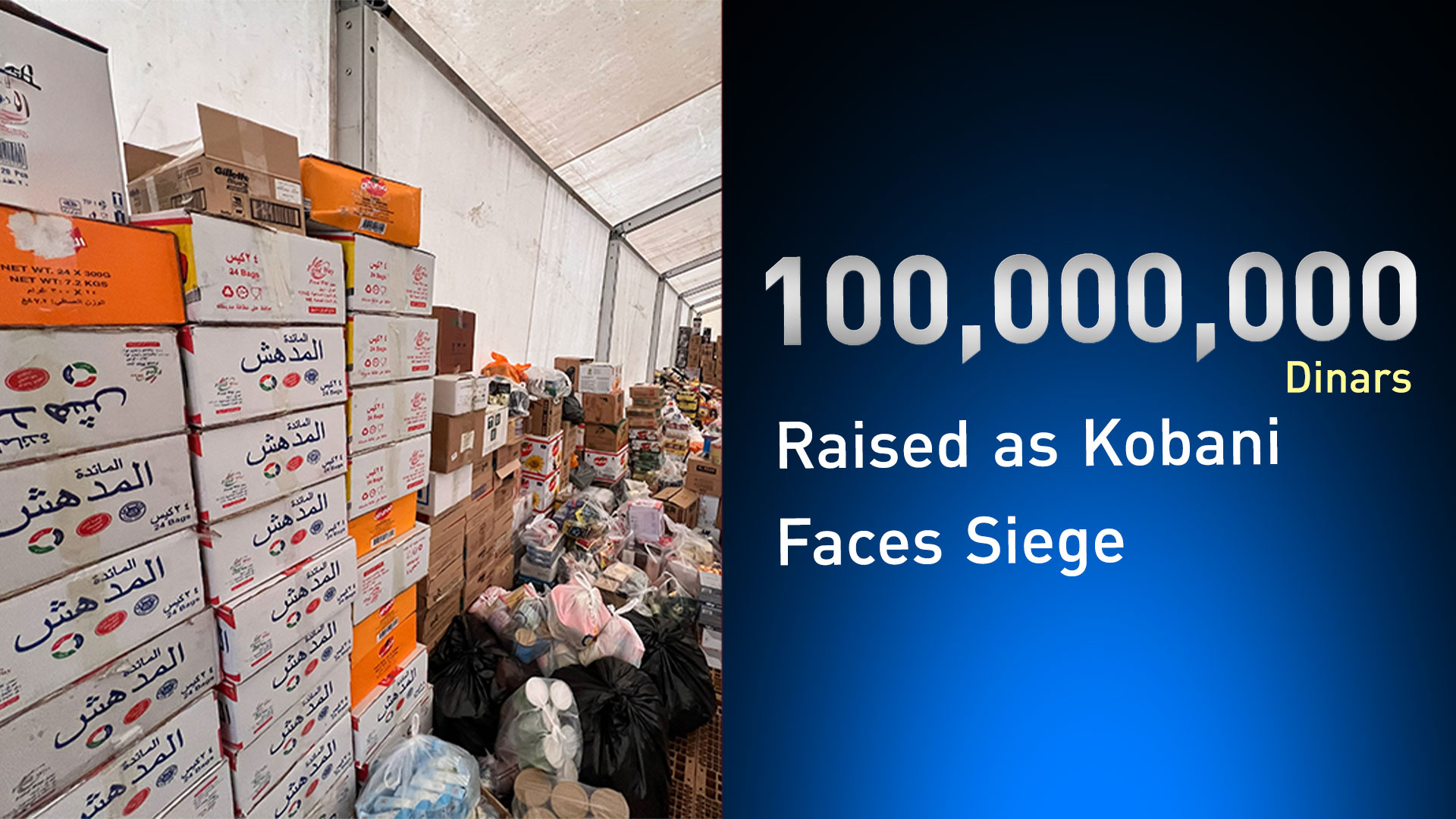
ERBIL (Kurdistan24) - A humanitarian relief effort centered in Erbil has generated significant financial and material support for the population of Western Kurdistan (Rojava), as regional observers warn of a deepening catastrophe driven by military encirclement and the most severe winter conditions in decades.
Stav Aso, the director of the Barzani Charity Foundation’s (BCF) Erbil office, announced on Friday that the ongoing aid collection campaign is continuing with great momentum, reflecting a massive public response to the escalating crisis across the border in Syria.
In a statement provided to Kurdistan24 on Friday, Aso disclosed that the campaign has successfully collected more than 100 million Iraqi dinars in cash from citizens and philanthropists. In addition to financial contributions, the foundation has processed a large volume of essential goods.
On Friday alone, the Erbil office prepared and dispatched two heavy transport trucks to the affected areas. According to Aso, one vehicle was dedicated specifically to food supplies, baby formula, and diapers, while the second carried mattresses, blankets, and critical winter provisions.
She further indicated that a third truck is currently being prepared for imminent dispatch as donations continue to arrive.
The urgency of the humanitarian mission is underscored by unprecedented weather patterns in northeastern Syria.
Aso noted that the city of Qamishlo is currently experiencing its heaviest snowfall in more than 50 years. She characterized the situation as "very difficult" and described the cold as "extreme," justifying the necessity for a sustained and expanded relief effort.
Beyond the current public campaign, the Barzani Charity Foundation has a long-standing operational presence in the region; Aso pointed out that the organization has previously delivered over 100 trucks of aid through its own logistical network and international partners.
Furthermore, a specialized medical team comprising more than 25 doctors, nurses, and support staff is currently stationed in Rojava to provide emergency services.
Additionally, Karzan Noori, a member of the Administrative Board of the Barzani Charity Foundation (BCF), told Kurdistan24 that the foundation's humanitarian efforts are continuing through diplomatic channels to establish a humanitarian corridor and allow BCF teams to reach Kobani.
He also revealed that they are taking every possible measure through all available channels to break the siege on Kobani.
The BCF Administrative Board member added: "To date, 102 trucks of aid have been sent from Southern Kurdistan [Iraqi Kurdistan] to Western Kurdistan [Rojava], consisting of more than 850 tons of food and essential supplies."
Karzan Noori further noted that a specialized medical team has been dispatched to Rojava, and over the past two days, they have provided primary medical treatment to 685 individuals.
The relief efforts in Erbil are unfolding against a backdrop of a rapidly deteriorating security environment in the Syrian city of Kobani.
Reports from the ground indicate that the city and its surrounding villages have been placed under a tightening siege by the Syrian Arab Army and affiliated armed groups loyal to the Damascus government.
Mustafa Sheikh Muslim, a lawyer residing in Kobani, told Kurdistan24 on Friday that the urban center is in its "worst" condition since the onset of recent hostilities.
Muslim reported that while attacks by the Syrian military continued through noon on Friday—marked by the audible use of heavy weaponry—the delivery of humanitarian aid is being systematically obstructed.
Although no official ban on the entry of goods has been announced by the Syrian government, Muslim emphasized that, in practice, the encircling forces are preventing the arrival of any outside assistance.
The blockade has resulted in a total collapse of public infrastructure within Kobani. Local residents currently lack access to electricity, drinking water, and internet services, effectively isolating them from the international community.
Redwan Bezar, a journalist reporting from the city via video, warned that basic necessities, including fuel for heating, medicine, and baby formula, are nearing total depletion.
The situation is further complicated by a significant demographic surge; thousands of Kurdish migrants displaced from the Tal Samen camp and areas such as Ain Issa, Raqqa, and Girê Spî have fled into Kobani, placing an unsustainable burden on the city’s limited food and medical reserves.
Monitoring groups have echoed these concerns with increasing alarm.
The Syrian Observatory for Human Rights (SOHR) issued a stern warning on Friday, stating that the heavy siege by government forces and allied militias has pushed the region to the brink of a major humanitarian disaster.
The Observatory specifically criticized what it described as "international silence" in the face of Damascus’s efforts to prevent the arrival of basic necessities, noting that the lives of civilians are worsening daily as food security evaporates.
Amid this volatility, reports emerged of a convoy of individuals who escaped from the Aqtan prison arriving in Kobani, where they were welcomed by residents near the "Free Woman" statue despite the snow. However, Muslim noted that many personnel tasked with protecting the facility were reportedly wounded during the transition.
The physical isolation of Rojava is a primary concern for regional analysts.
Megan Bodette, the Director of Research at the Kurdish Peace Institute, reported from Qamishlo on Friday that efforts are underway to cut off the primary escape routes linking the region to the Kurdistan Region of Iraq.
Bodette warned that government-affiliated fighters appear intent on severing the road between Qamishlo and Derik, a move that would trap the population in the event of an emergency.
She described the current military campaign as an assault on the "last bit of autonomy and self-administration" in Syria, noting an atmosphere of profound anxiety among residents despite a "fragile hope" for peace.
The human toll of the conflict has been further documented by the Syrian Democratic Forces (SDF). Farhad Shami, the spokesperson for the SDF, released a dossier on Friday alleging that the Syrian Arab Army and affiliated paramilitary units have committed extensive war crimes during the 17-day military campaign.
The dossier lists 51 specific incidents, including the three-day siege and shelling of the Khaled Fajr Hospital in Aleppo, where patients and staff were reportedly left without food before being targeted by drone strikes.
Shami also published graphic video evidence purportedly showing the burning of mutilated bodies and the torture of captives by government-affiliated factions. He characterized these acts as a "clear breach of all humanitarian and international laws and norms."
As military pressure mounts, political and cultural responses have intensified. Elham Ahmad, the Head of Foreign Relations for the Autonomous Administration of North and East Syria (DAANES), issued a public message on Friday crediting the Kurdish diaspora and the domestic population as a "true line of defense" against the threat of genocide.
In Erbil, the crisis has sparked symbolic protests; dozens of women gathered on Friday to publicly braid each other's hair in a show of solidarity.
The "Braid Campaign" was launched after a video circulated showing a Syrian soldier bragging about cutting off a Kurdish fighter's braid in Raqqa. Vienna Salam, a 31-year-old lecturer at the Erbil protest, told reporters that the act was intended to demonstrate "our way of resilience and power" in the face of attempts at cultural and gender-based intimidation.
High-level diplomatic efforts are concurrently underway to de-escalate the violence. President Masoud Barzani recently met with U.S. Special Envoy Tom Barrack and U.S. Central Command Commander Admiral Brad Cooper in Erbil, resulting in reported "positive steps" toward a ceasefire.
President Barzani emphasized that "our hearts and minds are with our brothers and sisters in Western Kurdistan" and reiterated the need for international support to safeguard Kurdish rights.
Despite these glimmers of diplomatic movement, the situation on the ground remains precarious.
Bodette noted that while people are heartened by news of mediation, the looming expiration of the ceasefire deadline keeps the region in a state of high alert. As the Barzani Charity Foundation continues to dispatch trucks and medical personnel from Erbil, the immediate future of Rojava remains dependent on a resolution to the military siege and the successful delivery of life-saving aid.