U.S. Secretary of State Commends Iraq on ISIS Transfers While Warning Against Regional Political Influence
Marco Rubio spoke with Iraqi PM, praising Iraq’s efforts to transfer and detain ISIS members, urging faster repatriation of foreign nationals, and discussing government formation and Iraq’s role in regional stability.
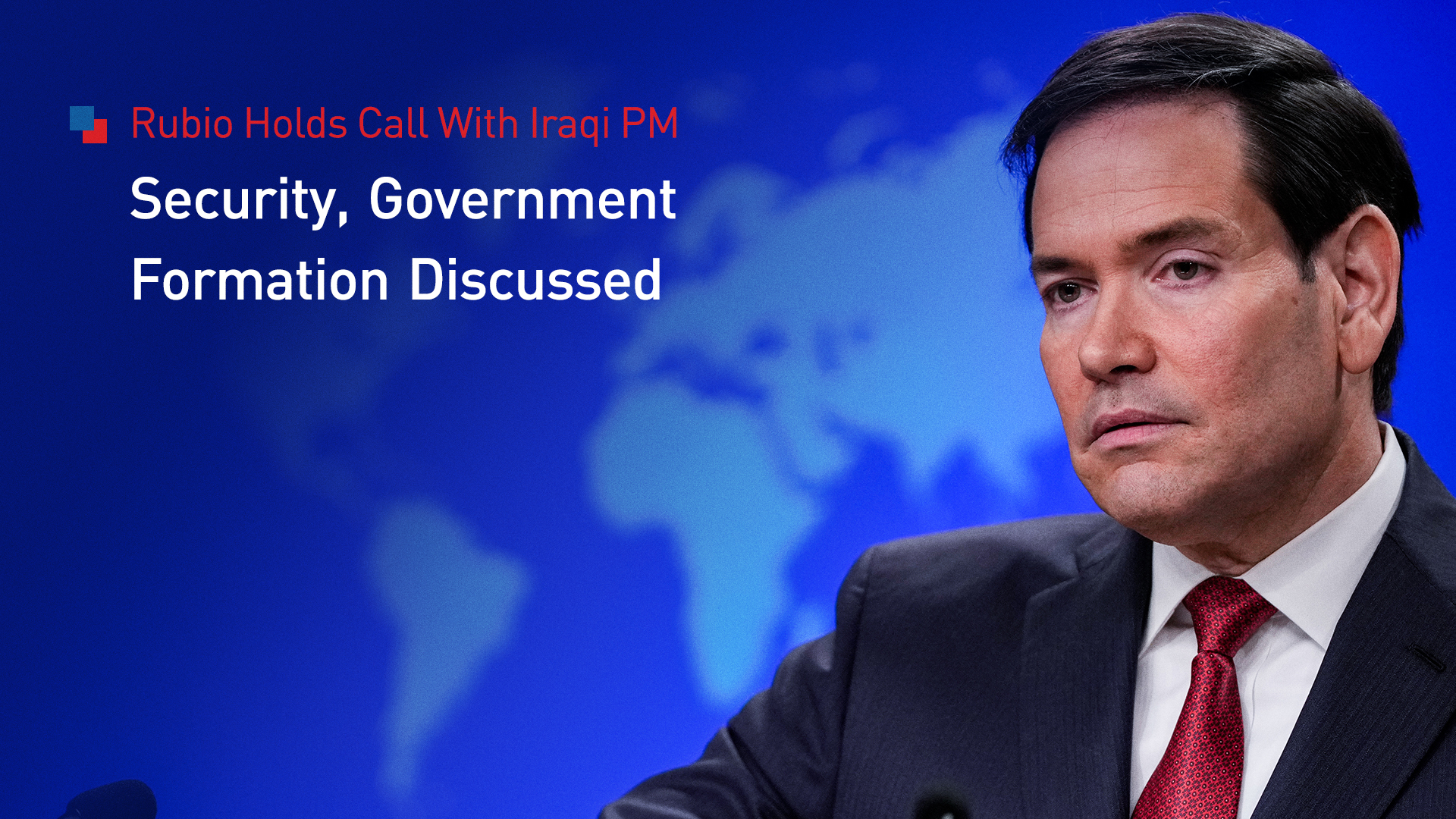
ERBIL (Kurdistan24) - United States Secretary of State Marco Rubio held a telephone conversation on Sunday with Iraqi Prime Minister Mohammed Shia al-Sudani, during which he commended Baghdad’s leadership in managing the relocation of Islamic State (ISIS) detainees from Syria while issuing a firm caution regarding the role of any regional powers in Iraq’s ongoing government formation process.
According to a readout released by the U.S. State Department on Jan. 25, 2026, Secretary Rubio praised the Iraqi government’s "initiative and leadership" in accelerating the transfer of Islamic State (ISIS) terrorists to secure facilities within Iraq.
The Secretary characterized the operation as a critical response to recent instability in northeastern Syria, where the security of detention centers has been compromised. The high-level dialogue underscored the shifting security architecture of the region as Iraq assumes a greater custodial role for thousands of combatants previously held by Kurdish-led forces.
The Secretary and the Prime Minister discussed ongoing diplomatic efforts to compel other nations to rapidly repatriate their citizens currently in Iraqi custody to ensure they are brought to justice. However, the conversation transitioned from security cooperation to Iraq’s internal political deadlock.
Secretary Rubio emphasized that for Iraq to realize its potential as a "force for stability, prosperity, and security," its government must remain independent of regional proxies. The Secretary stated that a government controlled by any regional powers "cannot successfully put Iraq’s own interests first, keep Iraq out of regional conflicts, or advance the mutually beneficial partnership between the United States and Iraq."
Strategic Scope of the Detainee Transfer
The commendation from Washington arrives as the Iraqi Ministry of Interior finalized preparations for a second convoy of ISIS prisoners scheduled to arrive from Syria in the coming days.
Miqdad Miri, the spokesperson for the Ministry of Interior, told Kurdistan24 on Saturday that the relocation process is being conducted under the joint supervision of the Iraqi government and the United States Central Command (CENTCOM).
To date, approximately 150 fighters have been handed over to Iraq, but CENTCOM has indicated that the ultimate goal of the operation is the transfer of nearly 7,000 ISIS prisoners.
This move has been described by government spokesperson Basim Alawadi as a "preemptive step" to safeguard national security against the risk of mass prison breaks in Syria.
The Interior Ministry confirmed that the detainees are being distributed among various high-security facilities in Nasiriyah, Hillah, and Nineveh to mitigate the risk of a single point of failure in the prison system.
The logistical undertaking has placed a significant burden on the Iraqi state. Deputy Prime Minister and Minister of Foreign Affairs Fuad Hussein noted during a press conference on Sunday that the ISIS prisoner file is a "strategic issue" linked directly to national security.
While Hussein affirmed Iraq’s readiness to repatriate fighters holding Iraqi citizenship, he revealed that Baghdad has requested the European Union and the United States to bear the financial costs and logistical responsibilities for the transfer of foreign nationals.
Judicial Readiness and Internal Security Friction
As the transfers accelerate, the Iraqi judiciary is moving to formalize the legal status of the incoming detainees. Faiq Zidan, the President of the Supreme Judicial Council, has called for "intensive coordination" between the Ministries of Interior and Justice to investigate and prosecute the suspects.
Sabah al-Numan, spokesperson for the Commander-in-Chief of the Iraqi Armed Forces, stated that most of the prisoners are already wanted by Iraqi courts and will receive "just punishment" under national law.
This legal approach has drawn support from veteran military figures but sparked dissent within certain paramilitary factions. Babakir Zebari, the former Chief of Staff of the Iraqi Army, told Kurdistan24 that the transferred militants are "dangerous individuals with blood on their hands" who should be sentenced to death.
Zebari emphasized the necessity of maintaining the Syrian Democratic Forces (SDF) as a protective barrier in Rojava to prevent a total security collapse, warning that the removal of Kurdish-led forces would be a "major catastrophe."
Conversely, the policy of bringing ISIS fighters into Iraq has encountered resistance from the Popular Mobilization Forces (PMF).
Abu Turab al-Tamimi, a senior commander in the Badr Organization, described the move as a "major mistake" and a "wrongful act" for which the government must bear responsibility.
Despite this political friction, the PMF has participated in fortifying the frontier. Security officials reported that the border with Syria is now protected by three reinforced defensive lines—manned by the Border Guard, the Army, and the PMF—utilizing drones, thermal cameras, and concrete barriers.
Deliberations on Government Formation
Secretary Rubio’s warning regarding regional influence coincides with a protracted struggle within Baghdad to elect a new President of the Republic, a necessary precursor to forming a full cabinet. Foreign Minister Fuad Hussein confirmed on Sunday that the Kurdistan Democratic Party (KDP) and the Patriotic Union of Kurdistan (PUK) have not yet reached an agreement on a joint candidate.
"The final list of candidates includes 18 people, and ultimately the Iraqi Parliament will decide," Hussein stated. The lack of Kurdish consensus has delayed the constitutional timeline, as the President is tasked with nominating the candidate of the largest parliamentary bloc to form the government.
The U.S. remains concerned that the political vacuum may be exploited by factions prioritizing regional agendas. The State Department readout indicated that Secretary Rubio’s emphasis on an independent government is tied to the U.S. desire to keep Iraq insulated from regional conflicts.
This mirrors previous diplomatic messages conveyed to Iraqi leadership suggesting that the country’s financial stability—including the protection of oil revenues deposited in the Federal Reserve Bank of New York—is contingent upon the nature of the parties participating in the government.
The complexity of the regional security environment was further highlighted by recent developments in Raqqa, where Syrian government forces, having recently taken control of al-Aqtan Prison from the SDF, released 126 juvenile detainees.
Syrian authorities claimed the release followed a review of digital records confirming the individuals were minors at the time of detention and posed no security threat. However a statement from Prison Administration of the Autonomous Administration of North and East Syria (DAANES) argued that the juveniles were initially housed in a dedicated, specialized section of al-Aqtan Prison, separate from the adult population.
The administration asserted that the transfer of these individuals from standard juvenile reform centers to the Raqqa facility occurred approximately three months ago, a move it characterized as a necessity dictated by volatile security conditions on the ground.
In its detailed breakdown, the Prison Administration categorized the detained juveniles into two distinct groups. The first group consisted of minors involved in various criminal activities for which Syrian citizens had filed formal legal complaints.
The second group comprised individuals described as victims of the terrorist organization ISIS, having been recruited as fighters or utilized for other auxiliary purposes during the group’s territorial control. The clarification emphasized that despite the security-driven nature of their detention, the administration remained committed to rehabilitation and behavioral correction.
However, while Iraq prepares for the arrival of the next convoy of 7,000 prisoners, the convergence of high-stakes military transfers, judicial mobilization, and Secretary Rubio’s political ultimatums underscores the fragile nature of the Iraqi transition.
The Sudani administration now faces the dual challenge of securing the border against extremist resurgence while navigating a political path that satisfies Washington’s requirements for sovereign independence.