Iraqi Cabinet’s Decision to Cut Teachers’ Allowances Sparks Protests Amid Longstanding Corruption Concerns
Educators say Baghdad targets vulnerable public servants while billions vanish through mismanagement, militia-controlled border gates, and fake projects.
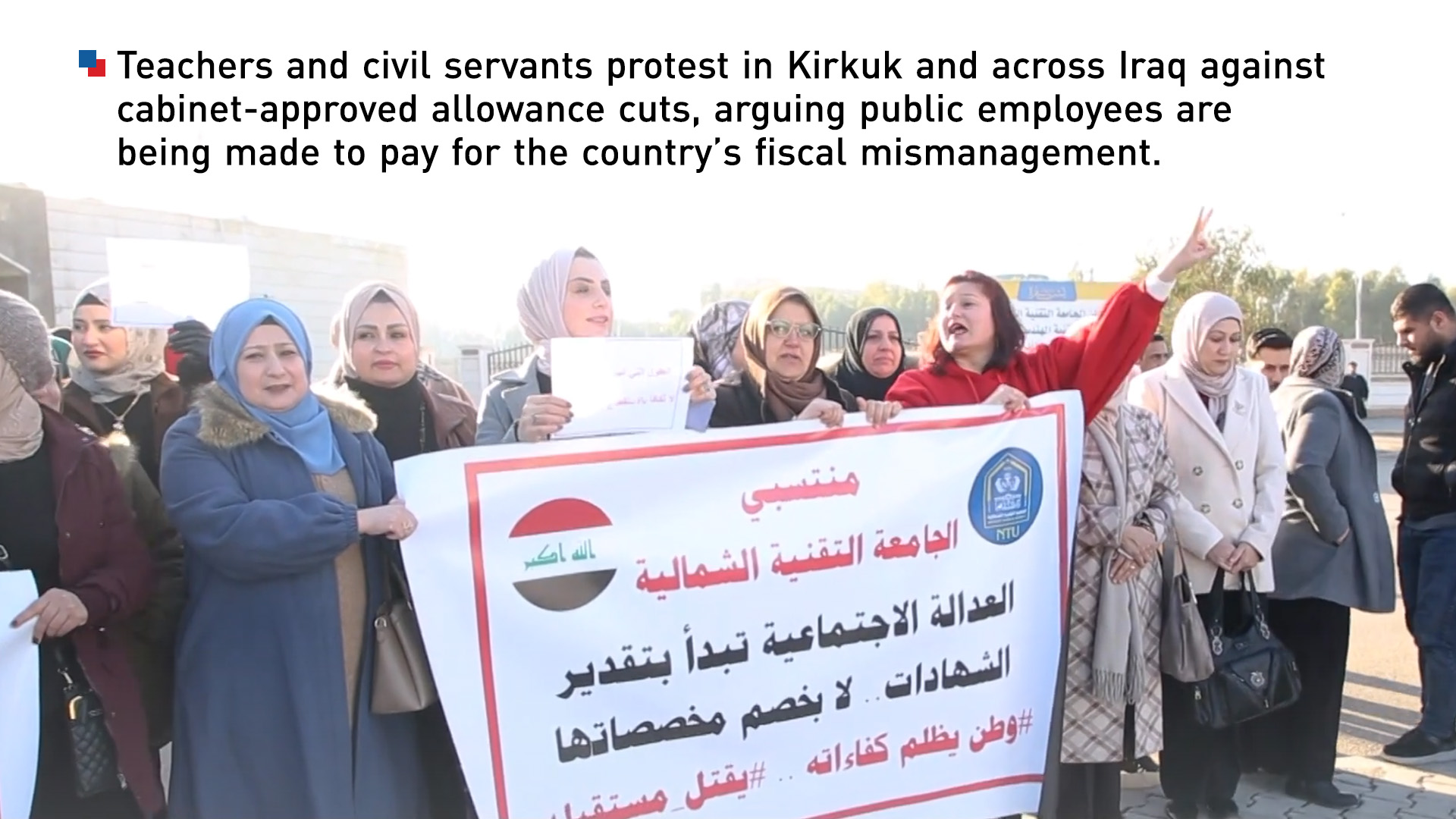
ERBIL (Kurdistan24) — A decision by Iraq’s Council of Ministers to reduce or suspend allowances for teachers and employees in the education and higher education ministries has triggered strong backlash and street protests, across Iraqi provinces, particularly in Kirkuk, where demonstrators accused the federal government of placing the burden of fiscal mismanagement on the country’s most vulnerable public servants instead of confronting entrenched corruption.
Teachers and civil servants in Kirkuk took to the streets on Sunday, warning the federal government against “touching their livelihoods,” according to Hemin Dalo, Kurdistan24 correspondent in Kirkuk.
The cabinet decision, justified by Baghdad as a step to return revenues to the general budget, has been widely criticized as an unfair and socially harmful measure that fails to address the root causes of Iraq’s chronic financial crisis.
Within a single day, at least four major demonstrations were reported in Kirkuk. Protesters said their allowances are a legal entitlement earned through years of service, stressing that the government, instead of rewarding educators, has chosen to cut their income.
“If the government wants to restore money to the state treasury, it should reduce the number of parliament members — 329 lawmakers — not take from teachers who have served for decades,” Rebwar Ali, a teacher participating in the protests, told Kurdistan24.
Huda Imad, a civil servant, echoed the sentiment, saying the decision represents a violation of workers’ rights.
“This is our right, and we will not back down. We spent years of our lives in public service. The government should not treat us this way,” she told Kurdistan24 correspondent.
A deeper crisis of corruption and mismanagement
The protests come against the backdrop of decades of systemic corruption, weak financial oversight, and mismanagement of public funds by successive Iraqi federal governments. Despite Iraq’s vast oil wealth, state revenues have repeatedly failed to translate into sustainable public services or financial stability.
Officials, diplomats, and anti-corruption bodies have long pointed to militia-controlled border crossings as a major source of lost state revenue. Several customs gates, particularly along Iraq’s borders, are effectively outside full government control, with armed groups accused of collecting fees unofficially and diverting customs income away from the national treasury.
Billions of dollars in potential annual revenue are believed to be lost through smuggling, underreported imports, and parallel tax systems enforced by powerful factions.
At the same time, Iraq has witnessed repeated scandals involving the disappearance of millions of dollars from state banks, ministries, and public institutions. Funds allocated for infrastructure, electricity, water, and housing projects have often vanished through fake or incomplete projects, inflated contracts, and shell companies linked to political parties.
Despite frequent promises of reform, meaningful accountability has remained elusive. Major corruption cases rarely result in convictions, while recovered funds represent only a fraction of what has been lost.
Critics argue that instead of confronting political elites, corrupt networks, and armed groups siphoning off state resources, the federal government has opted for austerity measures that directly impact ordinary citizens.
Teachers bear the cost
According to official figures, Iraq employs nearly 4.5 million public-sector workers, with more than $47 billion allocated annually for salaries — roughly 65 percent of total state revenues. While this wage bill places undeniable pressure on public finances, protesters argue that cutting teachers’ allowances is an unjust and short-sighted solution.
Educators and civil servants in Kirkuk and other provinces are now calling on Prime Minister Mohammed Shia al-Sudani’s government to reverse the decision, warning that protests will intensify if the measure is not withdrawn.
“Financial reform should not begin from the pockets of ordinary employees,” demonstrators said. “The state must first confront corruption, recover stolen funds, and regain control of its revenues.”
As public anger grows, the controversy underscores a broader crisis of trust between Iraqi citizens and the federal government — one fueled not only by economic hardship, but by a long history of unaddressed corruption and perceived injustice in how the burden of reform is distributed.