Are Kurdish Rights Truly Protected? Report Raises Questions Amid Official Assurances
A human rights report documents property seizures, arrests, and abuses against Kurds in Afrin, while Syrian President Ahmed al-Sharaa says Kurdish rights are constitutionally protected and guaranteed by law.
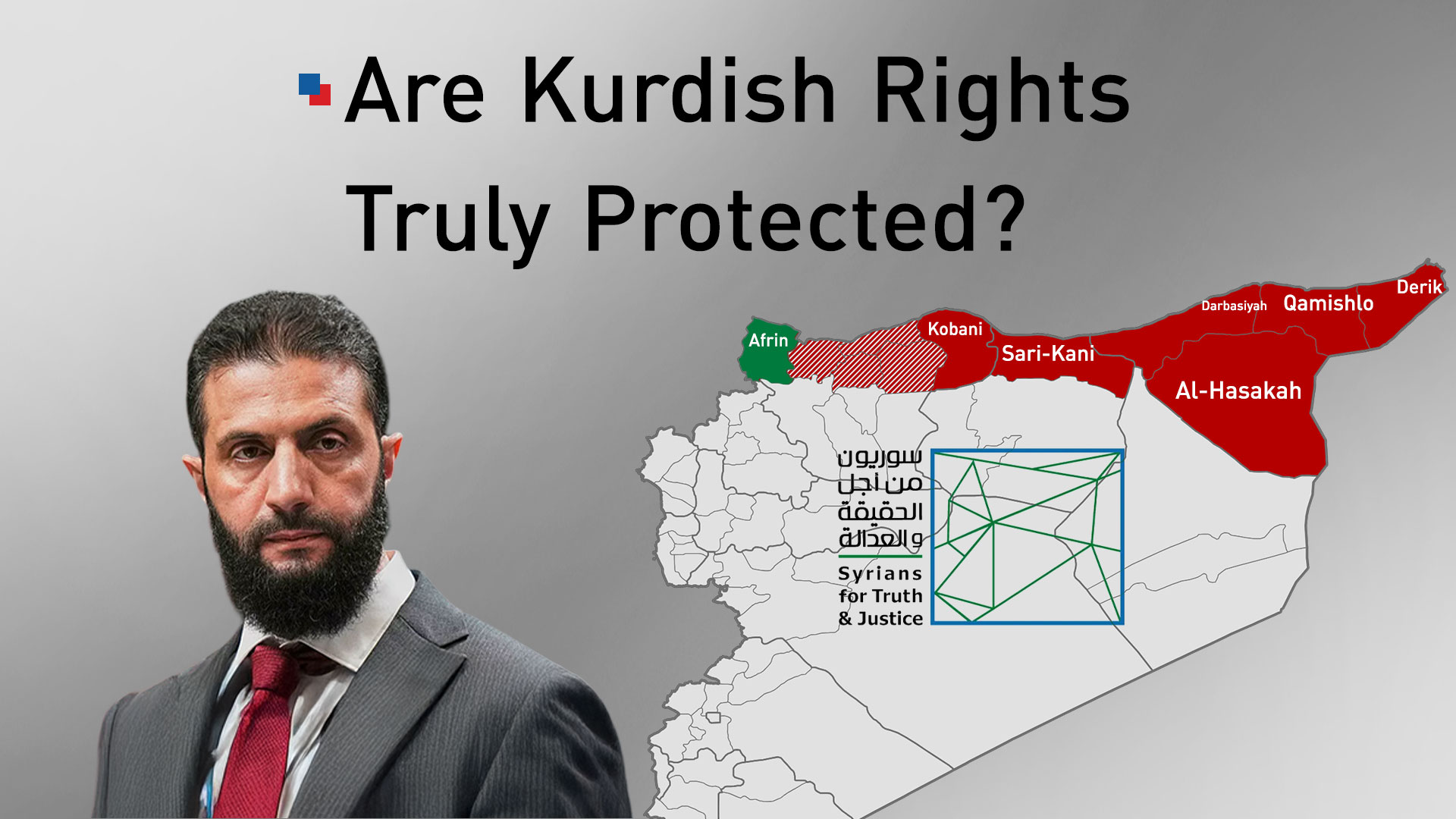
ERBIL (Kurdistan24) - A recent report published by Syrians for Truth and Justice has documented widespread and systematic violations of housing, land, and property rights affecting Kurdish residents in the Afrin region, raising questions about official assurances that Kurdish rights are protected in Syria.
The report, titled “How Do I Pay to Get Back My Home?”: Property Rights Violations in Afrin, was released on Tuesday. It examines the situation of Kurds in Afrin, described as the only Kurdish-majority area under the authority of Damascus, and is based on 39 detailed testimonies collected between May 2024 and July 2025.
On Jan. 14, 2026, Syrian President Ahmed Sharaa stated in a televised interview that Kurdish rights are safeguarded under Syria’s constitutional framework.
“Kurdish rights are preserved and will be preserved in the constitution,” Sharaa said. “We want Kurdish participation in the army, security, and parliament.”
He stressed that Kurdish citizens are entitled to full citizenship rights, participation in state institutions, and access to sovereign positions based on competence rather than quotas. He said Kurdish rights are non-negotiable and include restoration of rights related to forced displacement over the past fourteen years.
“We must think of the nation together and think of Kurdish rights through legal procedures, so that the law preserves the rights of everyone,” Sharaa said.
He added that Kurds are integrated into Syrian society, present in Damascus neighborhoods, studying in universities, and represented in government, noting that Syria’s minister of education is Kurdish.
Sharaa said that if Kurdish rights are the goal, “there is no need to spill a single drop of blood,” asserting that citizenship, participation, and military service are guaranteed through the constitution. He said discussions with Syrian Democratic Forces commander Mazloum Abdi evolved until a comprehensive agreement was reached, reaffirming his commitment to protecting the rights of all components of Syrian society under the law.
Thirteen days later, on Jan. 27, 2026, the organization Syrians for Truth and Justice published a report examining the situation of Kurds in Afrin, described as the only Kurdish region currently under the authority of Damascus.
The report documents what it describes as systematic and widespread violations of housing, land, and property rights in Afrin since the 2018 Turkish military operation “Olive Branch.” According to the organization, the findings are based on thirty-nine testimonies collected from victims and relatives of victims, documenting violations affecting at least fifty-three homes, in addition to agricultural lands, farming tools, and commercial shops.
The report states that the violations were carried out by elements, leaders, or civilians and families linked to nineteen factions of the Syrian National Army, including the Sultan Suleiman Shah Brigade (al-Amshat), Sultan Murad Division, Hamza Division, Ahrar al-Sharqiya, and Ahrar al-Sham.
According to the testimonies, the violations primarily targeted displaced Kurdish property owners, estimated to number in the tens of thousands, who were forced to leave Afrin during or after 2018 due to repeated abuses. Reported patterns include looting of property valued at thousands of dollars; seizure of homes for military or residential use; conversion of houses into military headquarters; settlement of fighters’ families and affiliated civilians from other regions; exploitation of confiscated shops; destruction of agricultural land; and operation of farmland without owners’ consent, compensation, or revenue sharing.
The report further documents cases of arbitrary arrest and detention of property owners, some of whom were subjected to torture. According to testimonies, these practices were used either to force owners to abandon their properties or to intimidate them into withdrawing claims. One owner reported being threatened with arrest after filing a complaint, highlighting what the organization described as the ineffectiveness of grievance mechanisms and the inability of authorities to restrain armed factions.
The report states that although Syrian National Army factions announced their dissolution and formal integration into the Ministry of Defense of Syria’s new government, many remain present in Afrin villages, and property violations have continued.
The organization states that the documented violations contradict Syria’s 2025 constitutional declaration, which affirms in Article 16 that private property is protected and may not be expropriated except for public benefit and with fair compensation. The declaration’s preamble emphasizes justice for victims, the rule of law, and the construction of a state based on citizenship, freedom, and dignity.
The report cites multiple provisions of the Syrian Civil Code affirming exclusive ownership rights and prohibiting deprivation of property without legal basis and compensation. It also states that the documented acts constitute crimes under the Syrian Penal Code No. 148 of 1949, including property usurpation, theft during unrest, threats, violation of the sanctity of homes, arbitrary detention, and torture.
Article 18 of the constitutional declaration affirms the prohibition of torture and states that such crimes are not subject to statutes of limitation.
From an international law perspective, the report states that the violations breach the Universal Declaration of Human Rights, the International Covenant on Economic, Social and Cultural Rights, and the International Covenant on Civil and Political Rights. It further states that destruction and seizure of property without military necessity, including the uprooting of hundreds of olive trees, violate the Geneva Conventions and the Rome Statute of the International Criminal Court.
One farmer testified: “The elite faction bulldozed the entire hill, including my orchard, and I estimate the number of trees uprooted and destroyed at around 300.”
Other testimonies describe financial extortion as a condition for reclaiming property. One owner said: “To this day, I have not returned to my home for fear of arrest… and I know they will demand large sums of money in exchange for returning my property.”
Another testimony recounts a threat issued during a grievance process: “If you do not want your children to become orphans, abandon your claim to your car and tractor. If you demand them, we will kill you.”
The report states that such practices persist in the absence of effective remedies and accountability, creating what it describes as a climate of impunity.
As constitutional guarantees and presidential assurances affirm the protection of Kurdish rights, the documented testimonies from Afrin present a parallel record of property seizures, displacement, and intimidation, leaving both narratives—official commitments and recorded violations—coexisting in Syria’s public record.