U.S., UAE Deepen Economic and Tech Partnership at Eleventh Policy Dialogue in Abu Dhabi
Talks highlight $1.4 trillion UAE investment pledge, AI cooperation, and supply-chain security amid expanding bilateral trade.
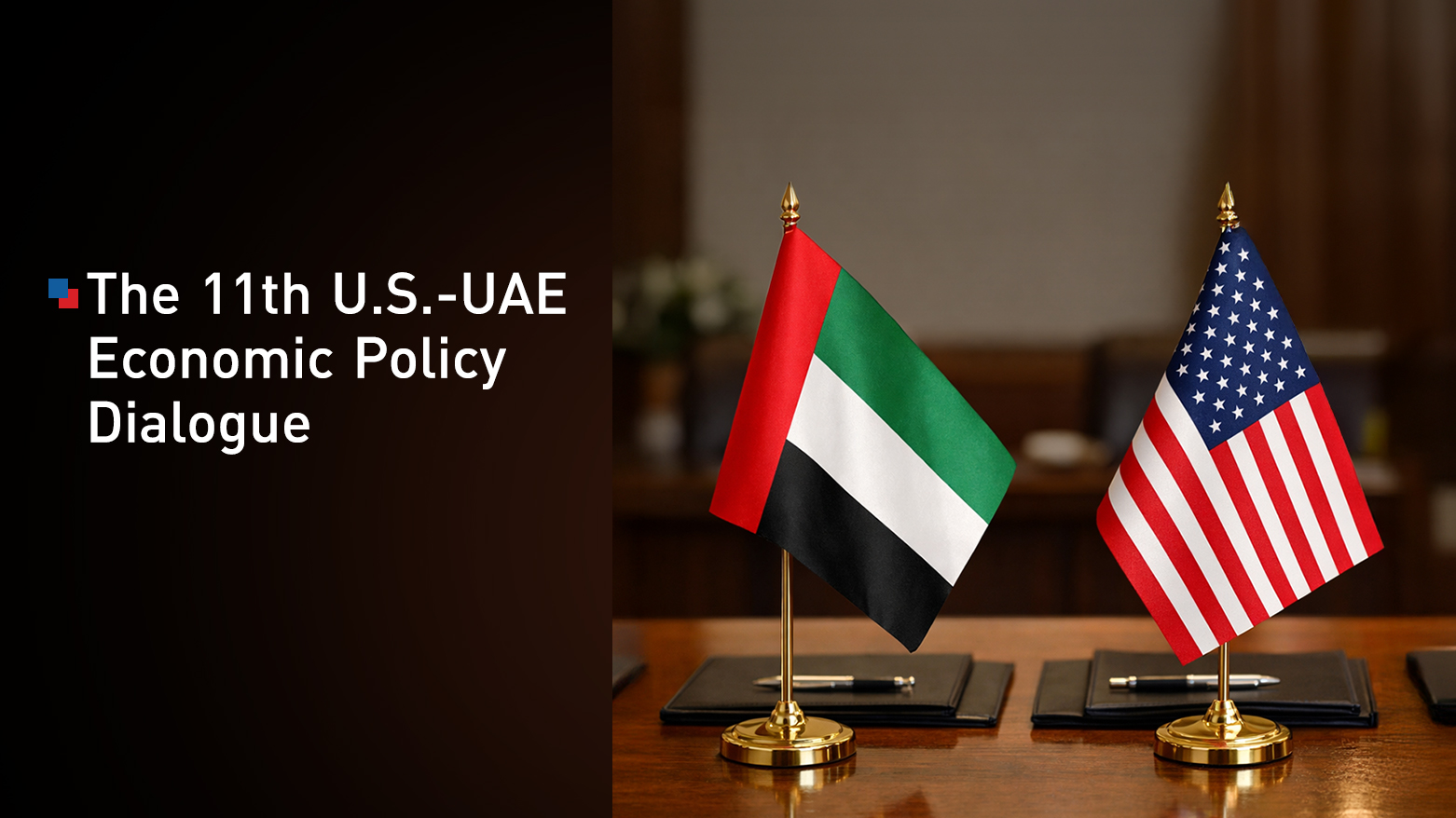
ERBIL (Kurdistan24) — The United States and the United Arab Emirates reaffirmed their deepening economic partnership during the eleventh U.S.-UAE Economic Policy Dialogue held in Abu Dhabi, underscoring robust trade ties, expanding cooperation in advanced technologies, and shared efforts to secure resilient global supply chains, read a press release published by the U.S. State Department on Tuesday.
The dialogue was co-chaired by UAE Minister of State Saeed Mubarak Al Hajeri and the U.S. Under Secretary of State for Economic Affairs Jacob Helberg, bringing together senior officials from both governments to review progress and set priorities across trade, investment, technology, and economic security.
Officials highlighted the UAE’s position as the United States’ largest trade partner in the Gulf for nearly two decades, noting that Washington continues to maintain a significant trade surplus with Abu Dhabi.
Both sides emphasized that clear regulatory frameworks and open markets have driven mutual prosperity, while cooperation has accelerated in priority sectors, including advanced technology, energy, manufacturing, life sciences, and critical minerals.
Al Hajeri noted that non-oil trade between the two countries surpassed $38 billion in 2024. Preliminary figures for 2025 show bilateral non-oil trade reaching $19.3 billion in the first half alone, a year-on-year increase of 3.4%, supporting key U.S. industries such as energy, aviation, and technology.
A central focus of the talks was economic security and trusted supply chains. Helberg stressed the importance of closer alignment in advanced manufacturing, artificial intelligence, energy abundance, and digital infrastructure, linking these areas to both economic resilience and national security.
The two sides explored expanded collaboration on critical minerals, including coordinated investment in third-country projects to diversify and strengthen supply chains.
The dialogue also addressed the implementation of the U.S.-led Pax Silica Declaration, aimed at building secure and innovation-driven supply chains for technologies foundational to the AI era.
The UAE formally joined the initiative on January 14, signaling its intent to play a leading role through investment, infrastructure development, and international partnerships. Both countries reiterated support for the India–Middle East–Europe Economic Corridor (IMEC), with an emphasis on expanding port and rail capacity to enhance regional connectivity.
On artificial intelligence, officials reaffirmed their commitment to the U.S.-UAE AI Acceleration Partnership signed during President Donald Trump’s visit to the UAE in May 2025.
The framework enables the export of advanced U.S. AI semiconductors to trusted entities in the UAE under enhanced security measures, unlocking significant Emirati investment in U.S. AI infrastructure, research and development, cloud architecture, and AI-enabled industrial applications.
The two sides acknowledged progress on a proposed five-gigawatt AI campus under construction in the UAE, expected to be the largest such facility outside the United States.
Officials said the project is already fostering deeper collaboration among technology firms, academic institutions, and research centers in both countries.
Discussions also covered financial cooperation, countering illicit finance, and strengthening the integrity of the global financial system. Officials reviewed ongoing sanctions coordination and welcomed plans to formally inaugurate the UAE-U.S. Treasury Engagement Framework on illicit financing in 2026.
UAE officials also welcomed the U.S. Treasury Department’s Known Investor pilot program related to the Committee on Foreign Investment in the United States (CFIUS).
Beyond technology and finance, the dialogue addressed water security and sustainability. Al Hajeri said the UAE looks forward to co-hosting the 2026 United Nations Water Conference with Senegal, highlighting Abu Dhabi’s growing role in shaping the global water agenda.
Both delegations concluded by reaffirming the Economic Policy Dialogue as a key mechanism for advancing bilateral cooperation and strengthening the long-term economic partnership between the United States and the United Arab Emirates.