'Kezi Monument' Planned in Sulaimani to Celebrate Kurdish Resilience
Sulaimani Governor Haval Abubakr announced plans for the "Kezi" (Braid) Monument on Wednesday. The move follows the viral outrage over attacks on female Kurdish fighters in Rojava and reflects a regional effort to institutionalize the braid as a symbol of national identity and resilience.
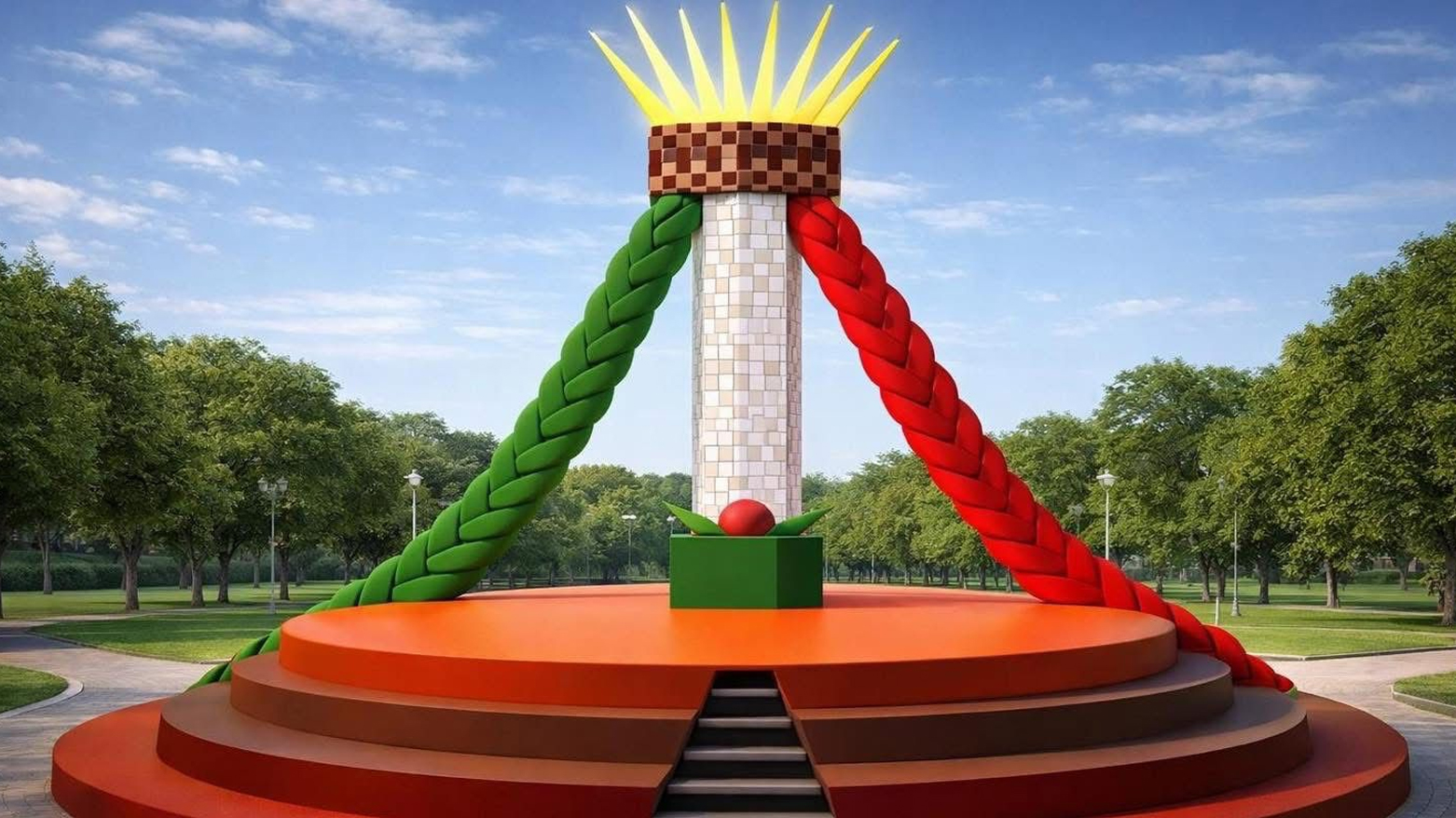
ERBIL (Kurdistan24) - Dr. Haval Abubakr, the Governor of Sulaimani, announced on Wednesday that the city will soon commence the construction of the "Kezi" (Braid) Monument, a large-scale artistic project designed to serve as a permanent tribute to Kurdish dignity, resistance, and national unity. The announcement marks the latest administrative move in a synchronized regional effort to institutionalize a symbol that has gained global prominence following recent military escalations and cultural provocations in northeastern Syria.
In a press release issued on January 28, 2026, Dr. Abubakr expressed the governorate's total support for the initiative, which was originally proposed by the artist Dilshad Bahadin.
The Governor characterized the project as "The Kezi Monument, the Monument of Dignity, the Day of National and Patriotic Unity, Resistance, and the Victory of Kurdistan."
He noted that the Sulaimani administration would take immediate practical steps toward the monument’s realization, conducting formal consultations with the Presidency of the Municipal Council of Sulaimani and the General Directorate of Culture and Arts to ensure the participation of technical experts and supporters in the field.
The decision to build a dedicated monument in Sulaimani coincides with a parallel development in the regional capital of Erbil. On the same day, Omed Khoshnaw, the Governor of Erbil, met with the Erbil Municipal Council to approve the naming of a major municipal roundabout "Kezi."
Governor Khoshnaw stated during the session that the theme of the braid has transcended its origins to become a "symbol of determination" regarding Kurdish national issues and a method of confronting the "oppression of occupiers."
The Erbil Municipal Council approved the proposal unanimously, viewing the civic naming as evidence that the Kurdish people, regardless of their geographic location, remain united by "one thought and one soul."
The elevation of the braid to an official state symbol is rooted in a visceral regional response to a video that circulated earlier this month on social media. The footage depicted a militant affiliated with the Syrian government bragging while displaying a braid of hair he claimed to have cut from the remains of a deceased Kurdish female fighter in Raqqa.
While Agence France-Presse (AFP) noted that the soldier later claimed the braid was a fake wig found in a restaurant, the imagery triggered widespread condemnation across the Kurdistan Region and the broader Middle East.
Kurdish security forces in Rojava subsequently released their own documentation, which they stated confirmed the killing and desecration of several fighters, including women, by Damascus-affiliated factions.
The resulting outrage coalesced into a synchronized protest movement known as "The Braid Campaign." According to a report by the Iraqi News Agency (INA), the movement has engaged a diverse cross-section of society, including female activists, media professionals, and academics.
Participants have utilized social media to share videos and images of themselves braiding their hair, framing the act as a declaration of defiance against attempts to control the image and dignity of women in conflict zones. In Erbil, dozens of women gathered last Friday for a public hair-braiding demonstration.
Vienna Salam, a 31-year-old university lecturer at the event, told AFP that the practice is "our way of fighting back and of representing our identity as Kurdish women."
Activists and cultural historians have highlighted the deep anthropological significance of the braid within Kurdish society. Bahar Ali, a Kurdish activist in Erbil, told INA that the braid represents "strength, pride, identity, and freedom," asserting that for every braid cut by an adversary, "thousands of braids will grow to humiliate [the aggressors] and triumph for dignity."
Media professional Lafa provided further cultural context, explaining that in Kurdish tribal custom, the braid is often viewed as a "supplication to the Creator" and that declaring the cutting of a braid is traditionally considered equivalent to a declaration of war.
The symbolic weight of the braid has also been reflected in a surge of artistic output across the region and the diaspora. Saman Hidayat, a Kurdish sculptor residing in Germany, recently unveiled a two-meter-tall work carved from oak wood titled “Kurdish Revolutionary Women Kazi (Braid).”
Hidayat told Kurdistan24 that the sculpture symbolizes the "enduring spirit" of the nation and that he plans to eventually cast the work in bronze and mount it on four large stones to represent the four parts of Kurdistan.
Simultaneously, in Berlin, Rojava-born artist Lukman Ahmad announced an exhibition titled "Braids of Rojava," pledging to donate all proceeds to humanitarian relief for Kurdish civilians in northern Syria. Ahmad remarked that his paintings serve as evidence of the "suffering and pain" currently being experienced by the population under siege.
In Sulaimani, the Artists Syndicate recently organized a joint exhibition featuring 50 paintings from 20 different artists. The exhibition carried the collective message: “If they cut one braid, we will weave thousands more.”
Parwin Ali, a visual artist involved in the show, told Kurdistan24 that the participating artists sought to confront military aggression through cultural expression, presenting Kurdistan as a place of persistent beauty and intellectual life that cannot be undone by violence.
The administrative decisions in Sulaimani and Erbil to formalize the braid symbol occur amidst a deteriorating security and humanitarian situation in Rojava.
The city of Kobani remains under a strict military blockade by the Syrian Arab Army and affiliated armed groups, resulting in a total cutoff of electricity and water services.
The Barzani Charity Foundation (BCF) has launched an emergency aid collection campaign in Erbil, raising 210 million Iraqi dinars in just three days to provide food, medicine, and winter supplies to those displaced by the fighting.
By commissioning the Kezi Monument, the Sulaimani Governorate is positioning the city as a center for the preservation of Kurdish national heritage.
Dr. Abubakr emphasized that the monument will not only celebrate a specific artistic form but will also stand as a testament to the "resistance and victory" of the Kurdish people.
The project aims to consolidate the various threads of current Kurdish advocacy—ranging from social media campaigns and academic lectures to high-level diplomatic interventions—into a single, enduring civic landmark.