Baghdad Markets See Widespread Protests Over New Customs Tariffs
Traders shut shops, demand government review of customs measures amid mounting economic pressure.
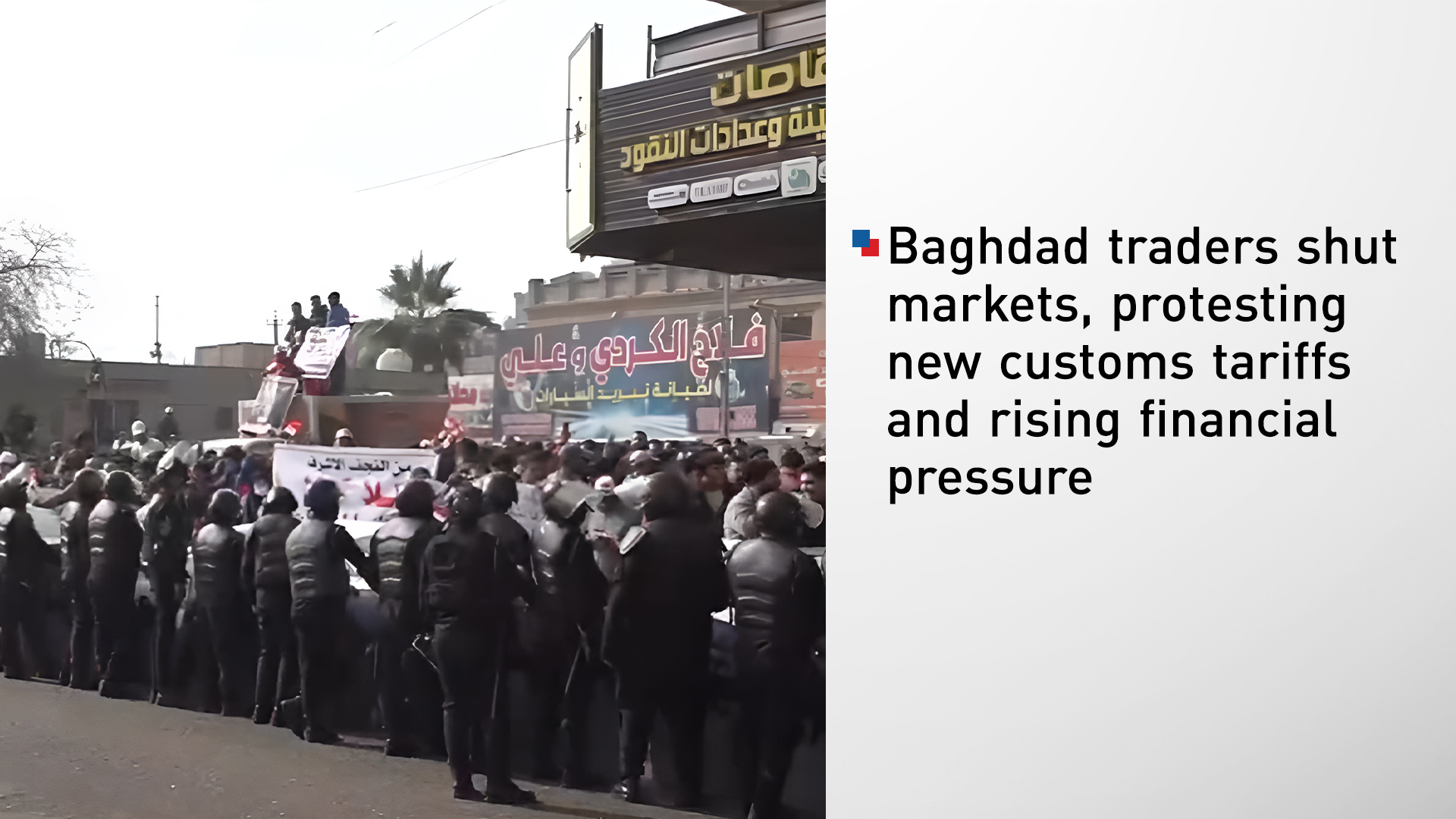
ERBIL (Kurdistan24) — Protests erupted across Baghdad on Sunday, as traders and shop owners launched a wave of demonstrations against newly imposed customs tariffs, warning that the measures have sharply slowed commercial activity and inflicted serious losses on local markets.
Demonstrators said the new customs duties have weakened buying and selling, disrupted supply chains, and placed additional financial burdens on merchants already struggling with rising costs.
As part of the protest, many traders closed their shops and markets, vowing to continue their strike until authorities respond with concrete solutions.
“Our strike will continue until the relevant authorities address our demands and find an appropriate solution to this crisis,” protesters told Kurdistan24 correspondent in Baghdad, stressing that the measures threaten the sustainability of small and medium-sized businesses.
The protests follow a statement issued on Saturday, by the Iraqi Traders Association, which called on all merchants and business owners across Iraq to take part in a nationwide strike and close markets in opposition to the new customs tariffs and additional financial obligations imposed on the commercial sector.
According to the association, the campaign to shut down commercial markets is set to continue for an indefinite period. The group described the action as a direct response to what it called unjustified customs policies and escalating fiscal pressures that have negatively affected trade and consumer demand.
In its statement, the association also demanded the immediate release of shipping containers currently stalled at Umm Qasr Port in the Iraqi southern province of Basra, where new procedures and fees have reportedly led to bottlenecks and operational paralysis.
Traders argue that delays at the port have compounded losses by preventing goods from reaching markets on time.
The Iraqi Traders Association emphasized that the protests aim to protect the interests of the commercial sector and to press for legitimate demands, urging all shop owners and market operators to adhere to the strike in order to compel the government to reconsider its customs policies.
Customs tariffs and tax reforms have been a recurring source of tension between Iraq’s government and the private sector. In recent years, authorities have sought to increase non-oil revenues through stricter customs enforcement and higher duties, particularly at border crossings and ports, as part of broader fiscal reforms encouraged by international financial institutions.
However, traders and business associations argue that such measures are often implemented without adequate consultation or supporting infrastructure, leading to delays, higher prices, and reduced competitiveness for local markets.
Umm Qasr Port, Iraq’s main maritime gateway, has repeatedly been at the center of disputes over customs procedures, with congestion and regulatory changes frequently disrupting imports.
The latest protests reflect wider economic pressures facing Iraq’s commercial sector, including inflation, fluctuating exchange rates, and weak consumer purchasing power. Observers warn that prolonged market closures could further strain the economy, while traders insist that meaningful dialogue and policy adjustments are essential to restore confidence and stabilize market activity.
The protests by traders come as Iraq faces growing public anger over recent austerity measures, including a controversial decision by the Council of Ministers to reduce or suspend allowances for teachers and employees in the education and higher education ministries.
The move has triggered strong backlash and street demonstrations across several Iraqi provinces, particularly in Kirkuk, where protesters accused the federal government of shifting the burden of fiscal mismanagement onto some of the country’s most vulnerable public servants instead of confronting entrenched corruption.
Teachers and civil servants in Kirkuk took to the streets on Jan. 26, warning the federal government against “touching their livelihoods,” according to Hemin Dalo, Kurdistan24 correspondent in Kirkuk.
Baghdad has justified the decision as part of efforts to return revenues to the general budget. However, critics have widely condemned the move as socially harmful and unfair, arguing that it fails to address the root causes of Iraq’s chronic financial crisis.
Within a single day, at least four major demonstrations were reported in Kirkuk. Protesters said their allowances are a legal entitlement earned through years of service, stressing that the government has chosen to cut educators’ income rather than reward their role in sustaining the public sector.
“If the government wants to restore money to the state treasury, it should reduce the number of parliament members — 329 lawmakers — not take from teachers who have served for decades,” Rebwar Ali, a teacher participating in the protests, told Kurdistan24.
Huda Imad, a civil servant, echoed the sentiment, describing the decision as a violation of workers’ rights. “This is our right, and we will not back down. We spent years of our lives in public service. The government should not treat us this way,” she told Kurdistan24.
The protests unfold against a backdrop of decades of systemic corruption, weak financial oversight, and mismanagement of public funds by successive Iraqi federal governments. Despite Iraq’s vast oil wealth, state revenues have repeatedly failed to translate into sustainable public services or long-term financial stability.
Officials, diplomats, and anti-corruption bodies have long pointed to militia-controlled border crossings as a major source of lost state revenue. Several customs gates, particularly along Iraq’s borders, remain outside full government control, with armed groups accused of collecting unofficial fees and diverting customs income away from the national treasury.
Billions of dollars in potential annual revenue are believed to be lost through smuggling, underreported imports, and parallel tax systems enforced by powerful factions.
Iraq has also witnessed repeated scandals involving the disappearance of millions of dollars from state banks, ministries, and public institutions. Funds allocated for infrastructure, electricity, water, and housing projects have often vanished through fake or incomplete projects, inflated contracts, and shell companies linked to political parties.
Despite repeated promises of reform, meaningful accountability has remained elusive. Major corruption cases rarely result in convictions, while recovered funds represent only a fraction of what has been lost.
Critics argue that instead of confronting political elites, corrupt networks, and armed groups siphoning off state resources, the federal government has opted for austerity measures that directly affect ordinary citizens.
According to official figures, Iraq employs nearly 4.5 million public-sector workers, with more than $47 billion allocated annually for salaries — about 65 percent of total state revenues. While the wage bill places undeniable pressure on public finances, protesters argue that cutting teachers’ allowances is an unjust and short-sighted solution.
Educators and civil servants in Kirkuk and other provinces called on Prime Minister Mohammed Shia al-Sudani’s government to reverse the decision, and warned that protests will intensify if the measure is not withdrawn.
“Financial reform should not begin from the pockets of ordinary employees,” demonstrators said. “The state must first confront corruption, recover stolen funds, and regain control of its revenues.”
As public anger grows, the controversy highlights a widening crisis of trust between Iraqi citizens and the federal government — driven not only by economic hardship, but by long-standing perceptions of inequality, corruption, and injustice in how the burden of reform is distributed.