Kirkuk Farmers Protest Delayed Wheat Payments, Accuse Baghdad of Discriminatory Policy
Kurdish, Arab and Turkmen Growers Say Federal Government Withholding Dues While Paying Southern Shiite Provinces
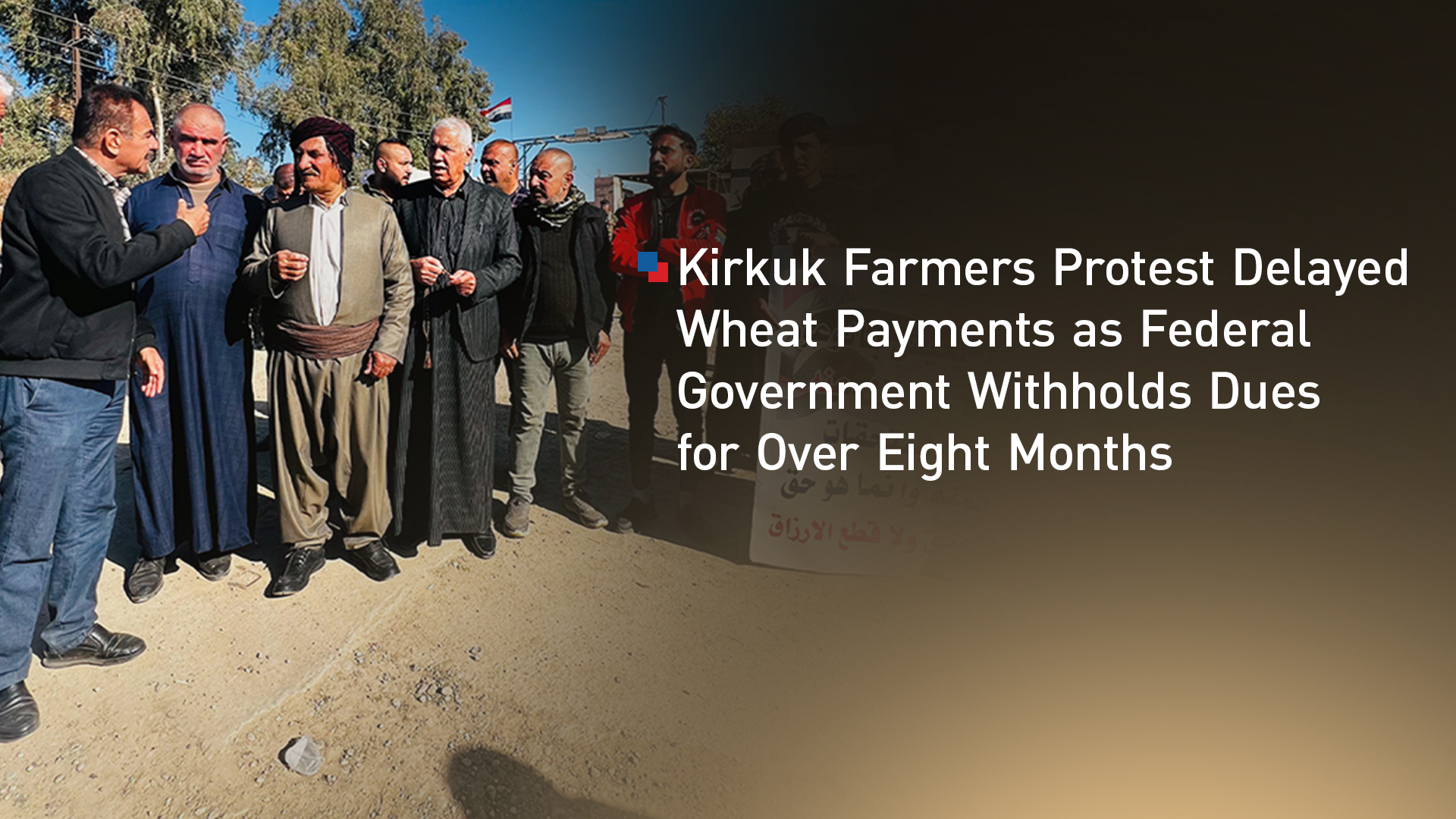
ERBIL (Kurdistan24) — Farmers from Kirkuk staged fresh protests on Tuesday, accusing Iraq’s federal government of withholding wheat payments for more than eight months, in what they describe as a discriminatory policy targeting non-Shiite farming communities in the disputed province.
Dozens of Kurdish, Sunni Arab, and Turkmen farmers gathered outside the Kirkuk silo facility, demanding immediate payment for wheat they delivered to the federal authorities during the 2025 harvest season.
Speaking from within the crowd of protesters, Sataa Nasih, a representative of farmers from the Topzawa area in Kirkuk province, told Kurdistan24 that more than 50 percent of the province’s farmers have yet to receive their financial entitlements.
“Farmers are in a very difficult financial situation and are no longer able to provide for their families because they have not received their dues,” he said.
The protesting farmers argue that while their payments remain suspended, growers in Iraq’s predominantly Shiite southern provinces have received full compensation.
“All farmers in southern Iraq have been paid. Only Kirkuk farmers have not received their entitlements,” the representative stated, warning that the group would soon issue a formal statement giving Baghdad a final deadline before escalating their protest measures.
The farmers say they fulfilled their contractual obligations by delivering wheat to Iraq’s Ministry of Trade. However, they claim the delay stems from the Ministry of Finance’s failure to transfer the allocated funds.
“We handed over our wheat to the Iraqi Ministry of Trade, but as we understand it, the Ministry of Finance has not transferred the money to the Ministry of Trade’s account,” the representative explained.
“The Trade Ministry says once the funds arrive, they will distribute the checks. But this is not our responsibility. We delivered the wheat to the government, and the government is obligated to pay us.”
Kirkuk — a multi-ethnic province claimed by both Baghdad and the Kurdistan Regional Government — has long been a flashpoint for political and administrative disputes. Since federal forces reasserted control over the province in October 2017 following the Kurdistan independence referendum, many local stakeholders have accused Baghdad of marginalizing Kurdish and other non-aligned communities in public sector employment, land administration, and agricultural policy.
Farmers allege that the current payment delays reflect a broader pattern of economic discrimination by Iraq’s Shiite-led federal government, particularly toward ethnically mixed and politically contested areas such as Kirkuk.
Agriculture remains a vital sector in Kirkuk’s rural economy, with wheat forming a cornerstone of both local livelihoods and Iraq’s national food security strategy. Under federal procurement mechanisms, farmers deliver wheat to government silos in exchange for guaranteed payments set annually by Baghdad.
Delays in disbursement can have cascading effects, limiting farmers’ ability to repay debts, purchase seed and fertilizer, and prepare for the next planting season.
By contrast, according to local farmer representatives, producers in southern and central provinces — where the population is overwhelmingly Shiite and politically aligned with ruling blocs in Baghdad — have reportedly received timely compensation for their harvests.
The demonstrators warned that if payments are not released promptly, they may resort to stronger protest measures. Farmers stressed that the issue is not logistical but administrative and political.
“This is about rights and fairness,” the representative said. “We fulfilled our part. The government must fulfill its obligations.”
The dispute comes at a sensitive time for Iraq’s federal government, which faces mounting economic pressures and growing public dissatisfaction in several provinces over service delivery and fiscal management.
For Kirkuk’s farmers, however, the issue is immediate and existential: without payment for last year’s wheat harvest, many say they face the prospect of abandoning cultivation altogether — a development that could further destabilize one of Iraq’s most politically fragile provinces.