KRG Unveils Seven Major Projects to Digitize and Globalize Kurdish Language
The Kurdistan Regional Government announced seven strategic projects to digitize and globalize Kurdish, spanning education, AI, proficiency testing, and children’s literature, aiming to introduce the language in 13 world languages.
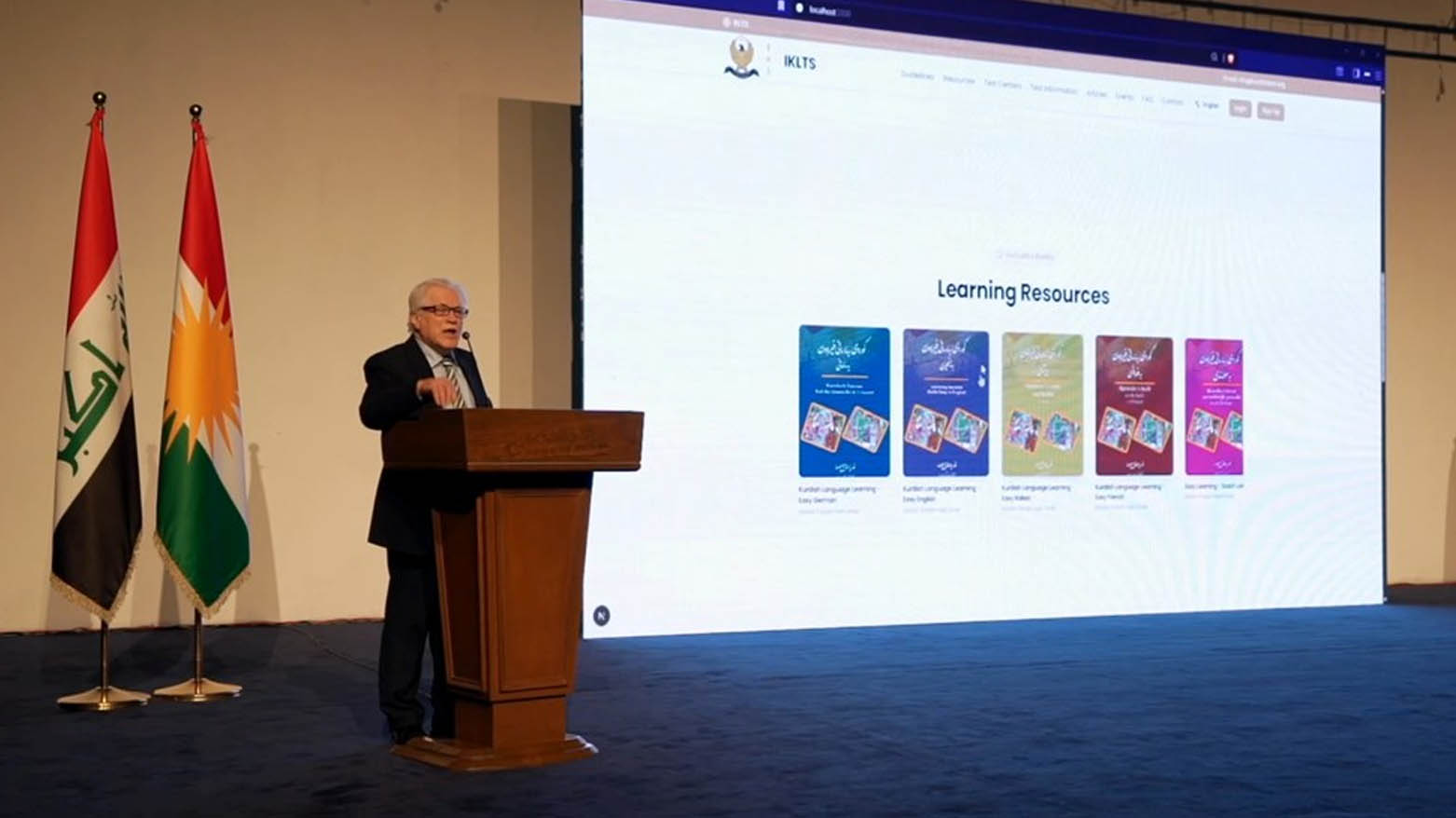
ERBIL (Kurdistan24) - In what it described as an unprecedented step toward digitizing and globalizing the Kurdish language, the Kurdistan Regional Government on Sunday, announced seven major strategic projects aimed at advancing, standardizing, and internationalizing Kurdish.
The projects were unveiled during an academic ceremony held at Saad Abdullah Hall in Erbil. According to the Media and Information Office, the initiatives fall within the vision of the ninth cabinet of the Kurdistan Regional Government to preserve and enrich the mother tongue, covering key sectors including education, technology, and international engagement.
The government stated that the projects aim to move the Kurdish language from a classical phase into the era of modern technology and introduce it in 13 living world languages.
The first project focuses on teaching Kurdish to non-native speakers. A series of books and a modern application titled “Learn Kurdish Easily” were introduced, prepared in 13 living languages, including seven European languages, three Middle Eastern languages, and, for the first time, Chinese, Japanese, and Korean.
The second initiative introduces the first Kurdish-language writing plugin for Microsoft Word and Excel, designed to correct spelling errors and unify writing standards.
The third project centers on big data and artificial intelligence. A “Word Registration System” has been established as a large Kurdish linguistic database containing more than 300,000 words. Built on morphological and semantic foundations, the system is intended to serve as infrastructure for integrating Kurdish into AI technologies.
The fourth initiative introduces the K-IELTS system, a Kurdish-language proficiency testing framework modeled on international exams such as IELTS and TOEFL, aimed at assessing the language skills of non-native speakers and certificate applicants.
The fifth project presents a new educational program for children, combining an application and animation to teach Kurdish letters and sounds at the primary level.
The sixth initiative consists of a series of written and audio children’s stories prepared with high artistic standards for different age groups.
The seventh project is a comprehensive multilingual dictionary covering 31 distinct scientific and everyday fields.
On the sidelines of the ceremony, writer and linguist Faryad Fazil highlighted the importance of the transformation, stating: “We have sought to make the Kurdish language possess big data and, through technology, bring it to the world. These projects are a historic step for the Kurdish language to stand alongside the world’s standard languages.”
The Kurdistan Regional Government reiterated that the mother tongue represents national identity and remains among its top priorities. It added that these projects provide modern scientific infrastructure for current and future generations, enabling them to use the Kurdish language across academic and administrative fields.
The announcement marks a coordinated institutional effort to position Kurdish within contemporary technological and educational frameworks.