U.S. War Secretary Promotes Space Dominance and Industrial Reform in Colorado Speeches
In Colorado, Hegseth outlined the administration’s emphasis on space dominance, expanded industrial competition and accelerated military investment during stops at Sierra Space and True Anomaly on the Arsenal of Freedom tour.
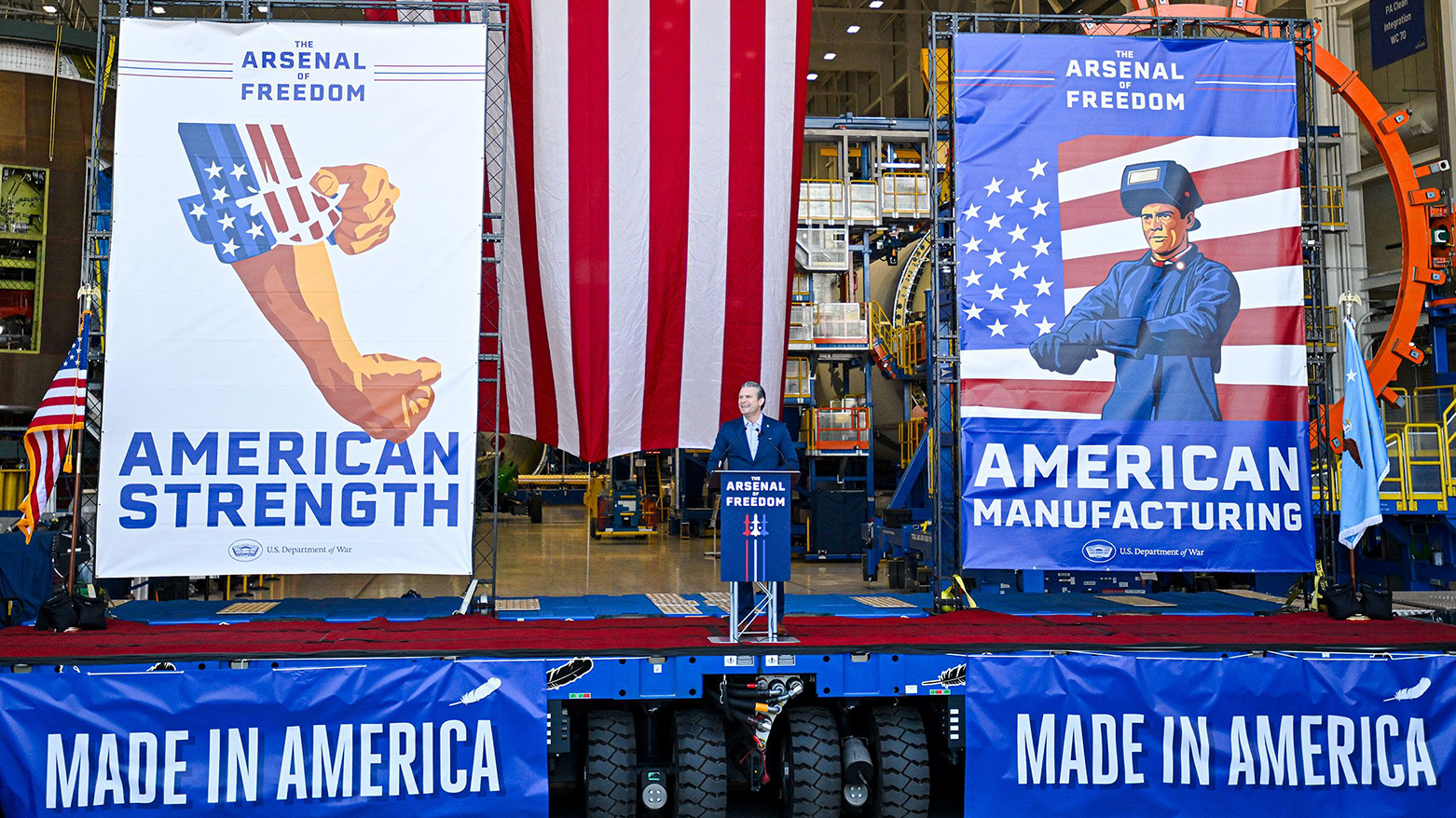
ERBIL (Kurdistan24) - U.S. War Secretary Pete Hegseth on Feb. 23 called for accelerated investment in military space capabilities, expanded competition within the defense sector, and a restructuring of Pentagon procurement practices during remarks delivered at two Colorado-based aerospace firms as part of the administration’s “Arsenal of Freedom” tour.
Speaking at facilities operated by Sierra Space and True Anomaly, Hegseth said the Department of War had received a mandate from Donald Trump to “build more and build faster,” emphasizing what he described as the centrality of space to future military operations.
At Sierra Space, Hegseth told employees that “the ultimate high ground, the single most decisive battlefield of this century and the centuries to come is hundreds of miles above our heads.” He stated that control of space would determine the outcome of future conflicts, adding that “the fight for space is the fight for the future of the world as we know it.”
The visit formed part of a broader effort, according to Hegseth, to send what he called a sustained “demand signal” to American industry that the federal government intends to prioritize speed, scale and competition in defense production. He said the War Department would work to reduce bureaucratic barriers that he characterized as slowing innovation and limiting participation by smaller firms.
Hegseth criticized what he described as a long-standing reliance on a limited number of large defense contractors. He said that for decades, procurement had been dominated by “a cozy club of bloated, over-budget prime contractors” and pledged to open competition to a wider range of companies.
“I don’t care whose name is on the side of satellites,” he said at True Anomaly. “I just want the best.” He added that firms would be judged on whether their products could scale and be delivered at cost and on schedule, stating, “If you build the best, if you build the fastest, and at cost for the American taxpayer, you’re going to win. If you don’t, then I’ll make sure you lose.”
The War Secretary described the administration’s approach as a “war of attrition against our own bureaucracy,” saying the department intended to remove internal obstacles that hinder competition and rapid development.
At both events, Hegseth framed space as a decisive military domain, stating that “whoever controls space controls the fight.” He said the administration is seeking “orbital and American dominance” rather than parity with potential adversaries.
He cited President Trump’s announcement of a $1.5 trillion investment in national security for 2027 and referred to additional funding included in what he described as a “one big beautiful bill.” According to Hegseth, the legislation provides billions of dollars for military space capabilities, including a $25 billion initial allocation for what he called the “Golden Dome for America.”
Hegseth described the Golden Dome as a “revolutionary shield of space-based weapons and sensors,” comprising a constellation of next-generation satellites designed to detect threats globally and a network of space-based interceptors intended to neutralize ballistic missiles, hypersonic weapons and drones before they reach U.S. territory.
“That’s how we establish complete and total orbital supremacy,” he said at Sierra Space.
Members of Congress representing Colorado attended the events, including Jeff Crank and Lauren Boebert. Hegseth thanked them for supporting the legislation and described congressional backing as essential to advancing the administration’s defense agenda.
Throughout his remarks, Hegseth emphasized domestic manufacturing, stating that defense systems should be “made in the USA.” He said that investing in American plants and workers was necessary to ensure both national security and economic growth.
“We invest in factories in Colorado, not in China,” he said, adding that American strength is “forged by American steel and built by American workers.”
At Sierra Space, Hegseth highlighted several of the company’s programs, including the Dream Chaser spacecraft, the Life Habitat module and the Vortex engine. He referred to these systems as part of the “arsenal of freedom” and said they provide capabilities essential to maintaining U.S. military advantage in space.
He also cited a recent operation referred to as “Operation Absolute Resolve,” describing it as a sophisticated mission conducted in Caracas. According to Hegseth, the operation demonstrated what he called “American dominance from above,” which he said was enabled by space-based capabilities.
During his speech at True Anomaly, Hegseth reiterated the need to expand access to Pentagon contracts beyond what he described as a small group of established contractors. “If we just rely on five companies that have the whole thing on lockdown, we’re screwed,” he said, arguing that broader participation would increase innovation and speed.
He told employees that the department is canvassing companies nationwide to identify firms capable of delivering advanced systems rapidly. “We’re going to open the doors of the Pentagon to you, welcome you in to compete,” he said.
Hegseth characterized speed and competition as central to the administration’s strategy. He said urgency had become “our new currency” and stated that procurement processes would be evaluated against the criteria of schedule, cost and scalability.
The War Secretary also linked the administration’s defense posture to broader foreign policy decisions, referring to what he described as the “disastrous retreat from Afghanistan,” the war in Ukraine and security challenges at the U.S. southern border. He said that from “day one” of the current administration, deterrence had been reestablished.
Quoting President Trump, Hegseth said that adversaries challenging the United States would “pay a terrible price.” He described deterrence as the primary objective of the War Department, stating that strength in space would dissuade potential adversaries from initiating conflict.
He said the department’s priority is defending the homeland, referencing threats ranging from ballistic missiles to drones. The Golden Dome initiative, he said, would play a central role in that effort.
At both companies, Hegseth addressed engineers and technicians directly, describing them as essential partners to uniformed service members. He referred to the workforce as “helmets and hard hats,” stating that their work provides the tools used by soldiers, sailors, airmen, marines and guardians.
“None of this is possible without the talent and precision that begins on factory floors just like this one,” he said at Sierra Space.
Hegseth concluded his remarks by urging companies to invest in facilities and personnel and to accelerate development timelines. He said the department would continue to push for procurement reforms to ensure that contracts are awarded based on performance rather than lobbying influence.
“We will evaluate, open the aperture, so that everyone can compete,” he said, adding that the administration’s objective is to ensure that warfighters receive the best available systems as quickly as possible.