Iran’s President Pezeshkian Declares Khamenei Killing a “Declaration of War Against Muslims”
Tehran Launches Retaliatory Strikes on U.S. Bases in Iraq and the Gulf Amid Explosions in Tehran
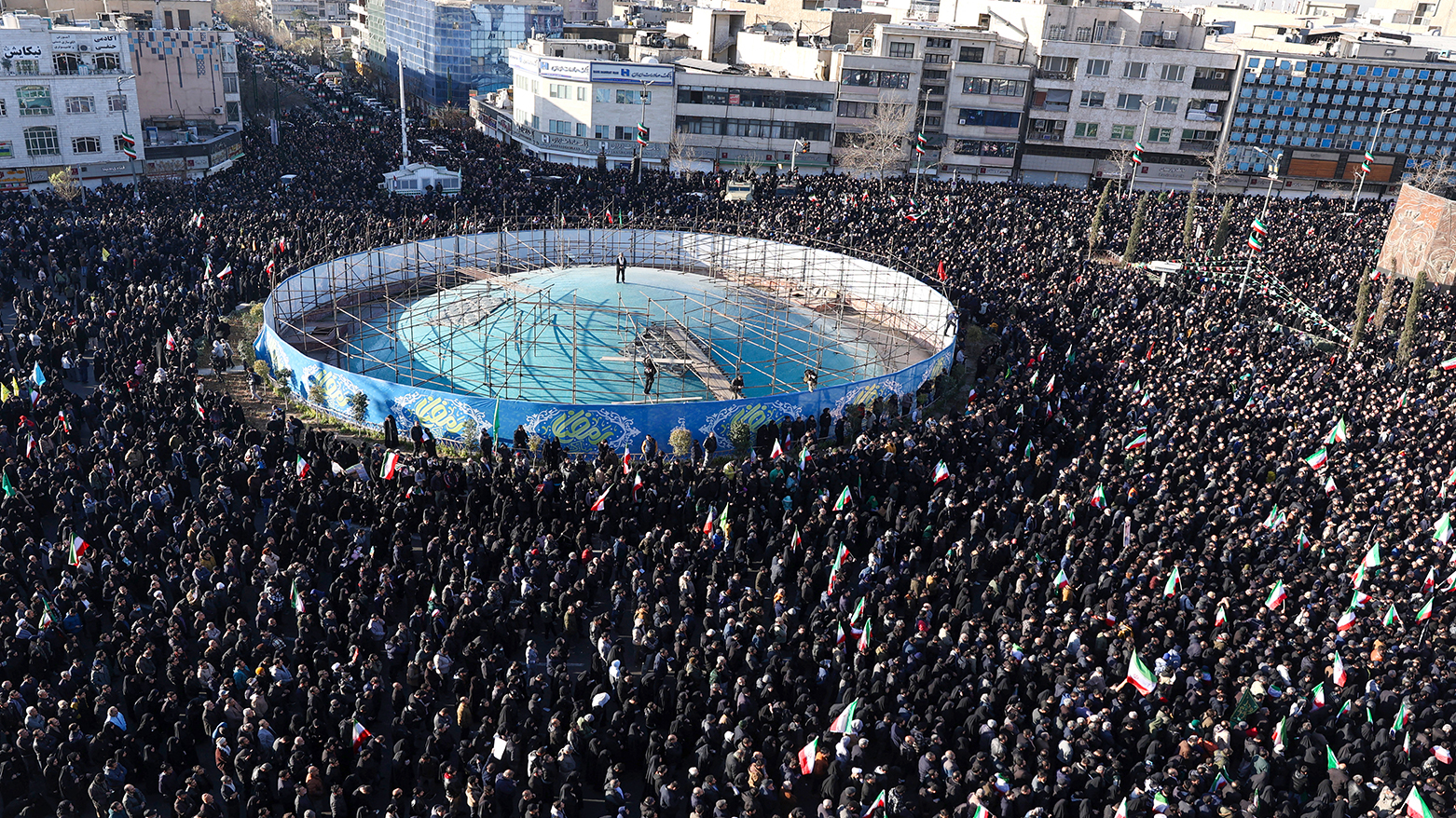
ERBIL (Kurdistan24) — Iran on Sunday vowed revenge after the killing of Supreme Leader Ali Khamenei in U.S. and Israeli strikes, with President Masoud Pezeshkian describing the attack as a “declaration of war against Muslims” and calling for retaliation against the perpetrators.
Pezeshkian said the assassination of Khamenei and other senior officials was an assault not only on Iran but on Shiites worldwide.
“The assassination of the highest political authority of the Islamic Republic of Iran and a prominent leader of Shiism worldwide… is perceived as an open declaration of war against Muslims, and particularly against Shiites, everywhere in the world,” he said in a statement carried by state television.
He added that avenging the attacks was both a right and an obligation of the Islamic Republic. “The Islamic Republic of Iran considers it its legitimate duty and right to avenge the perpetrators and masterminds of this historic crime,” Pezeshkian said.
Iranian state media confirmed that several top military and security officials were killed in Saturday’s strikes, including Abdolrahim Mousavi, Aziz Nasirzadeh, Mohammad Pakpour, Ali Shamkhani, and Gholamreza Rezaian. They were reportedly killed during a Defense Council meeting.
Explosions were reported in northern Tehran on Sunday, with smoke seen rising from several buildings, though the specific targets remained unclear.
In retaliation, Iran’s army announced that its air forces had bombed U.S. bases in Iraq’s Kurdistan Region and across the Gulf. “A few minutes ago, pilots of the air forces of the Islamic Republic of Iran successfully bombed U.S. bases in the countries of the Persian Gulf and in the Kurdistan Region of Iraq over several phases of operations,” a statement carried by state TV said.
The strikes signal a dangerous escalation in the region, marking one of the most serious confrontations between Iran and Western military forces in recent decades, and raising concerns over further destabilization of Iraq and the broader Gulf region.
The sudden loss of Khamenei has also intensified debate over Iran’s succession. State television confirmed that President Pezeshkian and two other top officials will lead the country during the transitional period, but observers note that the Revolutionary Guards may gain more influence in political and economic affairs.
Reza Pahlavi, son of the late shah, criticized any successor within the current system as illegitimate, asserting that Khamenei’s death “effectively ends the Islamic Republic” and could pave the way for a secular transition, though his support remains limited among opposition groups.
The developments mark a dangerous escalation in the Middle East, with Iran signaling its readiness for sustained retaliatory operations while the United States and its allies weigh the next steps in a conflict that now threatens civilian populations, regional stability, and global security.