UAE Warns Iran Against Targeting Neighbors as Gulf Retaliation Enters Second Day
Explosions Rock Riyadh, Dubai and Doha; US Embassies Issue Alerts as Hezbollah and Hamas Pledge Support for Tehran
ERBIL (Kurdistan24) — A senior Emirati official on Sunday warned that Iran’s retaliatory strikes across the Gulf had further isolated Tehran, urging it not to widen the conflict by targeting neighboring states as the region entered a second day of escalating violence.
Presidential adviser Anwar Gargash said Iran’s attacks amounted to a strategic error. “The Iranian aggression against the Gulf states was a miscalculation, and it isolated Iran at a critical juncture. Your war is not with your neighbors,” he said, calling on Tehran to “return to reason” before isolation and escalation deepen.
Explosions Across Gulf Capitals
Loud explosions were heard Sunday in eastern Riyadh, with residents reporting smoke rising over parts of the Saudi capital. AFP correspondents in Dubai described a second wave of blasts, following earlier explosions in Doha and Manama.
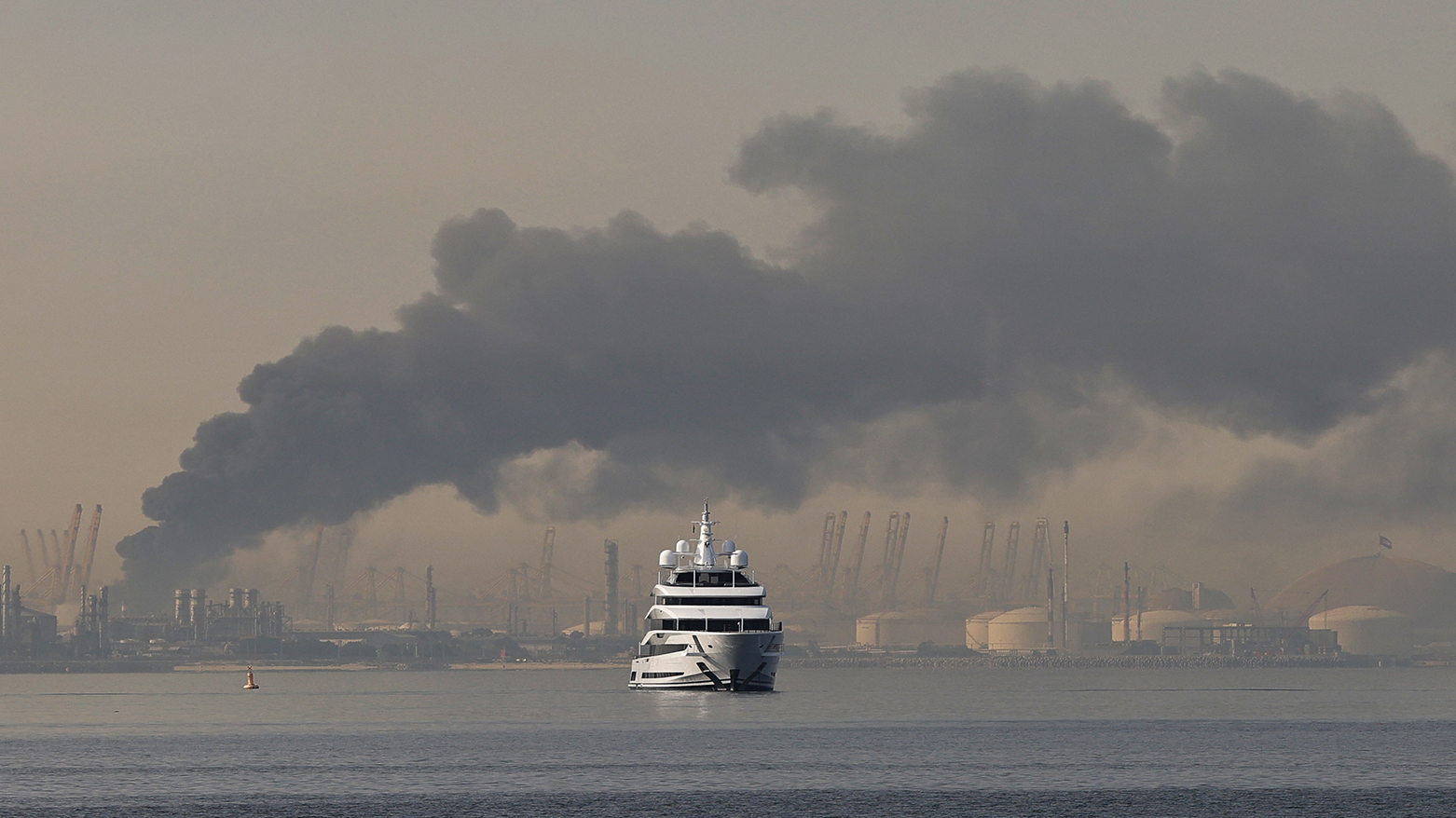
Thick black smoke was visible over southern Doha after strikes targeted U.S. bases in the region in retaliation for U.S. and Israeli attacks that killed Iran’s supreme leader, Ali Khamenei.
In Oman, which has long mediated U.S.–Iran talks, drones struck the commercial port of Duqm, injuring a foreign worker. The Oman News Agency said one drone hit a mobile workers’ accommodation unit while another landed near fuel storage tanks without causing additional casualties.
It marked the first reported attack on the sultanate since Tehran began its retaliatory campaign.
US Embassies Issue Warnings
The U.S. Embassy in Muscat instructed staff and American citizens to shelter in place, citing unspecified “activity” outside the Omani capital.
Similar precautions were issued in Jordan, where the U.S. Embassy in Amman warned personnel to avoid the embassy compound amid concerns it could be targeted.
In Bahrain, the U.S. Embassy in Manama confirmed that the Crowne Plaza Hotel had been struck during Iranian attacks, resulting in injuries.
The embassy urged American citizens to avoid hotels in the capital, warning they could become future targets. An AFP correspondent reported visible damage to the property following explosions.
Strikes Reach Iraq and Israel
In the Kurdistan Region of Iraq, U.S. defense systems intercepted at least two drones over Erbil as sirens sounded at the American consulate. Smoke was seen rising in the sky near the diplomatic compound.
Earlier, Iran’s army said it had targeted U.S. bases in Iraq’s Kurdistan Region.
Air raid sirens also sounded in Tel Aviv, where Israeli air defenses intercepted incoming missiles. At least one fatality has been reported in Israel since Iran began its retaliatory campaign.
Iranian state television said 27 U.S. bases in the region, along with Israeli military headquarters and a defense industries complex in Tel Aviv, were among the targets of missile and drone strikes.
Israeli President Isaac Herzog said Sunday that he hopes the confrontation with Iran will ultimately reshape the region’s future, describing the conflict as a “historic effort” to alter the Middle East’s trajectory.
Speaking while inspecting a site in Tel Aviv struck by an Iranian missile a day earlier, Herzog said the campaign could usher in “a different future, a future of peace,” adding, “We shall overcome and hopefully bring a new era to the Middle East and Iran.”
Regional Militants Signal Alignment
Lebanon’s Hezbollah vowed to confront the United States and Israel over the strikes on Iran. Hezbollah chief Naim Qassem on Sunday said the group would not abandon “the field of honor and resistance,” though it has yet to engage directly in hostilities.
Lebanon’s Prime Minister Nawaf Salam rejected the prospect of his country being drawn into the war.
Palestinian group Hamas also mourned Khamenei, describing his death as a “heinous” U.S.–Israeli attack and crediting him with sustained political and military support for the Palestinian cause.
Its armed wing, the Ezzedine al-Qassam Brigades, called Khamenei the “main supporter of the Resistance Axis.” Islamic Jihad similarly condemned the killing as a war crime.
Leadership Transition in Tehran
Amid the escalating conflict, Iran moved to formalize an interim leadership structure. Ayatollah Alireza Arafi was named to the interim leadership council, which will govern alongside the president and judiciary chief until the Assembly of Experts selects a permanent successor.
The rapidly widening conflict — stretching from the Gulf to Iraq, Israel, and beyond — has heightened fears of a prolonged regional war, with diplomatic channels under strain and civilian populations increasingly exposed to cross-border strikes.