U.S. War Secretary Says Tuesday Marked ‘Most Intense Day’ of U.S. Attacks on Iran
“Our objectives are straightforward,” Hegseth said. “Destroy their missile stockpiles, their missile launchers, and their defense industrial base, missiles and their ability to make them. Two, destroy their navy. And three, permanently deny Iran nuclear weapons forever.”
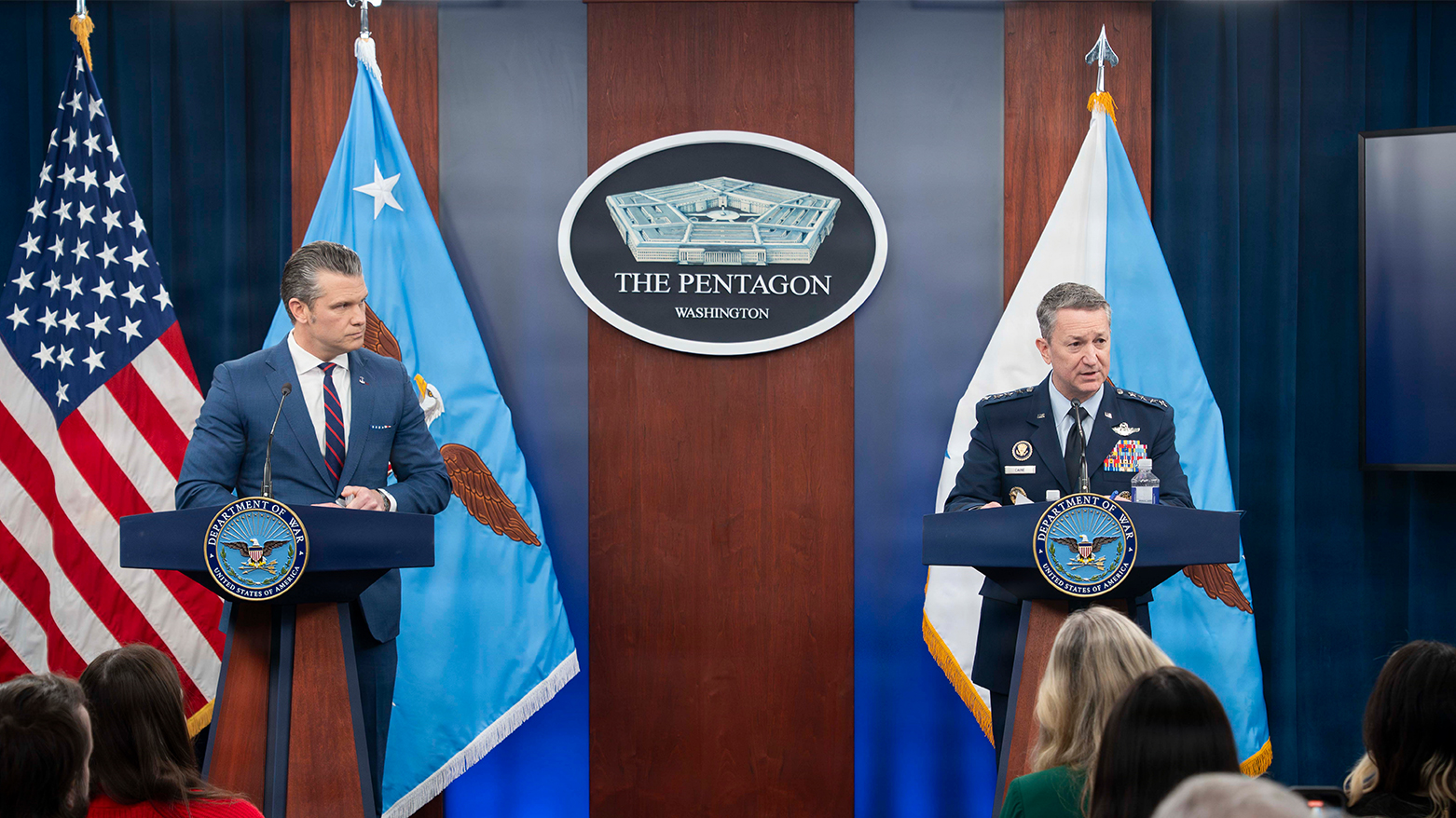
ERBIL (Kurdistan24) - U.S. Secretary of War Pete Hegseth said Tuesday that American forces were conducting what he described as the “most intense day of strikes” inside Iran since the start of Operation Epic Fury, as the Pentagon reported thousands of targets hit and significant reductions in Iranian missile and drone attacks.
Speaking at a press conference at the Pentagon alongside Air Force Gen. Dan Caine, chairman of the Joint Chiefs of Staff, Hegseth said the military campaign—now entering its tenth day—remains focused on destroying Iran’s missile capabilities, weakening its naval forces, and preventing Tehran from acquiring nuclear weapons.
“For example, today will be, yet again, our most intense day of strikes inside Iran,” Hegseth told reporters. “The most fighters, the most bombers, the most strikes, intelligence more refined and better than ever.”
U.S. officials said the operation has targeted Iranian missile infrastructure, naval vessels, and elements of the country’s military and industrial base. According to Caine, U.S. Central Command (CENTCOM) has struck more than 5,000 targets since the campaign began.
The Pentagon briefing provided one of the most detailed updates since the United States launched the operation earlier this month. Officials described the effort as a coordinated air and maritime campaign designed to degrade Iran’s ability to conduct missile and drone attacks across the region.
Caine said the Joint Force remains focused on three central military objectives: destroying Iran’s ballistic missile and drone capabilities, targeting the Iranian Navy to secure maritime routes, and striking facilities connected to the country’s military and industrial infrastructure.
“Continue to destroy Iranian ballistic missiles and drone capability in order to prevent attacks on the U.S. and others throughout the region,” Caine said, outlining the first objective. “This means attacking launch sites, command and control nodes, stockpiles before they can threaten our personnel, our facilities, and our partners.”
The second objective involves striking Iranian naval capabilities to ensure continued maritime traffic through the Strait of Hormuz, a vital global shipping route. The third objective centers on targeting production facilities, research sites, and infrastructure connected to Iran’s military industrial base.
Caine said U.S. forces have employed a range of assets during the operation, including bombers operating under U.S. Strategic Command, fighter aircraft, artillery, and sea-launched missiles.
“U.S. Strategic Command bombers recently dropped dozens of 2,000-pound GPS-penetrating weapons on deeply buried missile launchers across the southern flank,” he said.
In addition to missile launchers, U.S. forces have targeted facilities linked to the production of one-way attack drones, which officials say Iran has used extensively in regional operations.
The Pentagon reported that the strikes have contributed to a substantial reduction in Iranian missile and drone attacks since the start of the campaign.
According to Caine, ballistic missile attacks have decreased by approximately 90 percent compared with levels at the beginning of the operation, while one-way drone attacks have declined by 83 percent.
“Our strikes mean we’ve made significant progress in reducing the number of missile and drone attacks out of Iran,” he said.
He attributed the reductions both to offensive strikes against launch sites and to defensive efforts by U.S. and partner air defense systems in the region.
“Ballistic missile attacks continue to trend downward 90 percent from where they’ve started, and one-way attack drones have decreased 83 percent since the beginning of the operation,” Caine said.
The chairman said regional partners have also assisted with intercepting drones using fighter aircraft and attack helicopters, contributing to the decline in incoming attacks.
The Pentagon also reported progress in operations against Iran’s naval forces. Caine said more than 50 Iranian naval vessels have been targeted during the first ten days of the campaign.
“We’re more than 50 Iranian naval ships into the campaign, using a combination of artillery, fighters, bombers, and sea-launched missiles,” he said.
Among the vessels destroyed was an Iranian drone carrier ship that U.S. forces struck and sank earlier in the operation, according to military officials.
Caine said CENTCOM continues to target vessels capable of laying naval mines as well as storage facilities used to support such operations. These actions, he said, are intended to reduce risks to maritime shipping in the region.
“U.S. CENTCOM continues today to hunt and strike mine-laying vessels and mine storage facilities,” he said.
In addition to naval targets and missile infrastructure, the campaign has expanded to include elements of Iran’s military and industrial network involved in producing weapons systems.
Caine said strikes have focused on “centers of gravity” in the country’s military industry to prevent the production of drones and other capabilities used in regional attacks.
“This means servicing production facilities, research and development sites, and infrastructure,” he said.
Hegseth said the operation is being carried out with what he described as “overwhelming and unrelenting precision,” emphasizing that the mission remains limited to the objectives set by U.S. President Donald Trump.
“Our objectives are straightforward,” Hegseth said. “Destroy their missile stockpiles, their missile launchers, and their defense industrial base, missiles and their ability to make them. Two, destroy their navy. And three, permanently deny Iran nuclear weapons forever.”
Hegseth also said the operation was designed to avoid what he characterized as prolonged military campaigns similar to earlier U.S. interventions in the Middle East.
“This is not 2003,” he said. “This is not endless nation-building.”
He added that the president retains authority over the timing and scope of the campaign, noting that military leaders provide daily updates to support decision-making.
“The president gets to determine the end state of those objectives,” Hegseth said.
When asked about the duration of the air campaign, Hegseth declined to provide a specific timeline, saying decisions about the operation’s pace and length rest with the president.
“Our will is endless,” he said. “Ultimately, the president gets to determine the end state of those objectives.”
The Pentagon briefing also addressed questions regarding Iranian military capabilities and the risks faced by U.S. aircraft operating inside Iranian airspace.
Caine said most of Iran’s higher-end surface-to-air missile systems are no longer significant factors in the conflict.
“Most of their higher-end surface air missile systems are not factors at this point in time,” he said, adding that U.S. fighters have been able to operate deeper into Iranian territory with “relative impunity,” although risks remain.
He noted that the U.S. military maintains the capability to conduct search-and-rescue missions should aircraft be downed during operations.
During the briefing, reporters asked whether there had been progress in assessing damage to Iran’s nuclear infrastructure. Hegseth said evaluations of strikes are ongoing and require time to determine the extent of destruction.
“You’ve got to look at imagery and recognize whether something’s been simply degraded or it’s been destroyed,” he said. “Or whether an underground facility has been collapsed or completely obliterated.”
Battle damage assessments are conducted by the Joint Staff and rely on satellite imagery and other intelligence sources, he said.
Hegseth also addressed reports about the condition of Iran’s newly appointed leader, declining to comment on claims that he may have been wounded.
“As far as his status, that’s not something I can comment on right now,” he said.
The secretary also discussed diplomatic contacts between the United States and other countries during the conflict, including a recent call between President Trump and Russian President Vladimir Putin.
Hegseth said the president maintains relationships with world leaders that could create diplomatic options but did not provide details about any potential involvement by Russia.
“The president said it was a good call,” he said. “Those that were on it said it was a strong call.”
Questions also touched on coordination with Israel, which has conducted separate strikes in Iran during the conflict. Hegseth said Israel has been a “strong partner” while emphasizing that U.S. operations remain focused on American objectives.
“Where they have different objectives, they’ve pursued them,” he said.
Hegseth added that certain strikes attributed to Israel were not part of the U.S. mission.
“That wasn’t necessarily our objective,” he said.
The Pentagon briefing also included remarks honoring several U.S. service members who died during the broader military operations.
Caine said national leaders had gathered at Dover Air Force Base to receive the remains of Major Jeffrey O’Brien and Chief Warrant Officer 3 Robert Marzan of the U.S. Army Reserve’s 103rd Sustainment Command, Staff Sergeant Benjamin Pennington of the U.S. Army’s 1st Space Brigade, and Major Sorfley Davias, who died from a medical condition while on duty in Kuwait.
“To the families of all of our fallen, we share in your profound grief,” Caine said.
The chairman also highlighted the role of U.S. naval personnel supporting carrier strike group operations during the campaign, including flight deck crews responsible for launching and recovering aircraft during combat missions.
“These young sailors are involved with every single movement on the roof on an aircraft carrier,” he said.
Caine said the work of these personnel enables continuous combat sorties during operations conducted day and night.
Throughout the briefing, both officials emphasized the scale of the ongoing military effort and the role of U.S. forces deployed across the region.
Caine said the Joint Force consists of approximately 2.8 million service members and continues to conduct operations despite the challenges of sustained combat deployments.
“Our work continues,” he said.
The Pentagon said Operation Epic Fury remains underway as U.S. forces continue air and maritime operations targeting Iranian military capabilities across multiple areas of the country.
This article was updated on Tuesday, March 10, at 04:16pm.