Baghdad Seeks Deal With KRG to Resume Oil Exports Through Ceyhan Amid War Disruptions
Baghdad is seeking an agreement with the Kurdistan Regional Government to resume exports of Kirkuk crude through the pipeline to Ceyhan, according to reporting by The National.
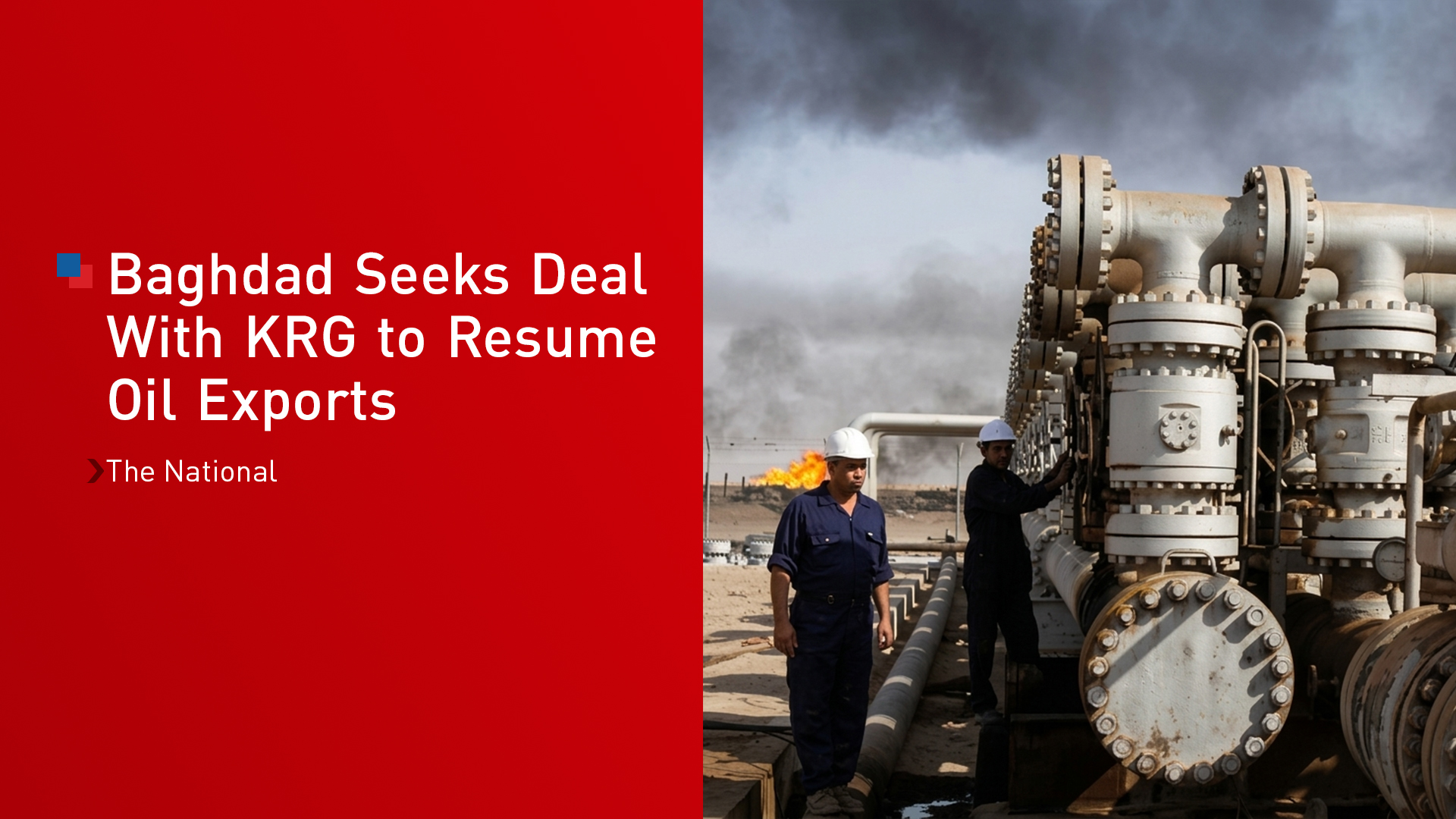
ERBIL (Kurdistan24) - The Iraqi government is seeking an urgent agreement with the Kurdistan Regional Government (KRG) to resume exports of crude from the northern Kirkuk oilfields through pipelines in the Kurdistan Region to the Turkish Mediterranean port of Ceyhan, as authorities attempt to offset billions of dollars in losses caused by war-related disruptions and the suspension of shipments through the Strait of Hormuz, according to reporting by The National.
Officials and analysts told The National that a deal between Baghdad and the Kurdistan Region would allow Iraq to redirect limited volumes of crude through the northern pipeline network, providing partial relief as the country’s principal export infrastructure has been disrupted by the regional conflict involving the United States, Israel, and Iran.
The proposal centers on transporting crude from Kirkuk fields through the pipeline system running across the Kurdistan Region into Türkiye, where the oil would reach the port of Ceyhan on the Mediterranean coast.
According to officials cited by The National, the arrangement could help compensate for a sharp drop in Iraq’s oil output and export capacity following attacks linked to the widening conflict.
Iraq’s Oil Minister, Hayan Abdel-Ghani, said the country’s crude production has fallen to approximately 1.4 million barrels per day. According to statements reported by The National, this figure represents less than one-third of Iraq’s production level before the escalation of hostilities.
The disruption has been driven in part by attacks targeting maritime shipping in southern Iraq. Iranian strikes on oil tankers near the southern export hub of Basra forced authorities earlier in the week to halt operations at the country’s oil terminals, The National reported.
With the closure of southern export routes and continued instability in regional shipping lanes, Iraq faces mounting pressure to find alternative routes to move crude oil to international markets.
Officials and analysts told The National that Iraq’s heavy reliance on oil revenue makes the disruption particularly severe. Oil exports account for roughly 90 percent of the country’s budget and national income.
The government in Baghdad has limited options if exports through the Strait of Hormuz remain suspended or if southern production continues to face disruptions. Under those conditions, the Iraq–Türkiye pipeline system represents the most immediate alternative route capable of transporting crude outside the Gulf.
According to The National, the Iraqi Oil Ministry formally approached the Kurdistan Regional Government earlier last week with a request to pump at least 100,000 barrels per day from the Kirkuk oilfields through existing pipelines to Ceyhan.
Kurdish officials involved in the negotiations told The National they are open to reaching an agreement, but said any arrangement must address economic measures imposed by Baghdad on the Kurdistan Region earlier this year.
A senior Kurdish official told The National that the KRG has proposed an arrangement under which it would facilitate exports from Kirkuk and fields within the Kurdistan Region, provided that Baghdad lifts a U.S. dollar embargo imposed on the region two months ago and restores revenue flows linked to regional trade.
“We want a deal. We’ve been realistic about the war and the pressure it will place on the country’s finances. Iraq is already feeling the liquidity crunch,” the Kurdish official told The National.
The official said the Kurdistan Regional Government had submitted what he described as a “sound, realistic proposal on the table over a week ago.”
“We’ve made clear to Baghdad and our U.S. partners that the KRG wants to help export oil from fields in Kirkuk and the Kurdistan Region. But this embargo must be lifted first,” the official said.
The negotiations revolve around the pipeline network commonly referred to as the Kirkuk–Ceyhan oil pipeline, also known as the Iraq–Türkiye crude oil pipeline. The system extends roughly 970 kilometers from the northern Iraqi oilfields around Kirkuk to the Mediterranean export terminal in Ceyhan.
For decades, the pipeline has served as Iraq’s principal northern export route for crude oil.
Flows through the Kurdistan Region to Ceyhan resumed in September 2025 after a suspension lasting more than two years. The halt followed a ruling by an arbitration court in Paris that found earlier Kurdish exports conducted independently of Baghdad to be in violation of Iraq’s federal authority over oil sales.
The current negotiations have revived discussions about cooperation between Baghdad and Erbil in managing northern oil flows, though political disagreements between the two sides remain unresolved.
Officials familiar with the talks told The National that Baghdad may need to adopt what one Kurdish negotiator described as a pragmatic approach to the crisis.
“Baghdad must be pragmatic too — an interim arrangement through this crisis until the broader dispute is settled,” the Kurdish official said.
If an agreement is reached, exports through the pipeline would not fully replace the volumes historically shipped from southern Iraq. However, Kurdish officials said the route represents the most feasible short-term option.
Another Kurdish official told The National that the northern pipeline could serve as “the most realistic partial alternative to maintain some level of exports.”
Analysts cited in the report also cautioned that the arrangement would only provide limited relief.
Yesar Al Maleki, a Gulf analyst at the Middle East Economic Survey, told The National that the proposed Kirkuk-to-Ceyhan exports would represent only a small fraction of Iraq’s normal oil shipments.
According to Al Maleki, the 100,000 barrels per day proposed for export through the northern route would amount to roughly 6 percent of the 3.3 million barrels per day shipped from Basra in February.
“Ultimately, these measures may restore limited export capacity, but they cannot compensate for the loss of Basra exports,” Al Maleki told The National.
“There is no viable infrastructure currently capable of redirecting large volumes of southern crude to other routes,” he said.
The analyst also noted that diverting Kirkuk crude to export markets could create supply shortages for domestic industries.
“Diverting Kirkuk crude for export risks depriving refineries and power plants in Iraq of critical feedstock,” Al Maleki said.
To offset those shortages, oil would have to be transported from Basra to northern Iraq, but questions remain about whether the country’s pipeline infrastructure can move sufficient volumes from south to north.
Beyond technical constraints, political considerations also complicate the arrangement.
“Baghdad would need to reach an agreement with Erbil to use the Kurdistan pipeline, which is currently the only operational segment of the Iraq–Türkiye Pipeline inside Iraqi territory,” Al Maleki said.
The challenges facing Iraq’s oil sector reflect broader disruptions triggered by the regional conflict.
According to The National, Iranian attacks on oil tankers near Basra earlier in the week forced Iraqi authorities to suspend operations at all of the country’s southern oil terminals.
The strikes occurred as the confrontation between the United States and Israel on one side and Iran on the other has expanded across multiple parts of the Middle East.
The impact of the conflict has extended beyond energy infrastructure, with security incidents also affecting diplomatic and military facilities in Iraq.
Security officials told The National that a missile struck the compound housing the United States Embassy in Baghdad on Saturday morning, producing visible smoke above the facility. Other reports cited by the outlet said a missile struck a helipad within the embassy compound.
The attack followed strikes that reportedly killed several Iran-aligned militia fighters in the Iraqi capital hours earlier.
According to The National, U.S. military installations in Baghdad and near Erbil International Airport, along with American diplomatic facilities across Iraq, have been targeted repeatedly since the war began on February 28.
The broader escalation has placed Iraq in a complex position as it attempts to manage economic pressures while avoiding deeper involvement in the regional conflict.
Renad Mansour, director of the Iraqi Initiative at the Chatham House think tank in London, told The National that Iraq has been caught off guard by the scale and pace of the confrontation.
“The only way to survive this hit on its oil infrastructure is by exploring different options through the Kurdistan region or through Syria,” Mansour said.
He added that both alternatives involve significant technical and political complications.
According to Mansour, the Iraqi government had not developed contingency plans for a conflict of this magnitude.
“Baghdad's central government has no plan or scenario or contingency for this war and as a consequence it has had significant hits to its infrastructure,” he said.
The effects of the conflict could extend beyond oil infrastructure if disruptions to supply chains continue.
Mansour told The National that ongoing attacks could affect the delivery of essential goods across the country.
“It is not only the oil tankers that have been hit, but also medicine, food and daily needs will soon be unable to reach Iraqis, and if it does, it will present many challenges,” he said.
Officials also acknowledged that Iraq previously explored alternative export routes that might have reduced the country’s dependence on Gulf shipping lanes.
One Iraqi official told The National that Baghdad had considered constructing a pipeline connecting southern oil fields to the Jordanian port of Aqaba on the Red Sea.
The project would have allowed Iraq to export crude without passing through the Strait of Hormuz, but the initiative stalled due to funding constraints and security concerns.
“However, due to the lack of vision by the government we failed to reach consensus on that. It was a missed opportunity,” the Iraqi official said.
Alternative measures currently under discussion include transporting oil by road to Aqaba using tankers or trucks, though officials say such arrangements would require complex logistical coordination with authorities in the Kurdistan Region as well as neighboring countries including Jordan, Syria, and Türkiye.
Analysts cited by The National said these proposals remain preliminary and would not be capable of handling the scale of exports normally shipped through Basra.
For now, the Kirkuk–Ceyhan pipeline remains the most immediate alternative route available to Iraq, though its use depends on reaching an agreement between Baghdad and the Kurdistan Regional Government.
Officials told The National that negotiations are continuing as Iraq seeks to restore some level of crude exports amid ongoing disruptions to its southern oil infrastructure.