Dams at Capacity: Kurdistan Region Harvests Record Rainfall Into Strategic Reserves
The KRG asserts its water management policies have successfully captured over 11 billion cubic meters of precipitation, ensuring critical reserves for agricultural and municipal use.
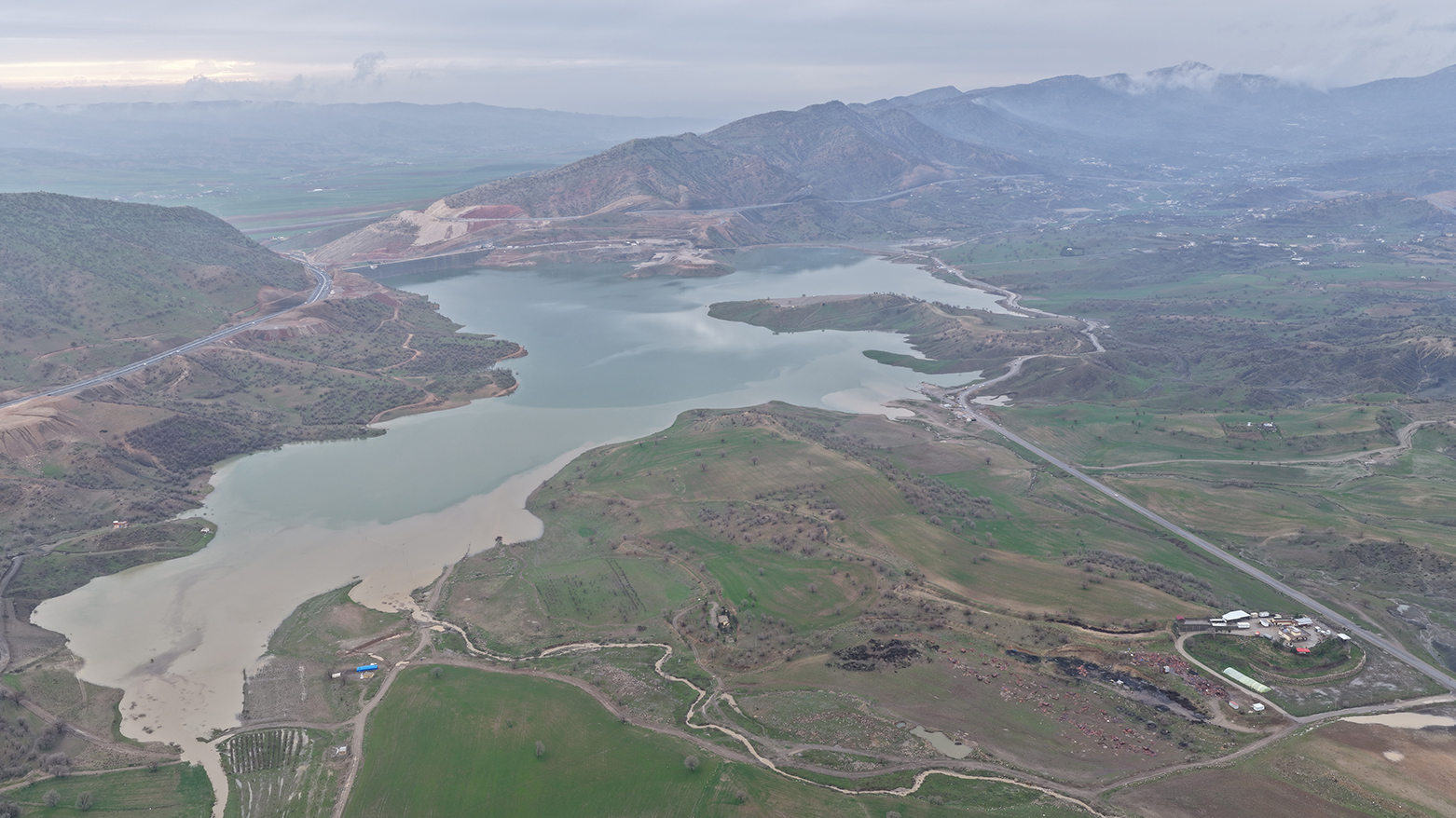
ERBIL (Kurdistan24) - Regional authorities stated this week that the Kurdistan Regional Government succeeds in its water resource management plan, pointing to the collection of more than 11 billion cubic meters of water across regional infrastructure as evidence of effective environmental policy implementation.
The government's water strategy centers on capturing seasonal precipitation through a centralized network of major dams and a decentralized system of targeted water ponds to ensure long-term resource stability.
In a semi-arid region where climatic variability frequently threatens water security, the ability to harvest and store winter rainfall is a critical governance priority necessary for maintaining year-round agricultural and municipal operations.
According to the KRG Ministry of Agriculture and Water Resources, the strategy's reported success is measured by the current volume of the region's primary reservoirs, several of which have reached maximum capacity.
Officials noted that extensive infrastructure developments have allowed the region to maximize the retention of this year's exceptionally high rainfall.
These collected water reserves are designed to act as a buffer against drought.
The government states that the stored billions of cubic meters will directly support agricultural sectors, replenish depleted groundwater systems, and secure drinking water supplies for the upcoming year, highlighting the broader economic and environmental implications of the regional water management framework.
Infrastructure Development and Policy Implementation
To execute its water management objectives, the KRG has prioritized resource preservation by focusing on the construction, expansion, and maintenance of 23 large and medium-sized dams.
This macro-infrastructure is supported by a growing network of smaller water ponds designed to capture runoff across varying topographies and rural districts.
Karwan Sabah Hawrami, Director General of Water Resources in the KRG, outlined the historical and recent expansion of this secondary infrastructure.
"Previously, 118 ponds were built over an area of 479,364 dunams, with a total storage capacity of more than 22 million cubic meters," Hawrami told Kurdistan24.
To further optimize water harvesting, the government has accelerated the approval and construction of additional facilities.
"Under the KRG's Ninth Cabinet, approval was granted for an additional 41 ponds—some of which have been completed while others are under construction," Hawrami added.
Institutional reports indicate that all recently completed ponds have reached maximum capacity this year.
The integration of these localized ponds serves as a crucial policy tool for environmental management, allowing for distributed groundwater replenishment and providing immediate agricultural relief without forcing rural areas to rely solely on the major provincial dams.
Reservoir Capacity and Storage Metrics
The primary indicators of the policy's reported success are the volume metrics generated by the region's largest reservoirs.
Rahman Khani, Director General of Dams and Reservoirs at the KRG Ministry of Agriculture and Water Resources, provided an overview of current storage levels, confirming the accumulation of more than 11 billion cubic meters across all facilities.
The Dokan Dam, the largest in the region with a maximum storage capacity of 6.8 billion cubic meters, is currently operating at 87 percent capacity.
Khani noted that the reservoir's water level requires an increase of approximately 3.3 meters to reach absolute capacity and begin overflowing.
Other critical infrastructure has already exceeded total retention thresholds.
The Darbandikhan Dam, which holds a capacity of 3 billion cubic meters, is completely full and actively overflowing. The Duhok Dam, possessing a 52 million cubic meter capacity, has also reached its overflow point.
Newly commissioned infrastructure has similarly contributed to the total collected volume.
The Gomaspan Dam, ranked as the third-largest dam in the Kurdistan Region, initiated water storage operations this year.
Designed to collect up to 115 million cubic meters of rainwater, it currently holds between 25 and 26 million cubic meters.
Additionally, the Bastora Dam, a 30-meter-high structure with a 20 million cubic meter capacity, currently retains 15 million cubic meters and is overflowing, according to ministry records.
Hawrami emphasized the practical socioeconomic outcomes of these metrics. "In general, most other dams in the Kurdistan Region are currently overflowing, which is good news for farmers, tourists, and the provision of drinking water for the coming year," he said.
Meteorological Data and Environmental Context
The high retention rates are directly correlated with significant precipitation levels recorded across the region.
Fazil Ibrahim, Director General of the General Directorate of Meteorology and Seismology of the Kurdistan Region, provided comprehensive data detailing the environmental conditions that tested the region's water management framework.
At the provincial level, Halabja recorded the highest volume of rainfall this year, receiving 1,109.3 millimeters. Sulaimani Province followed with 1,052.4 millimeters.
Duhok Province recorded 896.4 millimeters, while Erbil and Kirkuk provinces registered 718.5 millimeters and 392.5 millimeters, respectively.
The meteorological data also revealed intense precipitation concentrations in mountainous and district-level areas, which serve as the primary catchment zones for the regional dams.
The Mergasor district in Erbil Province recorded the highest rainfall in the entire Kurdistan Region, reaching nearly 2,200 millimeters, officially logged at 2,194 millimeters.
Other districts experienced similarly heavy rainfall, heavily impacting regional water flows.
Sheladeze recorded 1,925 millimeters, followed closely by Chwarta at 1,858 millimeters and Dinarta at 1,800.5 millimeters. Penjwen registered 1,758 millimeters, while Barzan and Tawela recorded 1,652.4 millimeters and 1,378.9 millimeters, respectively.
The alignment of this meteorological data with the current capacity of the region's dams forms the basis of the government's claim of effective resource management, demonstrating the capacity of the infrastructure to successfully capture and store extreme seasonal precipitation.