Gulf Leaders Urge U.S. to Degrade Iran’s Military Capacity Fully
Gulf states urge the U.S. to sustain pressure on Iran, warning that leaving its capabilities intact threatens regional security and oil flows, as fighting intensifies and the Strait of Hormuz remains effectively closed.
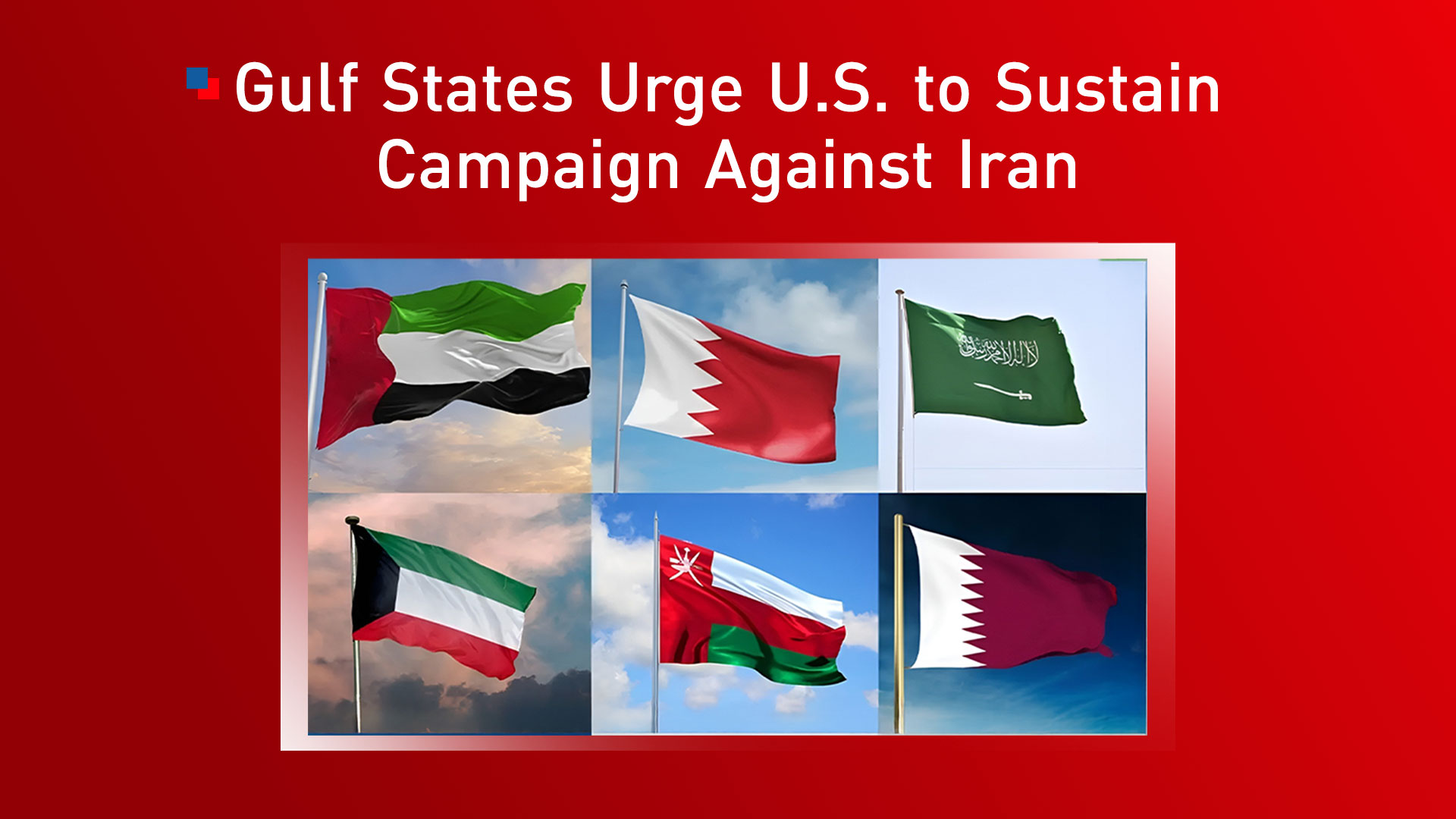
ERBIL (Kurdistan24) - Gulf Arab states are urging the United States not to halt military operations against Iran before significantly degrading its capabilities, citing recent Iranian attacks on regional infrastructure and the continued disruption of shipping through the Strait of Hormuz, according to multiple Gulf sources and Western diplomats cited by Reuters. The call comes amid ongoing U.S.-Israeli strikes on Iranian military sites and Tehran’s retaliatory actions targeting Gulf oil facilities, ports, and airports.
Three Gulf sources told Reuters that while regional governments did not initially request war, there is now a prevailing view that the United States should not leave Iran with sufficient offensive capacity to threaten the Gulf’s oil lifeline. At the same time, five Western and Arab diplomats said Washington has been pressing Gulf countries to join the U.S.-Israeli campaign. Three diplomats indicated that President Donald Trump seeks regional backing for the operation to bolster international legitimacy and domestic support.
“There is a wide feeling across the Gulf that Iran has crossed every red line with every Gulf country,” Abdulaziz Sager, chairman of the Saudi-based Gulf Research Center, told Reuters. “At first we defended them and opposed the war. But once they began directing strikes at us, they became an enemy. There is no other way to classify them.”
Iran has already demonstrated its regional reach, carrying out missile and drone attacks on airports, ports, oil facilities, and commercial hubs across the six Gulf states, while also disrupting shipping through the Strait of Hormuz, a vital waterway carrying roughly one-fifth of global oil supplies. The attacks, according to Reuters, have heightened concerns among Gulf leaders that leaving Iran with significant offensive weapons or arms manufacturing capacity could enable it to hold the region’s energy infrastructure hostage during future crises.
As the conflict entered its third week, with U.S. and Israeli airstrikes intensifying and Iran targeting U.S. bases and civilian sites throughout the Gulf, a Gulf source told Reuters that leaders are widely agreed that Trump should comprehensively degrade Iran’s military capacity. “The alternative,” the source said, “is living under constant threat. Unless Iran is severely weakened, it would continue to hold the region to ransom.”
Predominantly Shi’ite Iran has historically viewed its Sunni Arab neighbors—many of which host U.S. military bases—with suspicion, although relations with Qatar and Oman have been comparatively less strained. Over the years, Iran and its regional allies have been accused of attacks on Gulf energy installations, including the 2019 strike on Saudi Arabia’s Abqaiq and Khurais oil facilities, which halved Saudi output and rattled energy markets. Iran denied responsibility for that incident.
For Gulf leaders, inaction now carries heightened risks. Reuters reported that the recent attacks have not only disrupted oil flows but also undermined a carefully cultivated image of stability and security that Gulf states have relied upon to expand trade, tourism, and economic diversification away from fossil fuel dependency. Sager noted, “If the Americans pull out before the task is complete, we’ll be left to confront Iran on our own.”
The White House has said that the United States is working to curtail Iran’s military capabilities. Officials stated that the U.S. is “crushing (Iran's) ability to shoot these weapons or produce more” and confirmed that Trump is “in close contact with our partners in the Middle East,” Reuters reported.
Of the Gulf countries, only the United Arab Emirates publicly responded to inquiries about involvement in the conflict. The UAE affirmed that it “does not seek to be drawn into conflicts or escalation” but reserved the right to “take all necessary measures” to protect its sovereignty, security, and residents, Reuters noted.
Sources in the region told Reuters that unilateral military action by any Gulf state remains unlikely, as coordinated intervention would be required to limit exposure to retaliation. Consensus within the Gulf Cooperation Council, composed of Bahrain, Kuwait, Qatar, Saudi Arabia, Oman, and the UAE, has been limited. The six members have held only one virtual meeting, and no Arab summit has been convened to discuss coordinated responses.
Gulf leaders remain wary of triggering a wider conflict. U.S. Defense Secretary Pete Hegseth stated that Gulf partners were “stepping up even more” and willing to “go on the offense” while collaborating with Washington on integrated air defense systems, although he did not specify additional measures, Reuters reported. A senior UAE official confirmed that the country had exercised restraint after Iran claimed that U.S. forces used Emirati territory to strike Kharg Island, Iran’s main oil export terminal.
Sager indicated that Saudi Arabia, Iran’s principal regional rival, could be compelled to retaliate if Iran crosses certain thresholds, including strikes on major oil or desalination facilities or attacks causing significant casualties. “In that case, Saudi Arabia would have no choice but to intervene,” Sager said. He added that Riyadh would attempt to calibrate any response to avoid further escalation.
Experts have characterized the Gulf states’ position as a strategic dilemma. Fawaz Gerges of the London School of Economics told Reuters that the immediate threat of Iranian attacks must be balanced against the risk of being drawn into a U.S.-led war. Joining the campaign, Gerges noted, would add little to Washington’s military advantage while sharply increasing exposure to Iranian reprisals. Gulf governments are reportedly pursuing “calculated restraint,” focusing on defensive measures while signaling red lines without directly engaging in a war they did not initiate.
Iran’s leverage in the region is evident in its control over maritime traffic through the Strait of Hormuz. Bernard Haykel, professor of Near Eastern studies at Princeton University, said Iran has effectively determined which vessels can transit the waterway. “Now that Iran has shown it can shut down Hormuz, the Gulf faces a fundamentally different threat,” Haykel told Reuters. “If it’s not addressed, this danger will be long-term.”
Trump has called for the formation of an international coalition to secure the strait, though early outreach produced limited results. Haykel suggested that, given the bulk of Gulf oil and gas flows eastward to China, Japan, and other Asian markets, those countries may also bear responsibility for securing maritime routes. “China helped secure maritime routes off Somalia; it may be willing to step in here too,” he said.
Amid the escalation, Iran has simultaneously urged Muslim-majority nations to unite with Tehran against the United States and Israel. Ali Larijani, head of the Supreme National Security Council of Iran, criticized Islamic governments for insufficient support during the ongoing conflict. In a statement posted on X, Larijani labeled U.S. and Israeli operations as a “deceptive American-Zionist aggression” against Iran while diplomatic negotiations were ongoing.
Larijani said the attacks resulted in the deaths of the senior leader of the Islamic Revolution along with civilians and military commanders but argued that Iranian resistance has been “solid national and Islamic resistance.” He expressed frustration with what he described as limited backing from other Muslim-majority states, asserting that, with rare exceptions, governments had not gone beyond issuing political statements. Citing a saying attributed to the Prophet Muhammad, Larijani wrote, “He who hears a man calling ‘O Muslims’ and does not answer him is not a Muslim,” urging governments to reconsider their positions in the conflict.
The Iranian official also criticized states hosting American military bases in the region, framing Tehran’s strikes on such installations as acts of self-defense. “Is Iran expected to stand idly by while American bases in your countries are used to attack it?” he wrote, calling such arguments “flimsy excuses.” Larijani characterized the confrontation as a broader struggle between the United States and Israel on one side and “Muslim Iran and the forces of resistance” on the other, urging Islamic governments to determine their stance.
Larijani concluded by advocating greater unity among Muslim nations, asserting that closer cooperation could “ensure long-term security, development, and independence from foreign influence,” according to the statement. The remarks reflect Iran’s attempt to rally political and ideological support as hostilities with the United States and Israel continue to intensify.
The U.S.-Israeli military campaign has included strikes on Iranian military facilities and infrastructure, prompting Tehran to retaliate against regional targets linked to Washington and its allies. The continued disruption in the Strait of Hormuz has limited tanker traffic, affecting global energy markets. NBC News reported that the strait remains effectively closed, with U.S. officials noting that commercial shipping companies have requested naval escorts. Gen. Dan Caine, chairman of the Joint Chiefs of Staff, said safe passage remains complex to guarantee.
U.S. military planning incorporates options to end or escalate the conflict, with scenarios embedded in daily operational planning. White House press secretary Karoline Leavitt said a four- to six-week timeline had been outlined for military objectives, while officials acknowledged that the duration remains uncertain. U.S. and Israeli forces have carried out strikes on Kharg Island, and additional drone and missile activity has been reported across Saudi Arabia, Dubai, Kuwait, and Oman. Iraq suspended operations at its oil terminals following attacks on tankers, Reuters and NBC News reported.
Efforts to build an international coalition to secure the Strait of Hormuz have encountered resistance. Axios reported that some U.S. allies, including European Union members, have declined to commit naval forces, with EU foreign policy chief Kaja Kallas stating, “there is no appetite” for participation. The United Kingdom circulated a draft plan for a multinational task force, though discussions remain inconclusive.
U.S. Defense Department officials said Iran’s military capabilities have been degraded by the ongoing campaign. Hegseth said Tehran’s capacity was “crumbling,” according to NBC News, while intelligence assessments indicate that Iran’s governing structure remains intact.
The conflict has had notable economic implications. The International Energy Agency warned that the disruption represents “the largest supply disruption in the history of the global oil market,” according to NBC News, with oil prices rising and global markets experiencing uncertainty. Diplomatic measures have included U.S. Secretary of State Marco Rubio directing diplomats to encourage allied governments to designate Iran’s Islamic Revolutionary Guard Corps and Hezbollah as terrorist organizations. The guidance emphasized that joint international pressure is more likely to compel Tehran to alter behavior than unilateral actions.
Trump publicly expressed dissatisfaction with some partner countries’ limited engagement, stating that he was “greatly disappointed” by the lack of enthusiasm, Axios reported. The administration also sought to address concerns about escalation, with Trump asserting that Israel would not deploy nuclear weapons against Iran. Adviser David Sacks had raised potential escalation issues in a podcast, prompting the clarification.
As hostilities continue, Gulf states continue urging the United States to sustain pressure on Iran, balancing regional security concerns with the risks of direct involvement. Military, economic, and diplomatic factors remain intertwined as the conflict persists across multiple fronts.