Newroz: The Flame of Freedom Igniting Kurdish Identity and Resilience
Newroz is marked with bonfires and gatherings across Kurdistan communities, reflecting a centuries-old tradition tied to renewal, identity and resistance.
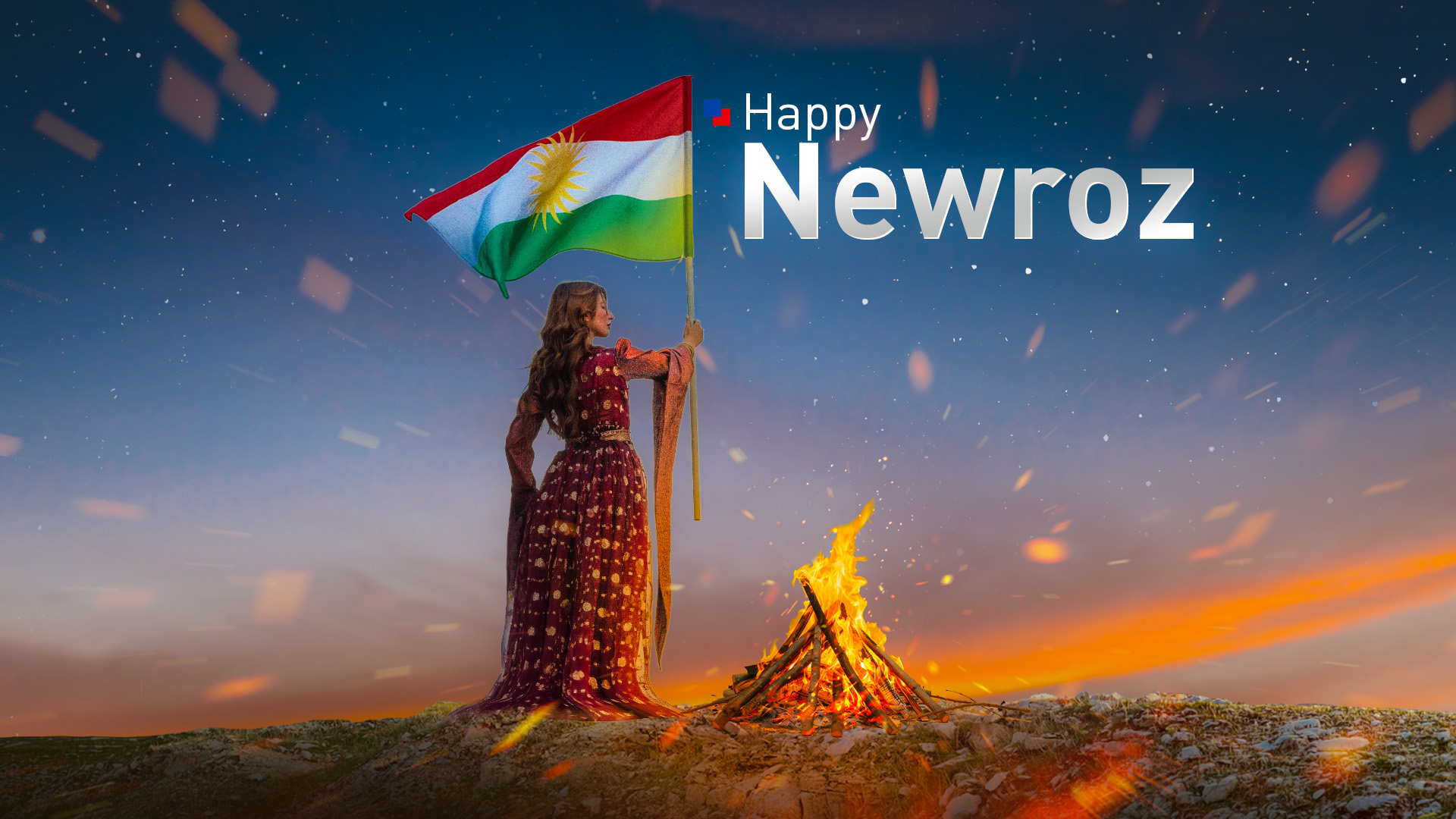
ERBIL (Kurdistan24) - As the sun sets on the hills surrounding Akre in the Kurdistan Region, as the designated capital of Newroz, thousands gather each March, their faces illuminated by towering bonfires that pierce the twilight. Torches carried by young people snake up mountain paths, fireworks crackle overhead, and circles of dancers link arms in rhythmic govend steps (govend is one of the many Kurdish words for dance) to the beat of traditional drums and zurna.
This is Newroz, the Kurdish New Year, not merely a seasonal marker but a profound reaffirmation of survival, resistance, and renewal for a people long divided by borders and adversity. In 2026, as in centuries past, the festival underscores the unbreakable thread of Kurdish cultural memory, where the victory of light over darkness echoes the lived struggles of a nation without a state.
For the Kurdish people, Newroz—meaning “new day” in Kurdish—transcends the shared spring equinox celebrations observed across the broader Indo-Iranian cultural sphere.
While Nowruz or similar festivals mark renewal for Persians, Tajiks, Afghans, and others, the Kurdish interpretation is indelibly tied to a narrative of liberation from tyranny, forged in the fires of resistance.
Official communications from the Kurdistan Regional Government (KRG) emphasize this distinction, framing Newroz as a holiday celebrated by Kurds for more than 2,700 years, embodying hope, unity, and freedom from oppression. It is the Kurdish New Year, an official multi-day holiday in the Kurdistan Region, where President Masoud Barzani, Kurdistan Region's President Nechirvan Barzani, Prime Minister Masrour Barzani and other leaders routinely participate in massive public gatherings to honor its enduring meaning.
At the heart of this Kurdish perspective lies the legend of Kawa the Blacksmith, a foundational myth preserved in Kurdish oral tradition, poetry, and collective memory.
According to the narrative upheld in Kurdistan, an ancient tyrant—often identified in Kurdish lore as the king Zahak (or Dehak/Zuhak)—ruled with cruelty, his shoulders sprouting serpents that demanded daily sacrifices of children’s brains to sustain them. The land fell into eternal winter, symbolizing despair and subjugation. Kawa, a humble Kurdish blacksmith, lost 16 of his 17 sons to this horror. Spared the final sacrifice through a shepherd’s substitution of sheep brains, Kawa vowed revenge. He forged weapons in secret, rallied parents whose children had been taken, trained an army in the mountains, and led a revolt that culminated on the eve of the spring equinox. With his hammer, Kawa struck down Zahak, ending the reign of terror. He then climbed the highest peak and lit a bonfire, its flames signaling victory to the oppressed people below. Bonfires spread across the land, melting the winter and heralding spring, freedom, and a new era.
This legend links directly to the Median Empire—widely regarded in Kurdish historiography as ancestral to the Kurds—around the 7th century BCE. Academic research from within the Kurdistan Region, including studies by scholars like Hewa Salam Khalid of Koya University, underscores how the Kawa story evolved in Kurdish cultural memory from a shared mythological motif into a potent symbol of national awakening.
Unlike the Persian emphasis on cultural renewal and figures like the legendary king Jamshid, the Kurdish version foregrounds Kawa as a hero of the people, his blacksmith’s hammer representing the agency of the oppressed.
As Khalid’s comparative analysis in the Journal of Ethnic and Cultural Studies (2020) notes, drawing on qualitative interviews and local sources such as Anwar’s Kurds and the History of the Newroz Feast, “For the Kurds who are a stateless nation, besides its cultural background, Newroz is a symbol of resistance while for Persians it is a pure cultural festival.”
Their calendars, myths, and observances diverge, with the Kurdish narrative prioritizing themes of revolt against assimilation and tyranny.
This symbolism has propelled Newroz to the core of Kurdish national consciousness, particularly in the modern era.
Emerging as a political and socio-cultural force in the 20th century amid repression across Türkiye, Iran, Syria, and even under earlier regimes in Iraq, the festival became a vehicle for asserting identity. In the Kurdistan Region, where it is freely and exuberantly celebrated, Newroz functions as a unifying national day. KRG leaders have repeatedly articulated its political depth.
President Masoud Barzani has described it as “a new beginning, fresh hope, and victory over oppressors and hardships,” highlighting how this occasion has taken deep root in the history of the people of Kurdistan "as a rich culture of perseverance and struggle to achieve freedom and peace.” Such statements, disseminated through official KRG channels, reinforce its role in fostering socio-political cohesion, honoring Peshmerga fighters, martyrs, and the collective aspiration for peace and prosperity.
Kurdistan Region President Nechirvan Barzani, in his Newroz message, described the Kurdish New Year as a “profound expression of a history filled with struggle and epics of resilience by a nation that has always resisted oppression with a strong will and has never surrendered.” He noted that the festival symbolizes both “the defeat of darkness and the renewal of life,” framing it as an enduring marker of Kurdish perseverance and a historical testament to the continuity of freedom within the region.
“I hope this Newroz becomes the start of a phase full of peace and comfort in the lives of the people of Kurdistan and marks the end of war and hardship in the region and the world in general,” Prime Minister Masrour Barzani stated in his 2026 Newroz message.
Across geographically fragmented Kurdish populations—spanning the Kurdistan Region of Iraq, Northern Kurdistan (southeastern Türkiye), Eastern Kurdistan (northwestern Iran), and Western Kurdistan (northeastern Syria)—Newroz serves as a rare common thread.
In areas where open expression has faced historical constraints, the festival has embodied defiance. Kurdish communities in Türkiye and Syria have transformed celebrations into affirmations of rights, even when public displays carried risks. Recent developments, including the designation of Newroz as a national holiday in Syria under post-2025 governance shifts recognizing Kurdish identity and language, illustrate its evolving resonance in geopolitics.
In Iran, public observances continue as subtle acts of cultural assertion.
The diaspora, numbering millions in Europe, North America, and beyond, amplifies this unity. Events at the U.S. Capitol organized with KRG representation feature traditional music, dance, and speeches that spotlight Kurdish heritage while advocating for broader recognition. In cities like Cologne, Germany, gatherings draw tens of thousands from all parts of Kurdistan, transcending political divisions through shared rituals.
Traditional modes of celebration remain vibrant, blending ancient symbolism with contemporary expressions.
In the Kurdistan Region, families don colorful Kurdish attire—often incorporating the red, white, and green of the Kurdish flag—before heading to parks or mountains for picnics.
Dishes like dolma (stuffed vegetables) and kofta (meatballs) are prepared in abundance, accompanied by seeds and snacks shared throughout the day.
As evening falls, bonfires blaze in villages and cities, their flames symbolizing life, rebirth, and the victory of Kawa. Elders recount legends around the fire, children play games like dama, and spontaneous circles of dancers form, hands linked in solidarity.
The KRG’s Austrian representation vividly captures this: “Newroz is every year a defining moment for Kurds, and this is the opportunity to show traditional clothing.” Outdoor gatherings emphasize reconnection with nature as winter yields to spring, with singing, storytelling, and laughter extending into the night.
Contemporary adaptations enhance accessibility and visibility.
In the Kurdistan Region, Akre—often called the “capital of Newroz”—hosts spectacles with fireworks, torch processions ascending hillsides, and performances drawing international attention. The KRG declares official holidays spanning several days, allowing widespread participation.
In the diaspora, satellite television, social media, and community organizations broadcast live events, ensuring even those far from the homeland can partake. These practices not only preserve culture but actively transmit it to younger generations, countering assimilation pressures.
A Lund University ethnographic thesis on Kurdish identity maintenance in Sweden highlights Newroz as a “ritual of belonging,” where performative elements—dance, attire, and fire-lighting—create liminal spaces of unity and resistance, producing a sense of collective ethnicity amid hybrid identities.
The festival’s function as a unifying symbol proves especially potent in divided contexts. Kurds, the largest stateless nation with an estimated 30-40 million people across four countries and the diaspora, find in Newroz a shared calendar unbound by political borders.
It bridges linguistic dialects, political affiliations, and generational gaps, fostering what scholars term “Kurdayetî”—Kurdishness—as both cultural heritage and forward-looking aspiration. In an era of regional flux, including post-conflict reconstruction in Iraq and evolving dynamics in Syria, Newroz resonates as a platform for cultural diplomacy.
KRG-hosted events in Washington, London, and European capitals showcase artistic performances that educate global audiences on Kurdish contributions while subtly advancing narratives of resilience and self-determination.
In modern geopolitical and cultural contexts, Newroz garners increasing international acknowledgment, even as Kurds carefully safeguard its distinct dimension.
The broader Nowruz festival was inscribed on UNESCO’s Intangible Cultural Heritage list in 2010 and designated as International Nowruz Day by the United Nations, recognizing its multinational observance.
Yet Kurdish voices, through KRG advocacy and academic discourse, insist on its unique symbolism of liberation. This distinction avoids appropriation while celebrating shared Indo-Iranian roots.
Globally, the festival’s resonance extends beyond ethnicity: it inspires solidarity movements, appearing in literature, art, and advocacy for minority rights. For Kurds, it remains a living emblem of endurance—Kawa’s hammer striking not just an ancient tyrant but every form of oppression encountered since.
As bonfires dim and spring fully blooms, Newroz leaves an indelible mark. It reminds the Kurdish people—and the world—that identity persists through fire and festival, not despite division but because of the collective will to overcome it. In the Kurdistan Region and far beyond, the flames continue to burn, illuminating a path toward renewal, unity, and an unyielding commitment to freedom.
For a nation forged in resilience, Newroz is not just a holiday; it is the heartbeat of a people’s enduring story.