U.S. Senator Says Iran Unable to Confront American Forces Directly, Turns to Regional Targets
Tim Kaine condemns attacks on Kurdistan Peshmerga, links escalation to Tehran’s strategic limitations
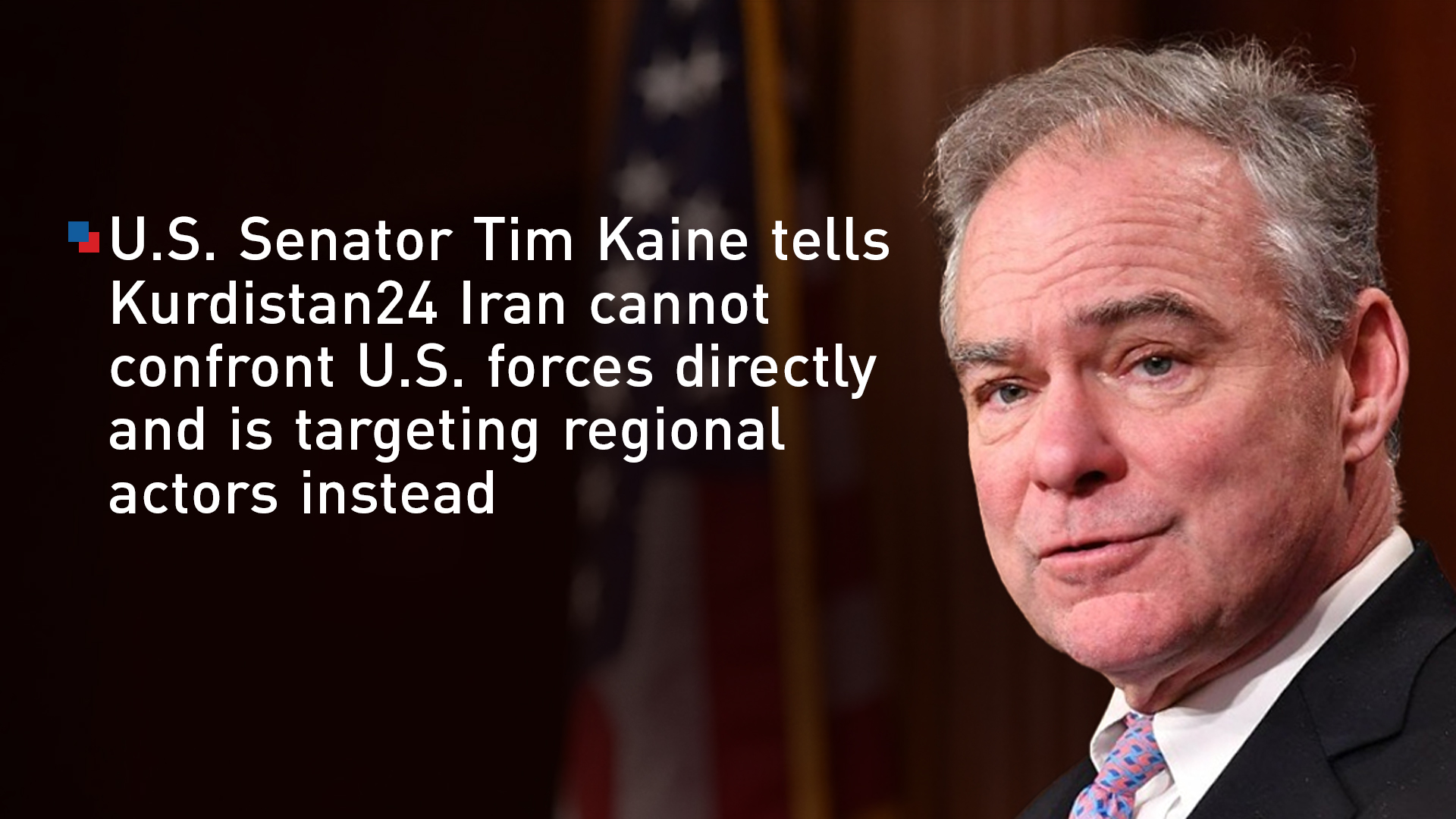
ERBIL (Kurdistan24) — U.S. Senator Tim Kaine on Wednesday stated that Iran lacks the capability to engage in direct military confrontation with U.S. forces, arguing that this limitation has driven Tehran to target countries across the region, including the Kurdistan Region’s Peshmerga forces.
In an exclusive statement to Kurdistan24, Kaine said recent U.S. strikes on Iranian targets have prompted Tehran to shift its response toward indirect attacks.
“Iran knows well that it cannot confront the U.S. military directly, which is why it attacks locations and actors it can more easily reach,” he said.
Kaine strongly condemned Iran’s attacks on the Peshmerga, describing them as unjustified and indicative of Tehran’s broader strategy.
“As we have seen, Iran targeted the Peshmerga. This is further evidence that these attacks lack any justification and are merely an attempt to mask Tehran’s inability to face U.S. forces directly,” he added.
The senator’s remarks come amid a rapidly escalating regional conflict that began on February 28, when the United States and Israel launched coordinated strikes on Iranian military and strategic sites.
Since then, Iran has expanded its retaliation through missile and drone attacks targeting U.S. military installations and allied infrastructure across the Middle East, including in the Gulf states.
The Islamic Revolutionary Guard Corps has claimed responsibility for multiple waves of attacks against bases hosting U.S. troops in countries such as Kuwait, Jordan, and Bahrain, as well as strikes against Israel.
These operations have increasingly affected civilian infrastructure, including airports and energy facilities, raising alarm among regional governments and international observers.
Within Iraq and the Kurdistan Region, Iranian-backed armed groups have also intensified pressure, with repeated attacks targeting strategic and security locations, including positions held by the Peshmerga.
Kurdish officials have repeatedly warned that such actions risk dragging the Kurdistan Region into a broader regional confrontation despite its stated policy of neutrality.
Kaine’s comments reflect growing concern in Washington over Iran’s asymmetric warfare tactics, which rely on proxies and indirect strikes rather than conventional engagement.
Analysts note that this approach allows Tehran to exert regional influence while avoiding the risks of a full-scale direct conflict with the United States.
As tensions continue to rise, regional leaders and international actors have warned that continued escalation could further destabilize an already volatile Middle East, with the Kurdistan Region increasingly exposed to the spillover effects of a widening conflict.