U.S. Forces Will 'Flee the Region,' Says Quds Force Chief Amid Escalating Strikes
Quds Force chief Esmail Qaani vows U.S. forces will “flee the region” as U.S.-Israeli strikes hit Iranian trade, petrochemical, and nuclear sites. Two U.S. aircraft downed; Iran’s oil exports continue. Casualties, executions, and regional tensions rise.
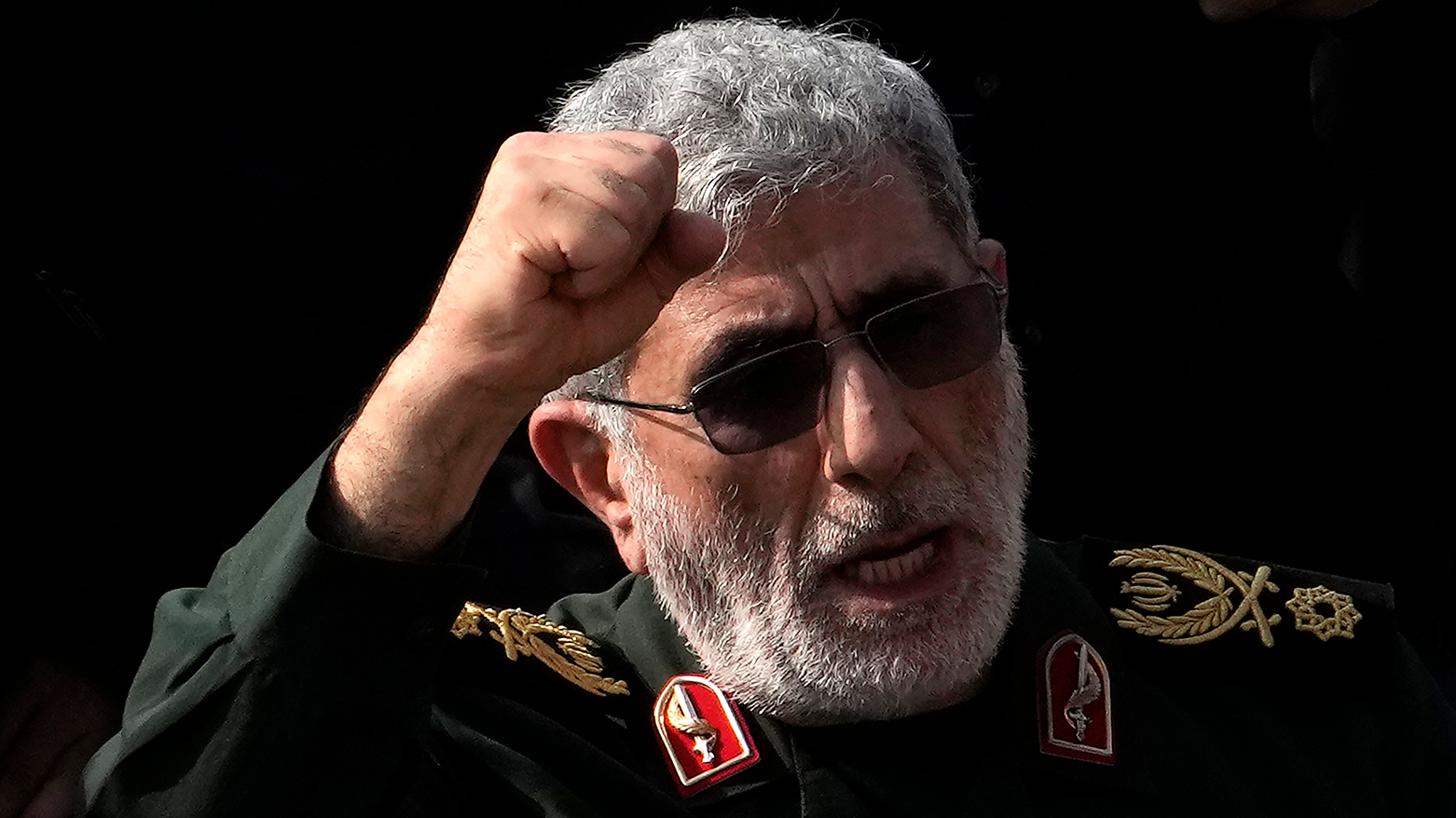
ERBIL (Kurdistan24) - Esmail Qaani, commander of the Quds Force of the Iranian Revolutionary Guard Corps (IRGC), sharply criticized U.S. forces in the Middle East in a message posted on X, asserting that their ultimate fate is to “flee this region,” Fars News Agency reported Saturday.
In his remarks, Qaani referenced the recent withdrawal of the aircraft carrier USS Gerald R. Ford, accusing its commander of failing to navigate the Bab-el-Mandeb Strait due to fear of “heroic mujahideen and the resilient people of Yemen,” and said the warship eventually departed the Red Sea under a “fake story.”
He concluded by reiterating, “The ultimate fate of all American terrorist forces is to flee this region,” according to the Fars citation.
The statement comes amid an intensifying U.S.-Israel-Iran conflict that entered its sixth week, with multiple strikes targeting Iranian infrastructure and regional energy routes.
Iranian media reported that on Saturday, a U.S.-Israeli airstrike hit a trade terminal at the Shalamcheh border crossing on the Iran-Iraq frontier. Mehr news agency cited Khuzestan province deputy governor Valiollah Hayati in reporting that an Iraqi driver was killed and two Iranian workers wounded.
Following the attack, Iraq temporarily suspended trade and passenger movement through the crossing, the Iraqi News Agency reported, quoting Omar Al-Waeli, head of Iraq’s Border Ports Authority. Authorities directed travelers and commercial traffic to alternative border points.
In southern Iran, U.S.-Israeli strikes targeted a cement plant in Bandar Khamir, the Tasnim news agency reported, quoting Ahmad Nafisi, deputy governor of Hormozgan province, who noted that operations at the facility continued uninterrupted.
Iranian media further cited that a petrochemical facility in the Mahshahr Special Petrochemical Zone of Khuzestan province and a separate Agriculture Ministry facility in Mehran were also struck. Semiofficial outlets reported multiple explosions in the petrochemical zone, affecting four companies within the complex.
Meanwhile, Iran’s oil exports from Kharg Island reportedly increased despite the ongoing conflict.
ISNA news agency quoted Moussa Ahmadi, head of the Iranian parliament’s energy commission, stating that recent visits and meetings on the island confirmed not only stable but increased exports.
Kharg Island remains a critical terminal for Iran’s crude oil, and U.S. President Donald Trump has reportedly threatened destruction of the facility if a settlement is not reached and the Strait of Hormuz does not reopen, according to ISNA reporting.
The ongoing hostilities have led to aircraft losses on both sides.
The Associated Press reported Saturday that two U.S. planes were downed in separate incidents. One fighter jet crashed in Iran, with a crew member rescued while another remained missing.
Iranian state media reported that an A-10 attack aircraft went down in the Persian Gulf after being struck by Iranian defenses. A U.S. official, speaking on condition of anonymity, noted that it was unclear if the second aircraft was shot down or crashed due to other causes.
The conflict has also affected Iran’s nuclear and energy infrastructure. The Atomic Energy Organization of Iran reported that an airstrike near the Bushehr nuclear plant killed a security guard and damaged a support building.
The International Atomic Energy Agency confirmed no increase in radiation levels following the strike, according to a social media post.
This marks the fourth attack on the facility since the war began. Israel’s military announced that its air force struck ballistic missile storage, anti-aircraft facilities, and weapons production sites in Tehran in a separate operation, describing the attacks as targeting Iran’s “core systems and foundations.”
Strategic waterways remain under heightened scrutiny.
Iranian parliamentary speaker Mohammad Bagher Qalibaf highlighted the importance of tanker and container traffic through the Bab-el-Mandeb Strait, a major link connecting the Red Sea with the Gulf of Aden and the Indian Ocean.
Iranian officials have previously disrupted oil flow through the Strait of Hormuz, contributing to global fuel price increases, AFP reported.
The conflict has prompted injuries and infrastructure damage in neighboring countries. Israel’s Magen David Adom rescue services reported that a man in Bnei Brak sustained glass shrapnel wounds after an Iranian missile strike.
In the United Arab Emirates, debris from intercepted Iranian drones damaged the facades of buildings, including one belonging to U.S. technology firm Oracle, though no injuries were reported.
Iranian Revolutionary Guard statements indicated threats against Oracle and 17 other U.S. companies allegedly involved in “terrorist espionage” operations in Iran, following earlier drone attacks that affected Amazon Web Services facilities in the UAE and Bahrain.
Bahrain’s Defense Ministry reported eight drone attacks in a 24-hour period, bringing the total number of projectiles launched since the conflict began to 188 missiles and 453 drones, according to AFP. Bahrain hosts the U.S. Navy’s Fifth Fleet.
Human toll and military logistics continue to challenge the United States.
Pentagon data, cited Friday, indicated that 365 service members have been wounded in the war: 247 Army soldiers, 63 Navy sailors, 19 Marines, and 36 Air Force personnel. Most casualties involve mid- to senior-enlisted troops, along with 85 officers and 80 junior enlisted personnel. The death toll remains at 13 U.S. service members killed in combat.
In addition to the military engagements, Iranian authorities have executed two members of the exile group Mujahedeen-e-Khalq, bringing the total to six since the war began, according to Mizan news agency.
The Iranian judiciary cited “membership in a terrorist group” as the charge, while activist organizations criticized the trials as closed-door proceedings lacking due process.
Diplomatic discussions are ongoing amid the hostilities. Italian Premier Giorgia Meloni met with Saudi Prime Minister Mohammed bin Salman to discuss defensive military support against potential Iranian retaliation, a statement from Meloni’s office noted.
The leaders also addressed diplomatic measures to end the war, the strategic importance of reopening the Strait of Hormuz, and broader efforts to stabilize regional trade flows. Meloni will continue her visit to Qatar and the United Arab Emirates.
As the conflict persists, officials and media reports emphasize the continuous disruption to commercial and civilian infrastructure. Trade and passenger movement at the Shalamcheh border crossing remains suspended after Saturday’s strike, while airstrikes on industrial and military targets continue across southern and western Iran.
Iranian parliamentary and energy officials maintain that essential services, including oil exports and industrial production, continue despite the attacks, according to ISNA and Tasnim agencies.