U.S. President Says 'Mini-War' With Iran Is 'Working Out Very Nicely'
Trump rejects prolonged war but insists Iran must not obtain nuclear weapons, as U.S. boosts military readiness and escorts shipping in the Strait of Hormuz amid rising tensions.
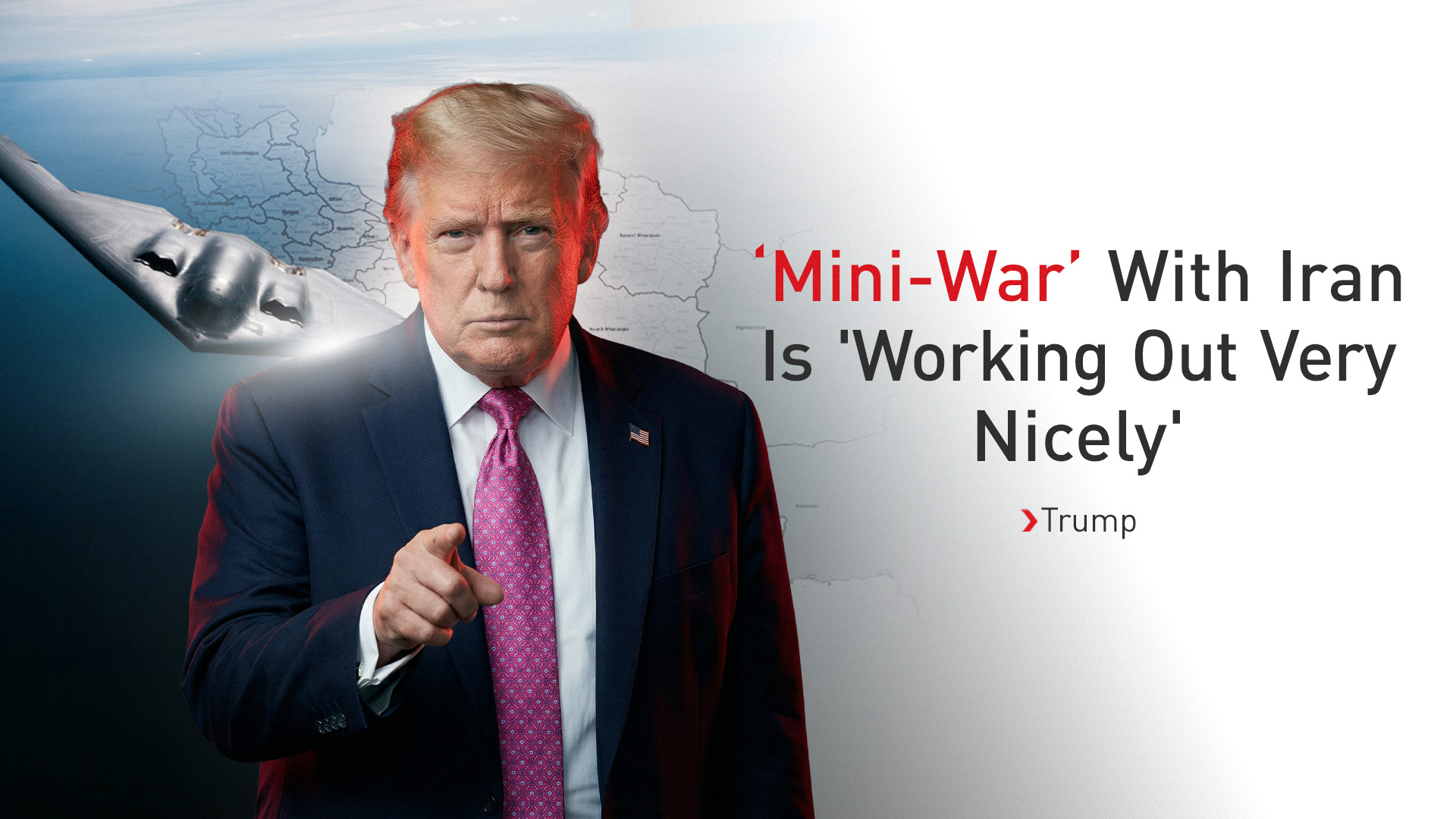
ERBIL (Kurdistan24) - U.S. President Donald Trump has clarified the United States' strategic posture toward the Islamic Republic, stating that while he opposes a prolonged, multi-year conflict, his administration maintains a non-negotiable prohibition on Tehran's nuclear ambitions.
Speaking to supporters, Trump characterized the ongoing six-week military confrontation as a "mini war" and a "little detour" that has thoroughly dismantled Iran's defensive and command capabilities, emphasizing that regional stability is contingent upon Iran remaining a non-nuclear state.
The president's remarks come during a period of heightened tensions in the Persian Gulf, characterized by a sustained U.S. naval blockade of Iranian ports and a series of maritime security incidents.
Trump noted that Iran's military and leadership structures have been decimated, asserting that Tehran's capacity to project power has been eliminated.
Despite this assessment, the U.S. executive branch has issued a stern ultimatum to Iranian authorities, presenting a choice between a good-faith diplomatic agreement and the potential for a resumption of full-scale hostilities.
In a parallel development to the president's policy declarations, the U.S. Central Command (CENTCOM) has announced a significant elevation in military readiness across the Middle East.
According to military officials, naval and air assets have been mobilized under a large-scale operation designated as "Project Freedom."
The primary objective of this mission is to secure international commercial traffic and ensure the freedom of navigation in the strategic Strait of Hormuz, an essential corridor for global energy supplies.
According to a message published by CENTCOM on the social network X, the operational buildup includes the deployment of the amphibious assault ship USS Tripoli (LHA 7) to the Arabian Sea.
CENTCOM said that air and naval officers are currently supervising intensified flight operations to prepare for any potential maritime contingency.
This military alert serves as a defensive framework intended to protect U.S. personnel and neutral merchant vessels from threats arising in the region's volatile waterways.
U.S. Position on Iran
The policy stance articulated by President Trump reflects an emphasis on overwhelming military superiority and domestic economic resilience.
Trump remarked that he does not support becoming entangled in decades-long conflicts, contrasting the current operation with historical U.S. engagements.
"Like we have a war right now and we're at like, what, six weeks? They said, 'what's taking so long?' We were in Vietnam, 19 years. We were in Iraq for many years," Trump said.
He referred to the current engagement as a "mini war," stating that the U.S. economy and stock market had hit "all new highs" despite the military operation. "So we did a little detour. And it's working out very nicely," Trump added.
However, the report stated that the president remains firm on the nuclear issue, viewing the prevention of an Iranian nuclear weapon as a core national security priority.
"We can't let Iran have a nuclear weapon or you're going to have problems like nobody would believe," Trump said.
According to the president, the six-week campaign has systematically dismantled the Iranian state's military infrastructure.
"They have no Navy. They have no Air Force. They have no anti-aircraft equipment. They have no radar. They have no nothing. They have no leaders, actually. The leaders happen to be gone also," Trump said.
Addressing the maritime confrontations, Trump revealed the scale of the U.S. naval assault, stating that U.S. forces eliminated 159 Iranian vessels in the opening phase of the conflict.
"159 ships in the first two weeks," Trump said.
The president noted a tactical divergence between himself and military commanders regarding the destruction of the vessels.
"I said, 'why didn't you just take the ship? Why did you have to send it to the bottom of the sea?'" Trump recalled, stating that the military would "rather blow them up than save them," whereas he "would have preferred saving them."
In an interview with Fox News, Trump also warned that any Iranian aggression against U.S. vessels in the Strait of Hormuz would result in the country being "destroyed," noting that the U.S. military is prepared to utilize its full array of advanced weaponry if necessary.
Military Readiness in the Gulf
The operational details of "Project Freedom" involve a substantial commitment of U.S. military resources.
According to CENTCOM, more than 100 advanced fighter aircraft are currently participating in the mission, flying from land bases in the region and from the decks of deployed warships.
F-16 fighter jets have been identified as a critical component of this aerial contingent, tasked with providing a security umbrella over merchant shipping lanes.
Military officials emphasized that the operation is explicitly framed as a defensive measure.
Brad Cooper, the Commander of CENTCOM's naval component, stated that the mission is necessary to safeguard both regional security and the global economy.
Cooper pointed out that the support for merchant movement is being conducted simultaneously with the enforcement of the U.S.-led blockade on Iranian maritime facilities, which has been in place since mid-April.
CENTCOM's latest information indicates that naval control towers are now operating with heightened oversight, closely monitoring the transit of vessels through the Strait of Hormuz.
The military buildup follows a period of significant maritime disruption that began on February 28, 2026, when Iranian forces originally closed the waterway.
Strait of Hormuz Developments
Recent evidence of the operational shift was highlighted by the successful transit of a high-value commercial vessel.
The maritime transport company Maersk announced that the US-flagged vehicle carrier "Alliance Fairfax" safely exited the Gulf after passing through the Strait of Hormuz under the direct protection of U.S. military forces.
The report noted that the vessel had been stranded for three months prior to the implementation of the current security protocols.
According to the maritime report, the safe passage of the "Alliance Fairfax" occurred despite claims from the Iranian military that they had successfully obstructed several U.S. ships in the same area.
Tehran had previously issued warnings that no vessel would be permitted to transit the waterway without prior coordination with Iranian authorities.
President Trump described these efforts to free stranded ships as a "humanitarian step" intended to assist neutral countries caught in the friction between the U.S., Israel, and Iran.
The commencement of these escorts on Monday marks a tangible escalation in the U.S. effort to challenge Iranian control over the strait.
Iranian Diplomatic Response
The Iranian government has responded to the U.S. military movements with a mixture of diplomatic warnings and strategic skepticism.
Iranian Foreign Minister Abbas Araghchi stated in a public message that the ongoing events in the Strait of Hormuz demonstrate that political crises cannot be resolved through military solutions.
Abbas Araghchi said that while negotiations facilitated by Pakistan have seen some progress, the United States risks being drawn into deeper "marshes and crises" by regional actors.
He specifically cautioned the United Arab Emirates against participating in the U.S.-led maritime initiatives.
Referring to the newly launched operation, Araghchi remarked that "Project Freedom is Project Deadlock," suggesting that the military escort program will not lead to a lasting resolution.
The Iranian diplomatic messaging coincides with a deteriorating security situation involving regional partners.
On Monday, the UAE Ministry of Foreign Affairs condemned a drone attack against an Abu Dhabi National Oil Company (ADNOC) vessel, attributing the incident to the Iranian Revolutionary Guard Corps.
The UAE government characterized the attack as an act of maritime piracy and a violation of UN Security Council Resolution 2817.
Furthermore, the UAE Ministry of Defense reported that its air defense systems intercepted three cruise missiles launched from Iran, while a fourth projectile impacted the sea without causing casualties.