Qassam Leader Explains Hamas’s Position on Iran Conflict
Hamas military official Taysir Suleiman said the group remains focused on its Gaza war and is not prepared to open additional regional fronts alongside Iran, noting that its current leadership is operating under a four-member council following the death of Yahya Sinwar.
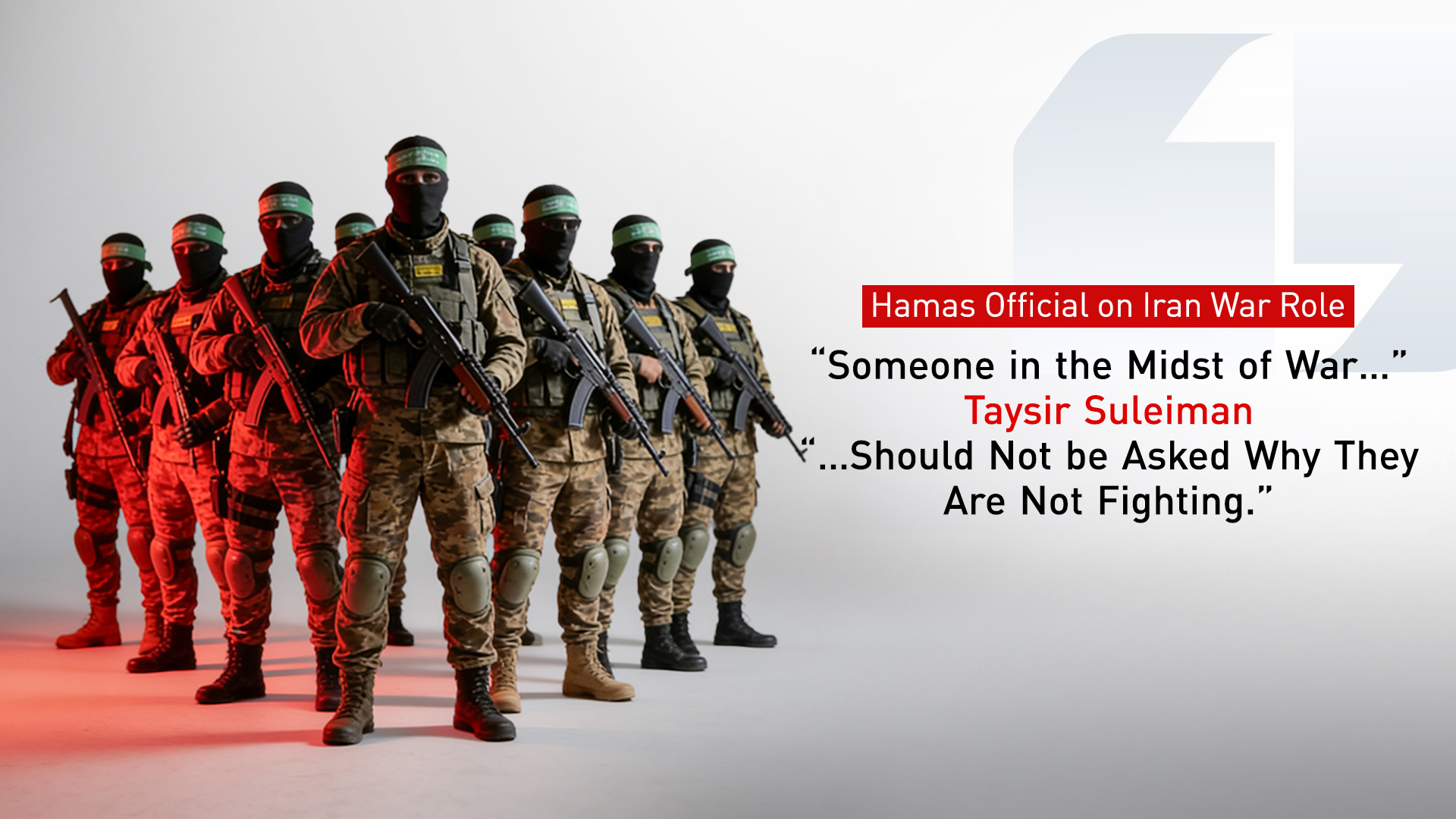
ERBIL (Kurdistan24) - A senior leader of the Hamas movement and a founding figure of its military wing, the Izz ad-Din al-Qassam Brigades, has clarified the group's stance regarding its involvement in broader regional hostilities involving Iran. In a statement to Kurdistan24 on Tuesday addressing the group's strategic priorities, Taysir Suleiman indicated that Hamas's deep-seated involvement in the localized Gaza conflict remains the primary factor governing its military focus.
Speaking to Kurdistan24, Suleiman addressed inquiries regarding why the movement has not opened a separate front or directly integrated into the wider Iranian-aligned military theater.
According to Suleiman, the question of non-participation is secondary to the reality that Hamas has been actively engaged in combat operations for more than two and a half years.
The official stated that a party already entrenched in the "midst of war" should not be scrutinized for its lack of participation in a separate, albeit related, regional escalation.
"Hamas has been fighting on all fronts for two and a half years, and someone who is in the midst of war should not be asked why they are not fighting," Taysir Suleiman said.
The remarks come at a critical juncture for the movement, which has been undergoing a significant internal restructuring.
Following the death of Yahya Sinwar, the former head of the Hamas Politburo who was killed by Israeli forces in Khan Yunis, Suleiman noted that the movement is currently governed by a four-member leadership council.
This transitional arrangement, he suggested, is a security measure designed to protect the leadership from further targeted assassinations, a tactic he claimed has historically impacted the group's hierarchy.
Regional Escalation and Competing Narratives
This clarification of Hamas's military posture arrives as the broader Middle East remains gripped by high-intensity conflict and a parallel battle over international narratives.
While Suleiman frames the group's actions as a localized resistance against occupation, an independent report recently released by an Israeli commission and cited by Agence France-Presse (AFP) presents a different characterization of the group's conduct.
According to the AFP account, an investigative body has accused Hamas and its allies of conducting "systematic and widespread" sexual violence during the Oct. 7, 2023, attacks.
These allegations, which Hamas has consistently denied, have become a focal point for international media and legal bodies, shaping the global perception of the Gaza-Israel-Iran conflict.
As regional tensions persist, the gap between the movement's self-described "resistance" and the gravity of the accusations detailed in international reporting underscores the volatile nature of the current security environment.
Qassam Leader Comments on Iran War Role
In his discussion with Kurdistan24, Suleiman emphasized that Hamas remains a resistance movement whose primary objective is the termination of the Israeli occupation.
He asserted that the movement maintains total autonomy in determining the timing and methodology of its military engagements.
Regarding the prospect of disarmament, a frequent condition discussed in international diplomatic circles, Suleiman was categorical, stating that Hamas would not accept any conditions for laying down its arms. He framed the group's arsenal as a necessary instrument for the "protection of the Palestinian people" and the eventual establishment of a sovereign state.
Suleiman's history within the movement provides significant weight to his statements.
A founder of the Al-Qassam Brigades in 1992, he was imprisoned by Israel in 1993 and was eventually released during the 2011 prisoner exchange process.
During his time in detention, Suleiman was reportedly a close associate of Yahya Sinwar. His current role within the leadership council highlights the movement’s reliance on its veteran cadres to navigate the post-Sinwar era.
Beyond military strategy, Suleiman also touched upon regional diplomacy, specifically expressing gratitude toward the people of the Kurdistan Region. He credited the region with providing consistent humanitarian aid to the Gaza Strip since the outbreak of the war on Oct. 7, 2023.
AFP Reports on Israeli Allegations
While Suleiman focused on the group's future strategy and regional alignment, the AFP report focused on a 300-page document released by the Civil Commission on Oct. 7th Crimes against Women and Children.
This commission, established by an Israeli legal expert in Nov. 2023, concluded that gender-based violence was not incidental but was "integral to the Oct. 7th attacks and their aftermath."
According to the AFP report, the commission's findings were based on:
- Over 1,800 hours of visual analysis.
- A review of more than 10,000 photographs and video segments.
- More than 430 formal and informal interviews with survivors, witnesses, and returned hostages.
The report, as cited by AFP, alleged that sexualized torture was utilized across multiple locations, including residential communities and the Nova music festival grounds.
Furthermore, the commission claimed that such abuse continued for months for those taken into captivity in Gaza. The investigators, according to the report, characterized these acts as war crimes and crimes against humanity under international law.
Hamas has persistently rejected these claims since they first emerged in late 2023.
However, the AFP report noted that the commission's work sought to prevent the suffering of victims from being "denied, erased, or forgotten," especially as many victims did not survive to provide testimony.
Regional Conflict Context Expands
The broader context of this conflict is marked by a massive humanitarian and human toll.
According to an AFP tally based on official Israeli data, the initial Oct. 7 attack resulted in the deaths of 1,221 people in Israel. Additionally, 251 individuals were taken hostage.
In the ensuing military campaign by Israel, the Gaza Strip has faced unprecedented devastation.
According to the Gaza health ministry, whose figures the UN considers reliable, more than 72,000 people have been killed in the territory.
The AFP report further detailed that of the 207 hostages taken alive, 41 have died in captivity. The remaining survivors were reportedly released in Oct. 2025 following a fragile ceasefire brokered under significant pressure from the United States.
Suleiman's comments regarding the Iran war must be viewed through this lens of localized exhaustion and structural transition.
By stating that Hamas is already "in the midst of war," he acknowledges the severe operational constraints facing the group after years of intense urban combat and the loss of key leaders like Sinwar.
Competing Narratives in Ongoing War
The divergence between the military framing provided by Suleiman and the legal allegations reported by AFP illustrates the ongoing struggle for narrative control in the international arena.
Israel has long accused international organizations, including the United Nations, of being slow to acknowledge the severity of the crimes alleged in the Civil Commission's report.
The AFP report referenced earlier findings by Pramila Patten, the UN secretary-general's special representative on sexual violence in conflict.
In March 2024, Patten's team reported "clear and convincing information" that sexual violence and cruel treatment had occurred during the Oct. 7 attacks and during captivity. These findings have consistently been used by Israeli officials to counter Hamas's characterization of its "resistance."
As Hamas continues to reorganize under its new leadership council, its ability to maintain its "resistance" narrative remains under pressure from these documented allegations.
Suleiman's insistence that the movement determines its own "manner of dealing with the enemy" reflects a desire for strategic independence, even as the movement remains inextricably linked to the broader "Axis of Resistance" led by Iran.
The strategic implications of Suleiman's remarks suggest that while Hamas remains ideologically aligned with Tehran, its immediate military capabilities are focused on survival and localized persistence in Gaza rather than expansion into a multi-front regional war.
This pragmatic admission of focus, however, does little to bridge the gap between the group's political claims and the international allegations of widespread misconduct that continue to define the conflict’s moral and legal landscape.
Competing narratives continue to shape understanding of the conflict as regional tensions persist.