Sen. Graham Says Iran Talks Have 'Hit a Wall,' Calls for More Pressure
Sen. Lindsey Graham said on NBC's Meet the Press that negotiations with Iran have "hit a wall," urging tougher economic and military pressure on Tehran while warning that Iran's energy infrastructure, including Kharg Island, could become a strategic target if regional tensions escalate further.
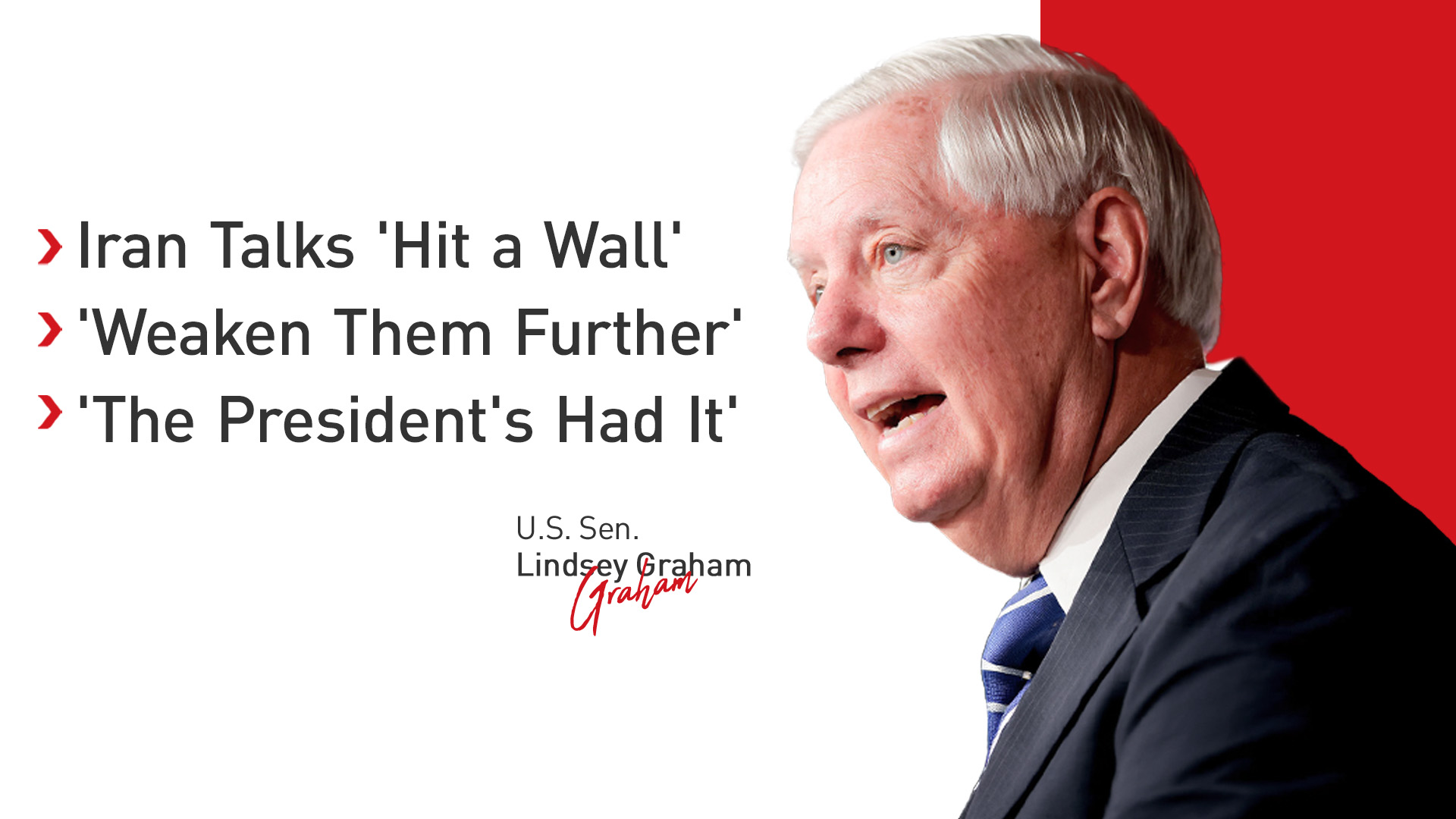
ERBIL (Kurdistan24) - In a comprehensive appearance on NBC News' Meet the Press on Sunday, senior U.S. Republican Senator Lindsey Graham asserted that diplomatic negotiations with Iran have effectively stalled, signaling a potential shift toward more aggressive economic and military options to counter Tehran's regional influence.
Speaking with moderator Kristen Welker, the South Carolina lawmaker underscored the strategic necessity of increasing pressure on the Iranian government, highlighting the critical vulnerabilities within its energy infrastructure and analyzing the broader geopolitical implications for maritime security in the Strait of Hormuz.
Graham's remarks reflect a growing consensus among hawkish Washington policymakers that current diplomatic channels are yielding diminishing returns, intensifying the debate over U.S. foreign policy direction in the Middle East amid deep regional instability.
The Senator's declarations come during a period of heightened friction involving Iran, Israel, the United States, and the Gulf Cooperation Council (GCC) states.
Ongoing disputes over maritime access, enforcement of international sanctions, and continued regional proxy maneuvers have continuously disrupted global energy markets and strained multilateral diplomacy.
According to reports from Reuters and regional state media, the administration of President Donald Trump has expressed profound frustration regarding the lack of progress in ongoing negotiations with Tehran following a brief pause in direct hostilities earlier this year.
As regional security anxieties expand, the broader consequences of this diplomatic deadlock have begun reverberating through international commerce, manifesting in significant disruptions to commercial aviation, shipping logistics, and critical energy corridors.
Graham Says Iran Talks Have Stalled
During his dialogue with Welker on NBC News, Senator Graham offered a bleak assessment of the current diplomatic track, explicitly stating that international negotiations aimed at resolving the impasse with Iran have "hit a wall."
"I think we hit a wall on deal-making. I would encourage the president to look at reducing Iran's military capability even further," Sen. Graham said.
Characterizing the leadership in Tehran as fundamentally erratic and unreliable, Graham asserted that the Iranian regime continuously alters its negotiating parameters, effectively preventing any sustainable breakthrough.
He noted that the Trump administration has grown increasingly weary of what he described as "moving the goalposts" by Iranian negotiators, where preliminary understandings are abruptly discarded or renegotiated by Tehran the following day.
According to Graham, this perceived lack of a coherent and unified interlocutor within the Iranian state apparatus makes traditional diplomacy unviable under the current circumstances.
"I think you can't get a coherent answer from Iran because they can't be coherent. I think they're so disheveled now, they're so weakened. They agree to things, and the next day they back up. President Trump's very frustrated," Sen. Graham said.
The South Carolina Republican argued that the internal structural disarray of the regime prevents it from delivering a stable diplomatic response.
He further emphasized that intelligence assessments offer no indication that the current ruling factions in Tehran have modified their core strategic objectives, which he identified as the targeted subversion of regional stability, the destruction of Israel, and direct opposition to American strategic interests across the Middle East.
From a diplomatic perspective, Graham's remarks suggest that Washington may increasingly view conditional engagement as a exhausted policy, clearing the path for an escalation in alternative containment strategies.
Senator Advocates Stronger Pressure on Tehran
Shifting from diplomatic critique to strategic recommendations, Graham articulated strong support for implementing measures designed to further weaken Iran's military and economic foundations.
While acknowledging that previous U.S. and allied military actions had significantly degraded Tehran's operational capabilities, the Senator maintained that a substantial array of high-value targets remains available to compel compliance.
Specifically, Graham identified Iran's vast fossil fuel economy as its "soft underbelly," advising the White House to place energy infrastructure at the absolute forefront of any prospective military or economic targeting matrix.
"The energy infrastructure is their soft underbelly. If you go back to the fight, I'd put energy on the top of the list," U.S. Sen. Lindsey Graham stated.
In a direct warning aimed at Iranian revenues, Graham explicitly referenced Kharg Island, the primary maritime export terminal for Iranian crude oil, suggesting that such vital infrastructure assets should be considered active variables in Washington's strategic planning if regional provocations persist.
He reasoned that continuing with standard containment protocols would yield identical, unproductive outcomes.
However, it is critical to contextualize these assertions as unilateral legislative viewpoints aimed at shifting policy debates, rather than confirmed or active Pentagon operational directives.
Graham's advocacy for targeting energy nodes underscores a broader geopolitical doctrine that favors absolute economic deprivation over incremental containment, though it carries inherent risks of escalating regional hostilities.
"They've been dramatically weakened, but there are still targets that could weaken them more militarily. And I would also keep the embargo on to weaken their economy. And I'd let the Iranians know if you keep terrorizing the region, Kharg Island, which is your source of revenue, will be in play. I think that's, that would be the smart next play. You can't pursue a deal more than the people on the other side want a deal," Sen. Graham
Nuclear Concerns and Deterrence Strategy
Addressing the central security imperative of the United States and its regional allies, the discussion on NBC News turned extensively to Iran's nuclear ambitions and the mechanisms required to enforce non-proliferation.
When pressed by Welker on how the United States could realistically secure or neutralize Iranian nuclear materials without committing conventional ground forces to an expansive campaign, Graham outlined an alternative deterrence framework based on strict spatial interdiction.
He revealed that he had discussed tactical alternatives with Israeli Prime Minister Benjamin Netanyahu, proposing the establishment of a localized exclusion zone around known enrichment facilities.
Dubbing this proposed perimeter a "circle of death," Graham suggested that international forces should enforce an absolute kinetic boundary around these installations, whereby any unauthorized entry would be met with immediate defensive force to prevent the extraction, dispersal, or further refinement of nuclear components.
"Call it the circle of death." Sen. Graham
The Senator argued that such an approach would successfully neutralize Tehran's capacity to construct radiological weapons or advance its enrichment timelines, asserting that Iran's core enrichment infrastructure has already suffered severe setbacks that will take years to rectify.
While Graham expressed an initial preference for resolving the nuclear dilemma via diplomatic avenues, his willingness to endorse high-stakes kinetic containment reflects the deep-seated skepticism in Washington regarding traditional inspection protocols and verification mechanisms.
China, Iranian Oil, and Economic Pressure
The economic dimensions of the current U.S. strategy formed a substantial portion of Graham's analysis, particularly regarding the enforcement of global trade energy restrictions.
Welker challenged the Senator on the efficacy of past White House declarations which warned global consumers that purchasing Iranian oil would result in complete economic isolation from U.S. financial markets, noting that Beijing continues to absorb approximately 90 percent of Iran's crude exports.
Graham acknowledged the challenge but framed the issue within a wider legislative effort in Congress to impose sweeping secondary sanctions and tariffs on any nation facilitating the evasion of international trade embargoes.
Drawing a direct parallel to existing legislative frameworks targeting the "shadow fleet" used to transport cheap Russian crude oil, Graham indicated that Congress is close to finalizing statutory measures that would penalize third-party states propping up adversarial economies.
He cited the administration's recent imposition of a 25 percent tariff on India for its engagement with Russian energy markets as a precedent for future enforcement actions against Beijing.
According to Graham, the complete cessation of Chinese oil purchases is the singular variable required to trigger the total collapse of the Iranian domestic economy.
Consequently, he argued that a decisive moment is approaching where China must be held accountable by Washington for its role as a vital economic lifeline for Tehran, a move that would undoubtedly introduce severe complications into bilateral Washington-Beijing relations.
Domestic Politics and Foreign Policy Intersect
Beyond the immediate geopolitical theater, Graham's interview highlighted the intricate ways in which Middle Eastern foreign policy intersects with intense U.S. domestic political dynamics and upcoming electoral cycles.
Welker pointed to recent public opinion polling indicating that approximately 70 percent of the American electorate disapproves of current domestic economic management, driven primarily by inflation, four-year highs in gasoline prices, and rising commodity costs.
"It's worth losing my job. If I had to give my job up to make sure Iran would never have a nuclear weapon, I would do it," Sen. Graham stated.
When asked whether the administration should balance its aggressive stance against Iran with the potential financial fallout for American consumers, Graham defended the executive focus, framing the prevention of a nuclear-armed Iran as an existential historical necessity akin to Winston Churchill's mobilization against Nazi Germany.
"That's his Churchill moment." Sen. Graham
In a stark defense of ideological prioritization over electoral security, Graham asserted that preventing a nuclear escalation in the Middle East supersedes domestic political concerns, stating he would willingly forfeit his legislative seat and even risk control of the House and Senate if it guaranteed the permanent containment of Iran's nuclear capabilities.
"I believe there are religious Nazis in Iran." Sen. Graham
He dismissed past administrative policies under the Obama and Biden Presidencies as ineffective, praising the current executive trajectory for actively confronting the challenge.
Furthermore, Graham maintained that long-term stabilization, including the eventual normalization of diplomatic relations between Saudi Arabia and Israel, remains fundamentally contingent upon successfully neutralizing Tehran's regional leverage, which he argued would ultimately stabilize global energy markets and lower consumer costs over time.
This focus on absolute party alignment was mirrored in Graham's commentary on recent internal Republican party developments.
Discussing the primary defeat of Louisiana Senator Bill Cassidy, who had previously voted to convict Trump during a 2021 impeachment trial, Graham described the outcome as a natural consequence of challenging the party's core leadership and agenda.
He noted that politicians who align with opposition narratives or attempt to disrupt the executive platform face immense electoral vulnerabilities within the modern Republican structure.
Graham confirmed he had spoken directly with Trump shortly before the broadcast, reinforcing the message that ideological solidarity behind the administration's domestic and foreign policy objectives remains the defining characteristic of the contemporary party landscape.
Strait of Hormuz Remains Central Concern
The strategic imperatives outlined by Senator Graham are closely mirrored by rapidly unfolding developments on the ground in the Middle East.
Highlighting the fragility of maritime logistics, Esmaeil Baqaei, the spokesperson for the Iranian Ministry of Foreign Affairs, announced during a press conference on Monday that Tehran is actively collaborating with Oman to establish a new regulatory mechanism governing transit through the vital Strait of Hormuz.
While Baqaei asserted that regional security must be built on mutual trust among neighboring states without external interference, he simultaneously reiterated that Iran would maintain an uncompromising stance regarding its domestic uranium enrichment program.
This dual positioning directly complicates the maritime security dynamic, as Western analysts view any unilateral Iranian adjustments to shipping protocols in the Strait as a potential lever to apply counter-pressure against international sanctions.
Regional Instability Expands
The broader regional atmosphere surrounding Graham's remarks remains defined by severe security anxieties and escalating cross-border operations.
Just hours prior to the Senator's interview, the United Arab Emirates Ministry of Foreign Affairs issued a formal condemnation regarding a series of coordinated drone attacks launched from Iraqi territory targeting the Kingdom of Saudi Arabia.
According to an official statement by Saudi Ministry of Defense spokesperson Brigadier General Turki al-Maliki, national air defense forces successfully intercepted and destroyed three hostile unmanned aerial vehicles after they breached Saudi airspace from the northern border.
The incident underscores the growing frustration of neighboring Gulf states, who had collectively requested the Iraqi government earlier this year to take decisive action against local armed factions aligned with Tehran.
In response to these developments, an informed Iranian military official speaking on state television rejected the accusations, alleging that the United States and Israel are intentionally executing operations across regional states to undermine the current indefinite ceasefire framework and deflect blame onto Tehran.
Concurrently, the tangible impact of these security risks on global infrastructure has become increasingly evident.
Israel's Channel 12 reported that American Airlines has officially extended its suspension of all commercial flights to Israel until January 2027, citing the acute potential for a sudden resumption of large-scale military operations.
This operational withdrawal coincides with reporting from Axios detailing recent high-level consultations between Prime Minister Netanyahu and the White House regarding the operational readiness of joint U.S.-Israeli military assets.
According to Israeli broadcasting sources, both nations remain on full alert, with strategic planning increasingly focused on the precise energy infrastructure nodes that Senator Graham highlighted during his television appearance, should the mediated negotiations in Islamabad remain definitively deadlocked.
It is within this volatile matrix of stalled diplomacy, maritime posturing, and domestic political resolve that the future of international engagement with Iran will be determined, as policymakers in Washington continue to weigh the severe economic costs of escalation against the strategic imperatives of regional deterrence.
A restrained observation that debates over Iran policy, regional security, sanctions, and diplomacy are likely to remain central in Washington and across the Middle East in the coming months.