Kurdish Farmers in Kirkuk Rally Against Federal Wheat Policy
Hundreds of farmers across Kirkuk protested Baghdad's decision to cut wheat procurement prices for unregistered growers to 500,000 IQDs per ton, warning that rising production costs, delayed state payments and exclusion from the federal agricultural plan threaten to collapse rural livelihoods.
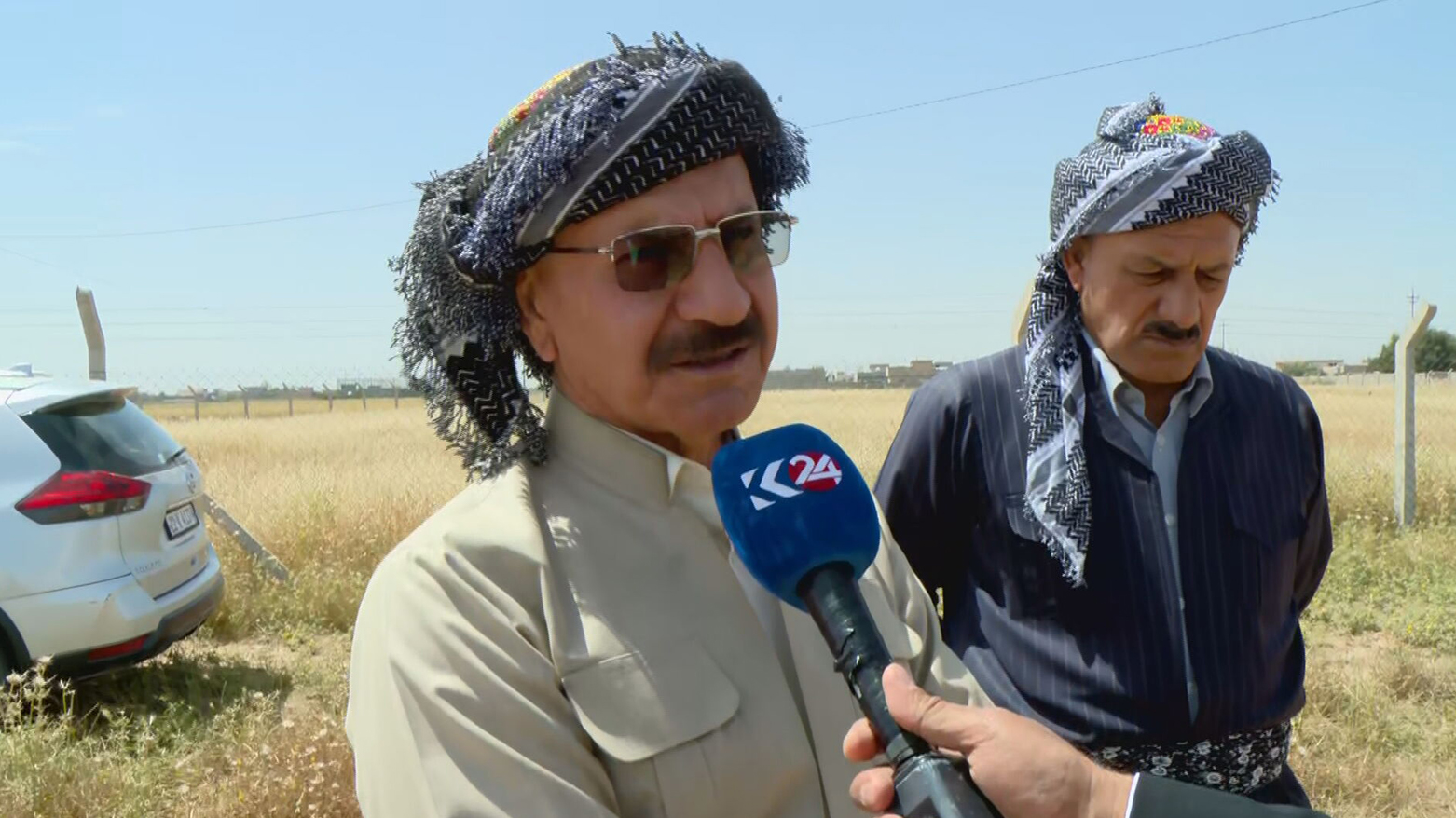
ERBIL (Kurdistan24) - Hundreds of agricultural producers from across Kirkuk Governorate and its surrounding districts staged widespread demonstrations on Monday, protesting the Iraqi federal government's recent decision to significantly reduce state procurement prices for domestic wheat.
Gathering in the strategic Topzawa region, farmers from agrarian hubs, including Sargaran, Palkana, Daquq, Leylan, and Shwan, voiced collective opposition to a newly enforced federal pricing tier that caps the purchase of wheat from non-registered growers at 500,000 Iraqi dinars (IQD) per ton.
The demonstrators warned that the convergence of slashed subsidies, skyrocketing input costs, and systematic exclusion from the national agricultural plan threatens to induce total financial insolvency across the region's rural economy.
According to field accounts and data gathered by Kurdistan24's Hemn Delo's field reporting, the central grievance of the protesting farmers centers on the unsustainable disparity between production costs and state compensation.
Producers operating in the Kurdistani territories of Kirkuk emphasized that the current overhead for cultivating a single dunam of agricultural land ranges between 400,000 and 500,000 IQD.
This figure encompasses essential expenditures such as certified seeds, specialized fertilizers, mechanical harvesting fees, fuel for irrigation machinery, and logistical transportation to government-managed silos.
With procurement prices compressed to 500,000 IQD per ton, growers outside the official state plan face the prospect of a net-negative return on their seasonal investments, effectively wiping out a full year of intensive agricultural labor.
The economic crisis in Kirkuk is deeply compounded by long-standing geopolitical and administrative impasses.
Protesting farmers told Kurdistan24 that their exclusion from the federal agricultural plan is primarily driven by unresolved political disputes, the prolonged non-implementation of Article 140 of the Iraqi Constitution, and systemic land ownership friction.
Because these administrative and land-tenure hurdles prevent many Kurdish and local growers in the Kurdistani territories outside KRG's administrative control from securing formal registration within Baghdad's official agricultural registries, they are barred from accessing the premium pricing tiers granted to registered peers.
While farmers formally integrated into the state plan receive up to 700,000 or nearly 800,000 IQD per ton, those in the vulnerable sub-districts of Palkana and Sargaran are forced to absorb the lowest state-mandated rates.
Furthermore, primary accounts from the Topzawa gathering indicated that local households are navigating an acute liquidity crisis due to historical administrative failures.
Protesters revealed that the federal government has yet to fully disburse outstanding financial entitlements and grain payments from previous harvest seasons.
This persistent delay in state compensation has left rural families unable to service debts accumulated during past planting cycles, rendering them highly vulnerable to sudden market shifts.
Consequently, the Topzawa demonstrators issued an urgent appeal to the federal government in Baghdad, demanding an immediate policy reversal, the integration of Kirkuk's unregistered lands into national procurement mechanisms, and the protection of local agricultural livelihoods from asymmetric market devaluation.
The localized protest in Kirkuk reflects a much broader, systemic friction unfolding across the state's agricultural framework.
According to a detailed previous report by Kurdistan24, identical economic anxieties have sparked major mobilizations in the federal capital and neighboring governates.
The report documented large-scale rallies centered in prominent locations such as Baghdad's Tahrir Square, where agricultural unions and local cooperatives unified to protest the federal government's fiscal retrenchment.
This nationwide pushback underscores a growing institutional consensus within the rural sector that the state's revised wheat pricing policy fails to evaluate the contemporary economic pressures facing independent growers.
The broader analysis provided by the Iraqi Farmers Protest Wheat Price Cuts in Baghdad and Kirkuk report highlights the exact mechanics of the contentious tiered pricing system.
Historically, the federal government maintained a stable, flat-rate subsidy of 850,000 IQD per ton for domestic wheat to incentivize self-sufficiency.
However, under current fiscal management policies, Baghdad has reduced this rate to 700,000 IQD per ton for growers formally registered within the state's seasonal agricultural plan, while setting a bottom-tier rate of 500,000 IQD for those operating outside the official framework.
Agricultural societies across the country have labeled these reductions tenetless, arguing that the policy devalues the strategic importance of domestic food production.
The institutional response to these fiscal measures has seen heavy involvement from agrarian leadership networks. Local media reports noted that the Local Union of Agricultural Cooperative Societies in Diyala Province actively mobilized its branch heads, executive officers, and individual growers to join the Tahrir Square demonstrations.
Beyond demanding a uniform reinstatement of the 850,000 IQD per ton rate, these cooperatives are pushing for an official overhaul of the state's approved agricultural yield metrics.
Currently, federal authorities utilize rigid metrics to cap the volume of wheat purchased per unit of land. The unions argue that the government must adjust these purchase ratios to exceed one ton per dunam to accurately reflect the intensive labor and high output achievements of modern Iraqi farmers during the current cycle.
The societal stakes of this ongoing administrative deadlock extend directly to national security and market stability. As emphasized by economic analysts in the region, wheat serves as a foundational cornerstone of Iraq's rural employment and national food sovereignty.
The agricultural community is currently navigating a "perfect storm" of structural deficits, characterized not only by falling state support but also by severe, multi-year water scarcity that has drastically restricted the volume of arable land available for cultivation.
The Iraqi Farmers Protest Wheat Price Cuts in Baghdad and Kirkuk report warned that if the federal government fails to establish a sustainable compromise with rural producers, the country faces a significant risk of systemic agricultural stagnation.
If low profit margins drive a substantial percentage of domestic growers to abandon farming entirely, the state will be forced to rely heavily on expensive international grain imports. Such a shift would introduce severe vulnerabilities into the national budget, exposing domestic food markets to global supply chain shocks and undermining long-term sovereignty.
The heightened friction surrounding the issue was further evidenced by demands from the Diyala union for an official administrative apology regarding alleged abuses committed by security forces during previous agrarian demonstrations earlier in May.
As the harvest season intensifies, the persistent protests in both Kirkuk and Baghdad signal that the agricultural community remains firmly committed to a coordinated defense of its economic rights.
Kurdish growers in the Kurdistani territories continue to call upon their elected parliamentary representatives in Baghdad to intervene responsibly, arguing that the current pricing model disproportionately penalizes regions where administrative hurdles complicate formal state registration.
The resolution of this pricing dispute will ultimately serve as a definitive indicator of how federal policymakers intend to balance state fiscal consolidation against the survival of Iraq's strategic rural economy.