Kurdistan's Interior Ministry Launches Environmental Crackdown as Ninth Cabinet Builds a Greener Region
From eight-million-dinar fines and surveillance cameras to dam construction, the Runaki electricity project, and highway development, Masrour Barzani's Ninth Cabinet is pursuing a sweeping vision
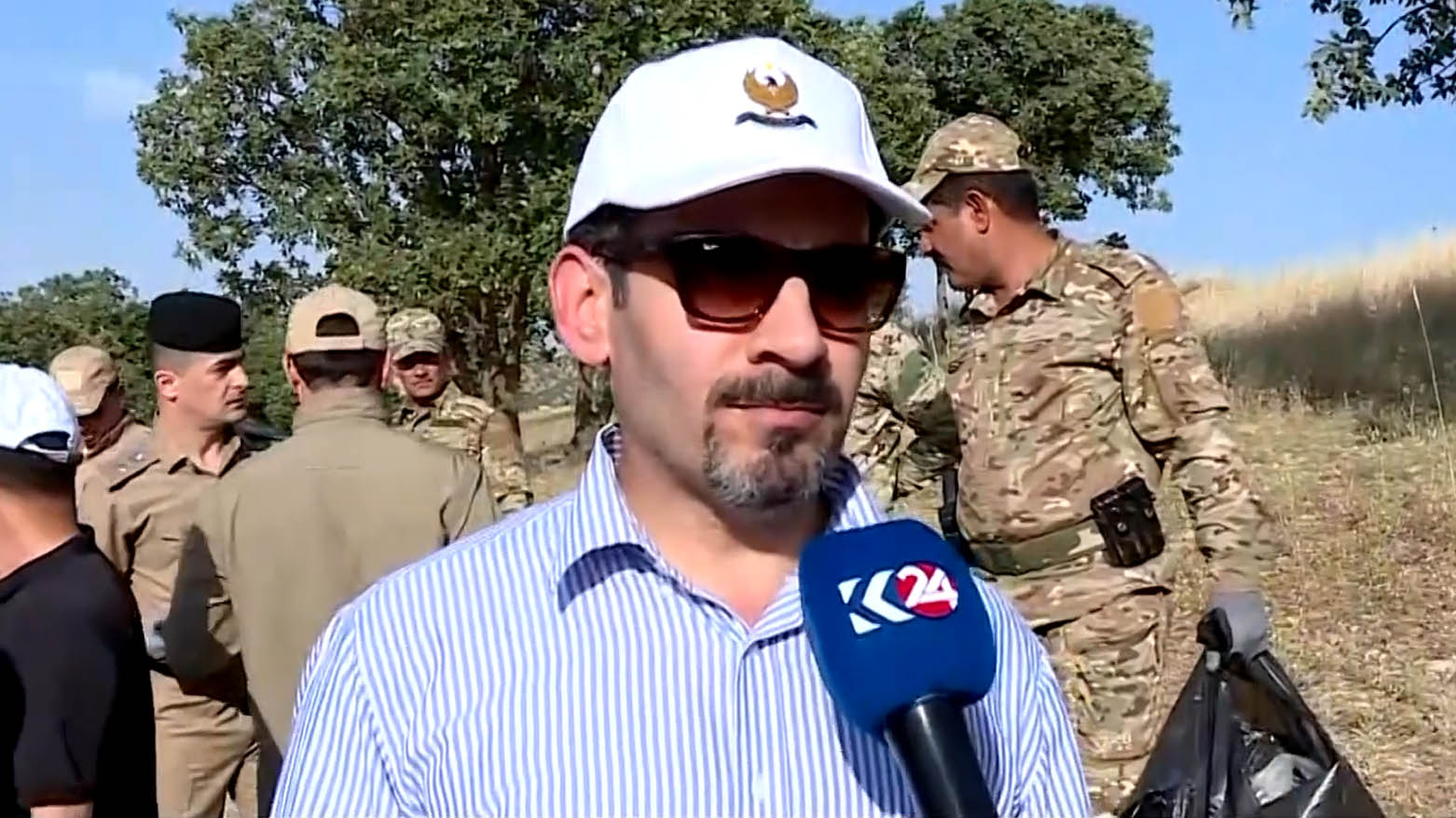
ERBIL (Kurdistan 24) - On the banks of one of Erbil's most beloved natural landmarks, a new kind of enforcement took shape on Saturday. Officers from the Kurdistan Region Government's Ministry of Interior fanned out across the Gomespian Dam area, backed by cameras, volunteer teams, and the authority to issue fines of up to eight million Iraqi dinars, a signal that Prime Minister Masrour Barzani's commitment to environmental protection has moved well beyond slogans.
The Saturday cleanup operation around Gomespian Dam brought together the Forest and Environment Police, Traffic Police, Civil Defense, Coordination and Crisis Management (JCC) volunteer teams, the Ministry of Municipality and Tourism, the Environment Protection and Improvement Board, and the Kurdistan Foundation in a coordinated multi-agency operation that officials described as both a practical intervention and a civic message.
A National Duty, Not a Seasonal Campaign
Speaking to Kurdistan 24 on Saturday, Hemen Mirani, Director General of the Interior Ministry's Diwan, was direct about the campaign's intent. "Although yesterday was World Environment Day, protecting the environment must become a daily and national duty for every citizen," he said. "Gomespian Dam is now considered one of Erbil's most important tourist areas and a source of clean air for the city, so maintaining its cleanliness is the responsibility of all parties."
Mirani also addressed one of the most persistent problems at tourist sites across the Region, visitors who gather waste in a pile and leave it behind, believing they have done their part. "Gathering rubbish and leaving it in place is not an answer, because wild animals search for food at night and scatter the waste," he said. "Our message to visitors is to take their waste with them and dispose of it in the designated areas provided by the municipality."
Heavy Fines and Camera Enforcement
The enforcement framework now in place carries significant financial weight. Mirani confirmed that penalties for environmental violations under the laws and guidelines of the Environment Board range from 100,000 dinars to eight million dinars, with officers of the Environment Board and the Forest and Environment Police holding full authority to impose them on violators.
For the specific offense of throwing waste from vehicles, a widespread problem on Kurdistan's roads and near its natural sites, the minimum penalty stands at 40,000 dinars. Traffic and security surveillance cameras have been reconfigured to detect and record this type of violation, removing the need for an officer to be physically present at the scene. Mirani also called on citizens to participate directly by photographing the license plates of offending vehicles and reporting them to traffic authorities.
Looking beyond immediate enforcement, Mirani pointed to a longer-term government strategy targeting plastic consumption. He stressed that plastic and glass materials cause severe environmental damage, requiring hundreds of years to decompose, and confirmed that the KRG's future plan involves promoting paper and cardboard as substitutes for plastic and nylon, with the protection of Kurdistan's natural environment as its central objective.
Prime Minister Masrour Barzani's Vision: Governance Meets the Environment
The enforcement campaign around Gomespian Dam reflects a governing philosophy that Prime Minister Masrour Barzani has placed at the centre of the Ninth Cabinet's agenda since taking office, one that treats environmental sustainability not as a peripheral concern but as a core pillar of modern, responsible governance.
Since assuming the premiership, Barzani has consistently framed the Kurdistan Region's development trajectory in terms of long-term resilience: an economy less dependent on a single revenue source, a population less exposed to the consequences of climate change, and a natural environment actively protected rather than passively inherited. The Ninth Cabinet's programme has given institutional shape to that vision through a series of interconnected investments in water, energy, infrastructure, and green public space, each reinforcing the others in ways that Saturday's enforcement operation made tangible.
Dams as the Foundation of a Green Kurdistan
Dam construction has been among the most visible expressions of Barzani's infrastructure agenda. Across the Kurdistan Region, multiple dam projects have been completed or are under active development under the Ninth Cabinet, designed not only to address water scarcity driven by declining rainfall and rising temperatures, but to create new reservoirs of green space, eco-tourism potential, and agricultural stability.
The dams serve as anchor points for the kind of natural environment that the Interior Ministry is now working to protect, making enforcement campaigns like Saturday's cleanup inseparable from the cabinet's broader infrastructure investment. The Gomespian Dam itself, situated on the outskirts of Erbil, has been developed in recent years into one of the city's primary recreational and environmental assets. Its growing importance as a tourist destination reflects the Ninth Cabinet's strategy of connecting water infrastructure with public enjoyment and ecological health, a model being replicated across the Region's governorates.
Runaki: Powering the Infrastructure of a Greener Future
Among the most transformative projects carried out under Masrour Barzani's leadership is the Runaki electricity initiative, one of the most ambitious public infrastructure programmes in the Kurdistan Region's recent history. The project, whose name means light in Kurdish, set out to deliver 24-hour electricity to homes and businesses across the Region, ending decades of reliance on private generators that have imposed enormous financial costs on households and contributed significantly to air and noise pollution in Kurdish cities.
The environmental implications of Runaki extend well beyond convenience. Private diesel generators, long the default solution for Kurdistan's chronic power shortages, have been among the most visible sources of urban air pollution, degrading the quality of life in residential areas and darkening the skies above Kurdish cities. By replacing generator dependency with stable grid electricity, the Runaki project directly supports the cleaner, healthier environment that campaigns like Saturday's operation are working to preserve on the ground.
Barzani has cited the Runaki project as emblematic of the Ninth Cabinet's broader approach, delivering tangible improvements to daily life while simultaneously building the environmental and economic foundations for a more sustainable Region. The project has also unlocked new possibilities for public and commercial investment in energy-efficient infrastructure, removing one of the most persistent obstacles to modernization that businesses and institutions across the Region have faced for years.
Highways and the Architecture of a Connected Region
Alongside its water and energy investments, the Ninth Cabinet under Barzani has pursued an accelerated highway construction programme designed to link the Kurdistan Region's cities, towns, and tourist destinations with modern road infrastructure. New and upgraded highways connecting Erbil, Sulaimani, and Duhok have been central to this effort, reducing travel times, easing commercial movement, and opening previously difficult-to-reach natural areas to visitors.
The highway programme carries environmental significance of its own. Well-designed road infrastructure, with proper waste management facilities at rest stops and entry points to natural sites, is a prerequisite for the kind of responsible tourism the KRG is now seeking to enforce. Saturday's operation at Gomespian Dam, a site increasingly accessible to Erbil's residents and visitors from across the Region thanks to improved road connections, illustrated both the opportunity and the challenge that expanded access brings.
As more of Kurdistan's natural areas come within easy reach of larger numbers of visitors, the pressure on those environments intensifies. The Interior Ministry's enforcement campaign is, in this sense, the necessary complement to Barzani's connectivity investments, ensuring that the roads built to bring people closer to Kurdistan's natural beauty do not become the routes by which that beauty is degraded.
A Vision Taking Shape
Taken together, the dam construction programme, the Runaki electricity project, the highway network, and the environmental enforcement framework announced on Saturday form the outline of a coherent regional vision championed by Prime Minister Masrour Barzani, one in which infrastructure investment and civic responsibility reinforce each other at every level of governance.
The Ninth Cabinet has consistently framed its development agenda in terms of long-term sustainability, and the Interior Ministry's announcement of fines reaching eight million dinars, backed by surveillance technology and multi-agency coordination, suggests that the enforcement side of that vision is now beginning to match the ambition of its construction programme.
For the citizens of a region that has endured decades of conflict, displacement, and underdevelopment, the combination of a lit home, a functioning road, a full reservoir, and a clean park represents something that statistics alone cannot fully capture. It is, in the language of Masrour Barzani's own stated goals for the Ninth Cabinet, the beginning of a normal life, and one worth protecting.
| BRIEF: The KRG Interior Ministry launched an environmental crackdown on June 6, 2026, with fines from 100,000 to 8 million dinars. The campaign reflects Prime Minister Masrour Barzani's Ninth Cabinet vision, linking dam construction, the Runaki electricity project, and highway development into a unified sustainability agenda. |