A Pillar of National Identity: Kurdistan President Calls for a Unified and Modernized Peshmerga Force
Addressing newly commissioned officers, Kurdistan Region President Nechirvan Barzani emphasized the necessity of depoliticizing the military and adopting advanced technologies to secure Kurdistan's future.
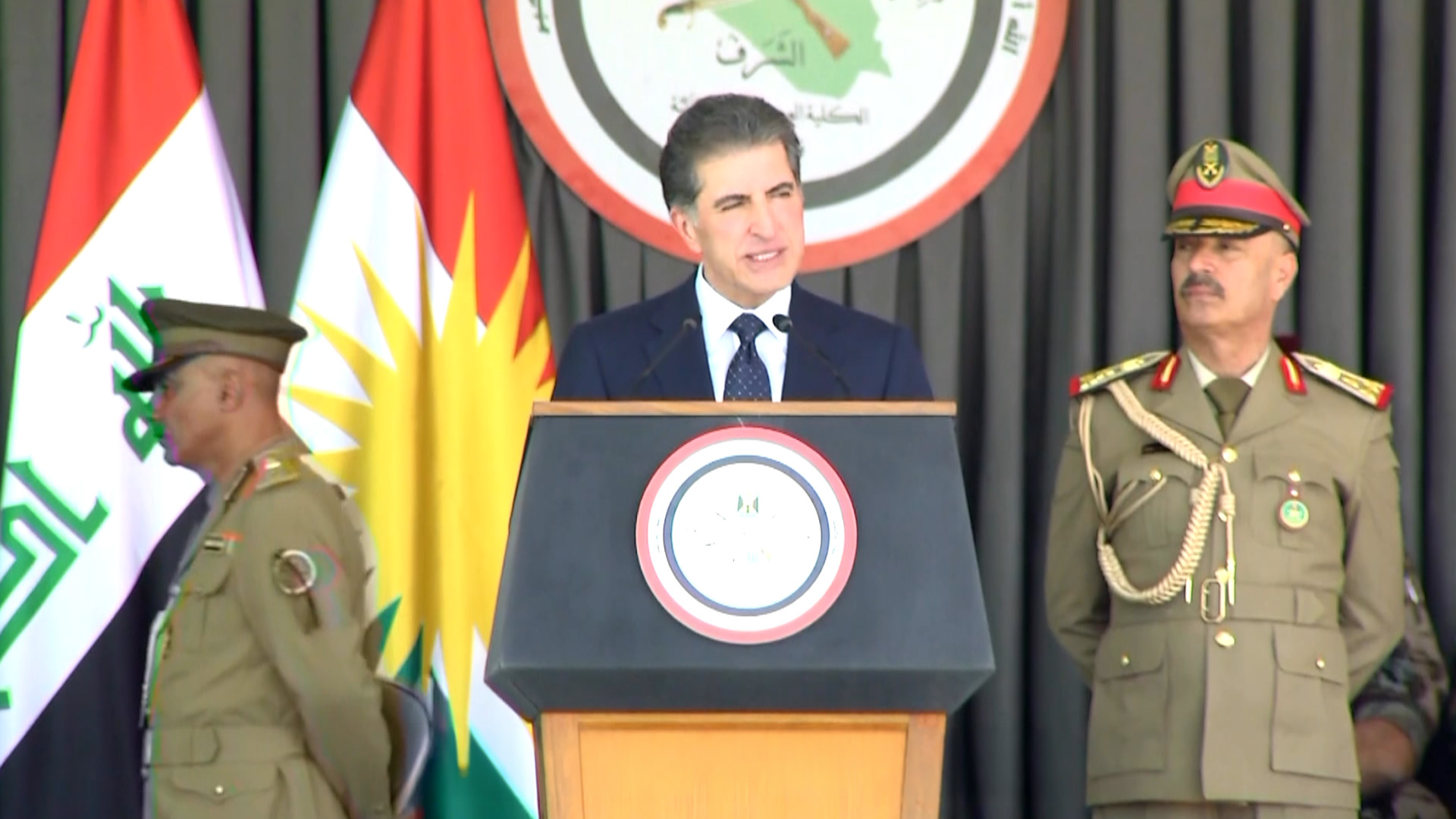
ERBIL (Kurdistan24) - In an era marked by shifting regional security paradigms, Kurdistan Region President Nechirvan Barzani delivered a forceful mandate to the next generation of Kurdish military leadership, declaring the Peshmerga forces a "golden and central part" of the Kurdish national identity. His remarks underscored a broad strategic vision aimed at transforming the historic fighting force into a modern, unified, and strictly nonpartisan institution.
The declaration came on Sunday as Kurdistan Region President presided over the graduation ceremony for the fifth cohort of the Qalacholan Military College in Sulaimani province.
Addressing the 210 newly commissioned officers, the president framed their graduation not merely as a personal achievement, but as a critical component in the ongoing professionalization of the Kurdistan Region's security architecture.
President Barzani utilized the high-profile ceremony to reaffirm the sacred status of the Peshmerga in the Kurdish historical consciousness, while simultaneously demanding an evolution in its operational culture.
"The name 'Peshmerga' is sacred," he told the assembled graduates and military officials. "The service of the Peshmerga is a central and golden chapter of our national and ethnic identity. It is the duty of everyone to preserve the history of sacrifice and the dignity of this force."
Yet, the preservation of that dignity, the President argued, now depends on rigorous institutional reform. For decades, the Peshmerga have served as the ultimate guarantors of Kurdistan autonomy, earning international acclaim for their decisive role in the territorial defeat of the Islamic State.
However, the Region's President emphasized that the challenges of the future require a force unburdened by the divisions of the past. He urged the new graduates to serve exclusively within the framework of a unified and professional national military, pushing back against the historical legacy of politically affiliated units.
This push for depoliticization formed the thematic core of his address.
In a pointed directive aimed at insulating the armed forces from domestic political friction, President Barzani cautioned the new officers to never allow themselves to become entangled in partisan disputes or political conflicts.
"Remain a national force for Kurdistan," he asserted, demanding a commitment to institutional integrity that places the security of the region above all internal factionalism. The strength and survival of the Kurdistan Region, he warned, rely entirely on the ability of its institutions to transcend political differences and prioritize high national interests.
Beyond structural unity, President Barzani outlined a modernized vision for the Peshmerga's tactical future. He clarified that the duties of a contemporary officer extend far beyond traditional battlefields.
As the Middle East grapples with increasingly sophisticated, asymmetric threats, the president noted that the Kurdish military must adapt to rapid technological shifts and foster a culture of tactical innovation.
Mastering modern military technology and committing to continuous, rigorous training must become the foundation of their operational strategy, he explained.
This focus on technological adaptation reflects a broader awareness within the Kurdistan Region Government that conventional infantry tactics alone are insufficient to secure the region's borders and critical infrastructure.
Crucially, the Kurdistan Region President also intertwined military duty with civic responsibility. In a segment of his speech that highlighted the Kurdistan Region's distinct political culture, President Barzani advised the newly commissioned officers to act as steadfast guardians of civil values, democratic principles, and human rights.
He instructed them to defend human dignity uniformly, without regard for religious or ethnic background, a mandate that reinforces the region's status as a sanctuary for coexistence and diversity in a deeply fractured Middle East.
The successful implementation of this ambitious reform agenda, ranging from technological modernization to structural unification, has been heavily supported by foreign allies.
Concluding his address, President Barzani expressed profound gratitude to the International Coalition forces, led by the United States.
He praised their sustained, critical support for both the Peshmerga and the Iraqi Army, emphasizing that international partnership remains an indispensable element in the ongoing mission to eradicate terrorism and stabilize the nation.
For the 210 officers departing the parade grounds at Qalacholan, the president's message established a daunting but clear mandate.
They are tasked with carrying forward the revered legacy of the Peshmerga, while serving as the vanguard of its transformation into a unified, technologically advanced, and strictly professional pillar of the modern Kurdish national identity.
|
Summary President Nechirvan Barzani hailed the Peshmerga as a pillar of national identity during the graduation of 210 officers at Qalacholan Military College. He urged the modernization and professionalization of forces, affirming a strong commitment to unity, democracy, and anti-terror cooperation. |