Iraq Appeals Court Upholds Death Sentence for Anfal Convict Ajaj al-Tikriti
Iraq's Federal Court of Appeals upheld the death sentence against Ajaj al-Tikriti over Anfal genocide crimes, marking a major milestone in Iraq's pursuit of justice.
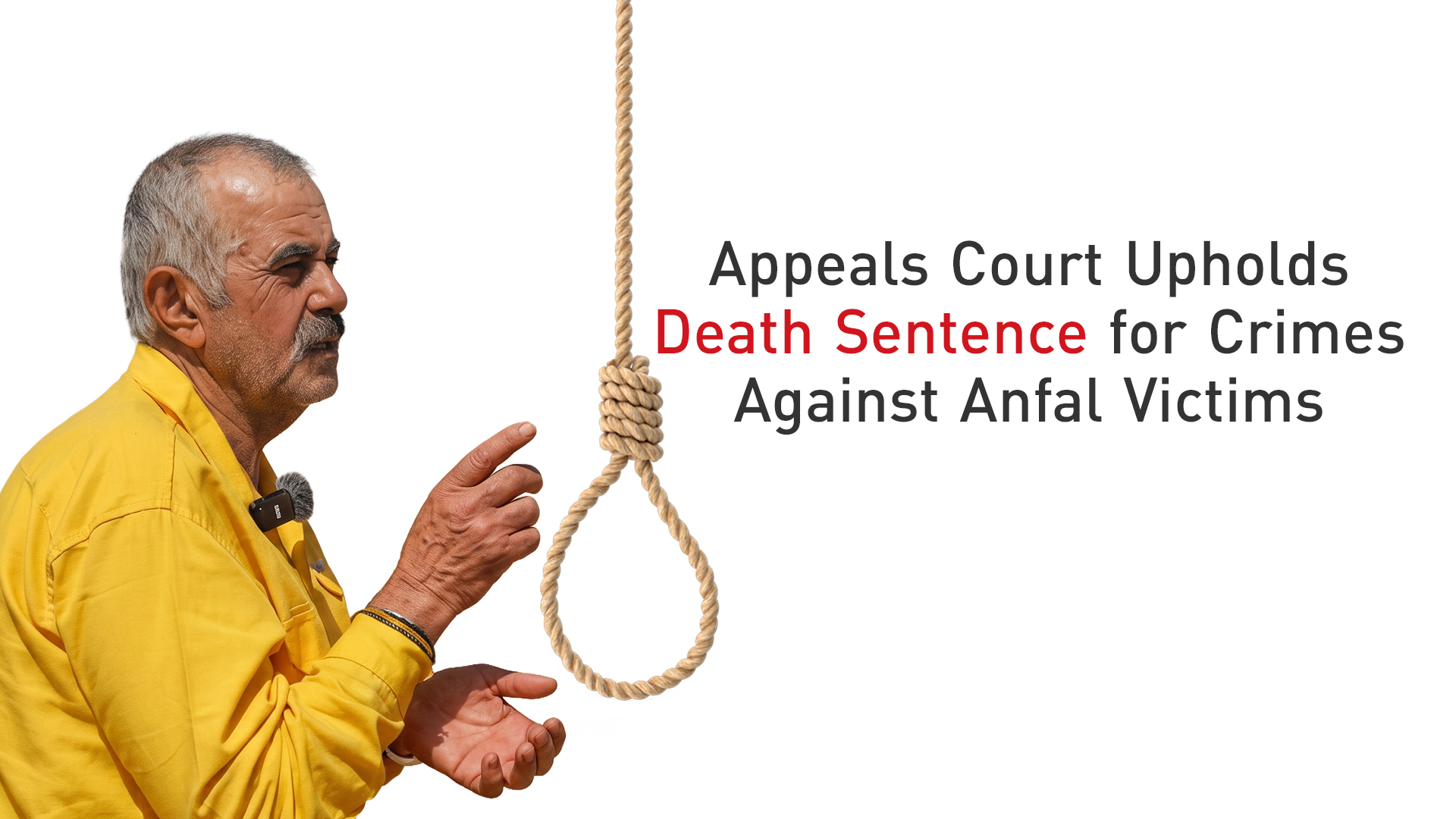
ERBIL (Kurdistan24) - Nearly four decades after the Anfal campaign left tens of thousands of Kurdish families searching for answers, Iraq's judicial process has reached another decisive moment. On Thursday, the Federal Court of Appeals upheld the death sentence imposed on Ajaj Ahmed Hardan al-Tikriti, a former Baath-era prison official convicted of genocide, crimes against humanity, sexual violence, and the murder of Kurdish detainees held at the notorious Nugra Salman prison in 1988.
The appeals ruling leaves one of the most prominent Anfal-era prosecutions at its final judicial stage. Under Iraqi law, the case will now be referred to the Presidency of the Republic, where a presidential decree is required before the sentence can be carried out.
For many survivors and relatives of those who never returned from Nugra Salman, however, the decision represents less a conclusion than another step in a decades-long pursuit of accountability.
The legal ruling cannot undo the suffering endured during the Anfal campaign, but it formally reaffirms judicial findings that some of its most notorious crimes amounted to genocide and crimes against humanity.
Presiding Judge Saad Lami told the Iraqi News Agency (INA) that the Federal Court of Appeals had ratified the death sentence after finding al-Tikriti responsible for crimes committed against Kurdish civilians imprisoned during the Anfal operations.
According to the court, the conviction rests on evidence that included systematic starvation, dehydration, torture leading to death, and sexual assaults committed against female detainees inside Nugra Salman prison.
The appellate ruling follows the Iraqi High Criminal Court's original judgment issued on May 14, which found al-Tikriti guilty under Iraq's High Criminal Court Law.
Read More: Death Sentence Issued Against 'Butcher of Nugra Salman' Accused in Anfal Atrocities
By affirming that verdict, the appeals court completed the final major judicial review required before the case advances to the executive stage prescribed by Iraqi law.
The significance of the ruling extends well beyond a single defendant.
It revisits one of the darkest chapters of modern Kurdish history, when the Baath regime's 1988 Anfal campaign targeted Kurdish civilians through mass displacement, village destruction, arbitrary detention, enforced disappearances, and mass killings.
Iraqi courts have previously recognized the campaign as genocide, yet many individual cases have taken decades to reach trial as investigators sought surviving perpetrators and assembled evidence from events that occurred nearly 40 years ago.
Among the places most closely associated with those crimes is Nugra Salman, the isolated desert prison in Iraq's southern Muthanna province where thousands of Kurdish detainees, including women, children and elderly civilians, were transported after surviving earlier phases of the Anfal campaign.
For many Kurdish families, the prison remains a symbol not only of imprisonment but of disappearance, as countless detainees never emerged alive and many victims were later found in mass graves or remain missing.
Read More: Families of Anfal Victims Hold Memorial at Nugra Salman Prison
Court findings in the al-Tikriti case described Nugra Salman as the site of systematic abuses carried out against detainees.
Prosecutors alleged that starvation, dehydration, torture and humiliation formed part of an organized pattern of abuse.
Judicial documents also concluded that more than 1,000 detainees died after being subjected to those conditions, while the forced disappearance of 1,068 people, including women, children and persons with disabilities, formed part of the prosecution's genocide case.
The trial also became a rare public forum for survivors whose experiences had remained largely confined to family memory for decades. Their testimony gave the proceedings a human dimension that extended far beyond legal arguments.
Among those who appeared before the court was survivor Amina Ali, who described losing her 11-year-old daughter and four-year-old son inside the prison because of starvation, thirst and the absence of medical treatment.
Other witnesses recounted watching fellow prisoners die from malnutrition and disease as food and clean water became increasingly scarce.
Additional testimony presented during the proceedings described alleged sexual violence against women and girls held at the prison, allegations that Iraqi judicial authorities said formed part of the basis for al-Tikriti's conviction.
Lawyers representing victims also told Kurdistan24 that investigators relied on witness testimony, documentary evidence, photographs and crime-scene reconstruction during the lengthy investigation.
The road to Thursday's appellate decision began long before the courtroom.
After the collapse of Saddam Hussein's regime in 2003, al-Tikriti disappeared from public view for years. Iraqi security officials say he lived under an assumed identity after allegedly altering his appearance and moving between locations in an effort to avoid capture.
Read More: Iraqi High Criminal Court Reveals New Details in Butcher of Nugra Salman Genocide Ruling
His arrest in July 2025 followed months of intelligence work by Iraq's National Security Service. Survivors also played a significant role in keeping the search alive.
One of them, Fazila Hama-Khula, spent decades trying to identify the man she believed had overseen abuses at Nugra Salman. Her efforts ultimately contributed to information that helped investigators locate and arrest him after years on the run.
For survivors, that arrest marked the first indication that accountability remained possible despite the passage of time.
When the High Criminal Court handed down its original death sentence in May, hundreds of relatives of Anfal victims and survivors traveled to Nugra Salman prison itself.
Rather than gathering in Baghdad outside the courtroom, they returned to the place where many of their relatives had suffered and died.
They prayed inside the abandoned prison, laid flowers in memory of victims, and commemorated relatives whose remains have never been recovered.
The gathering reflected a broader reality surrounding the Anfal genocide: for many families, the search for missing loved ones continues long after court verdicts have been delivered.
That unresolved legacy continues to shape Kurdish collective memory.
The Anfal campaign claimed the lives of an estimated 182,000 Kurds, according to widely cited historical estimates, while thousands of villages were destroyed across the Kurdistan Region.
Mass graves continue to be discovered decades later, and many families still do not know where relatives were buried.
Against that backdrop, the appeals ruling carries importance beyond the punishment of a single individual. It reinforces an official judicial record documenting crimes committed during Anfal and preserves testimony that might otherwise have been lost as survivors age.
Read More: Anfal-Era 'Executioner' of Nugra Salman Prison Captured in Iraq
At the same time, it serves as a reminder that many alleged perpetrators have never faced trial, while countless victims remain unidentified.
For Kurdish survivors, justice has never been measured solely by criminal convictions. It also encompasses recognition of historical truth, continued efforts to identify mass graves, support for survivors, and preserving the memory of those who disappeared.
The Federal Court of Appeals' decision therefore closes one important legal chapter but leaves larger questions unresolved. As the case moves to Iraq's Presidency for the final procedures required under law, the ruling stands as another acknowledgment of atrocities that shaped generations of Kurdish families.
Nearly four decades after the crimes at Nugra Salman, the search for accountability continues, not only through courtrooms, but through remembrance, documentation, and the determination of survivors who refused to let those events fade into history.
|
Summary Iraq's Federal Court of Appeals has upheld the death sentence against Ajaj Ahmed Hardan al-Tikriti for genocide and crimes committed during the 1988 Anfal campaign, advancing one of the country's most significant efforts to deliver judicial accountability for atrocities committed against Kurdish civilians. |