How Kurdistan Region Achieved Self-Sufficiency in Water Pipe Manufacturing?
Government support and advanced technology have propelled local plastic pipe producers to compete with, and in some cases surpass, European standards.
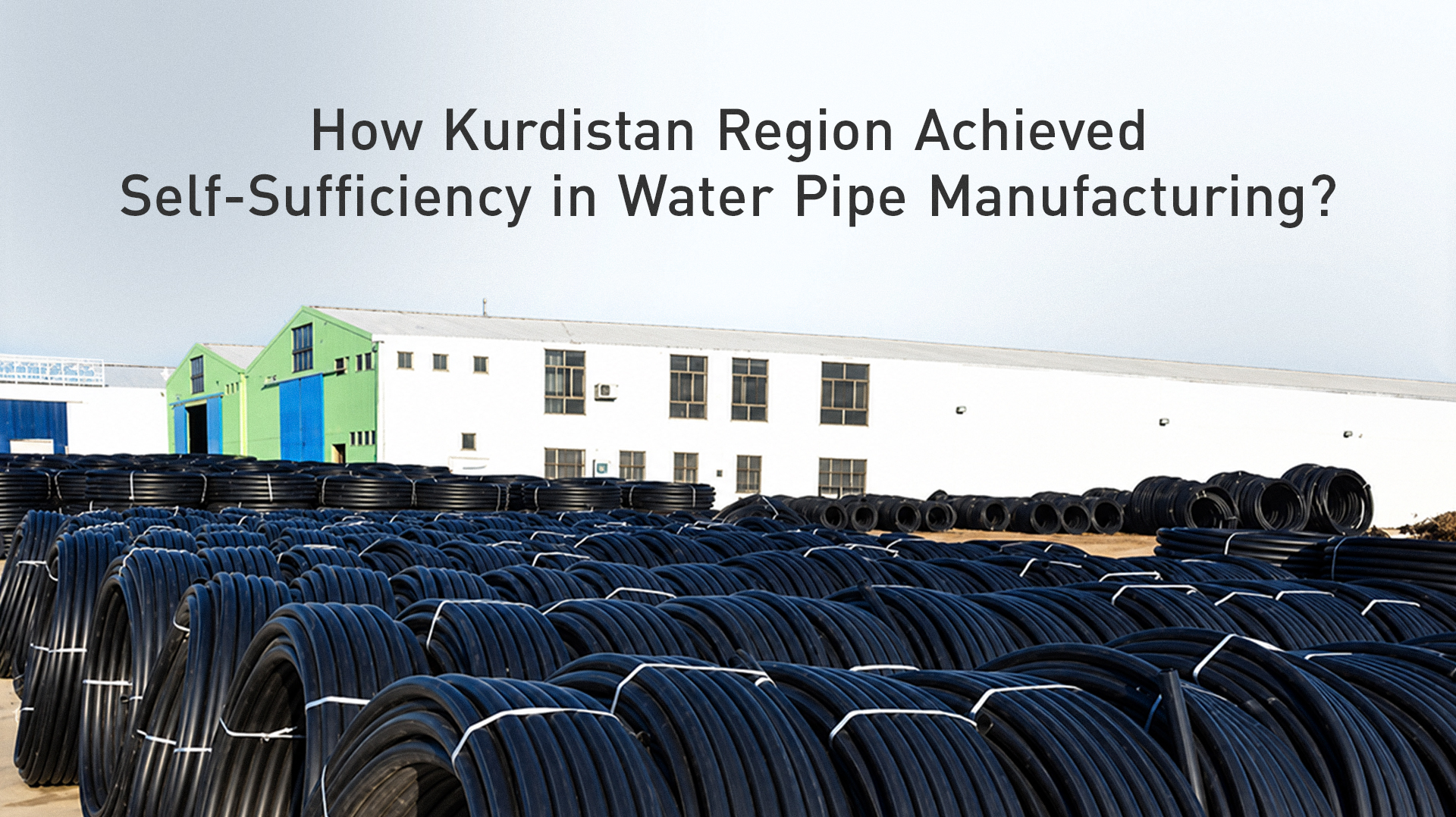
ERBIL (Kurdistan24) - An investigative report by the Kurdistan24 program "Bujanewa" has revealed a striking milestone in the Kurdistan Region's industrial development: local plastic pipe factories are now fully meeting the needs of major water and infrastructure projects across the region, eliminating reliance on imported pipes and, in some cases, outperforming their European-made counterparts.
According to the report, protective policies and direct technical support from the Ninth Cabinet of the Kurdistan Regional Government have enabled local factories to operate at full production capacity around the clock. Luqman Shekhani, owner of the Dilav Plast pipe factory, said government backing and official certification from the Ministry of Municipalities and the General Directorate of Water were the cornerstone of the factory's success. The plant now produces roughly 20,000 tons of plastic pipes annually, in more than 30 different sizes, supplying large-scale water and sewage networks.
"Based on tests and scientific reports issued by the laboratories of Salahaddin University, the efficiency of our locally made pipes exceeded that of imported German pipes by 12 percent, and imported Italian pipes by 24 percent," Shekhani said, adding that this technical edge has strengthened the region's ambitions to open export markets to neighboring countries after fully securing domestic demand.
The Kurdistan Region's mountainous and rocky geography poses a major challenge to sustaining water networks, but local factories have overcome this obstacle by employing advanced material technology. Engineer Kosrat Kawa, the facility's production manager, said the modern production lines rely entirely on advanced materials such as PE100 RC, which resists cracking, twisting, and breakage, allowing networks to be laid in rocky mountainous areas without the need for protective sand insulation layers. The factory offers an operational warranty of up to 50 years on its products.
Kawa also pointed to the integration of an automatic gravimetric weight-control system into the production lines, which precisely monitors the weight of every manufactured meter of pipe, reducing human error and ensuring the thickness required to withstand high hydrostatic pressure.
Factory director Roza Shekhani, who holds academic qualifications and extensive engineering experience from London, said the facility's strategy is built on localizing engineering knowledge and transferring advanced European standards to train local staff. To achieve this, the factory regularly sends its local engineering and technical teams on specialized training missions to Germany, China, and Egypt to keep pace with the latest multilayer pipe manufacturing techniques.
On product quality and environmental and health compliance, quality control officer Adnan Ali said the factory operates a laboratory equipped with the latest technical instruments and holds international accreditation under ISO 17025. Raw materials and finished products undergo strict, periodic testing to ensure defect-free output suitable for delivering clean and safe drinking water to citizens.
The model illustrates how an effective strategic partnership between government policy and regulatory decisions on one hand, and the operational efficiency and technological innovation of the national industrial sector on the other, has laid a solid foundation for self-sufficiency and a sustainable infrastructure base for future generations.