KRG's Mega Infrastructure Drive Reshapes Kurdistan Region with Strategic Water, Energy, and Transport Projects
Under the ninth cabinet led by Prime Minister Masrour Barzani, the KRG prioritized investment in water resources, energy, and transportation, shifting its focus from short-term solutions to sustainable projects intended to serve future generations.
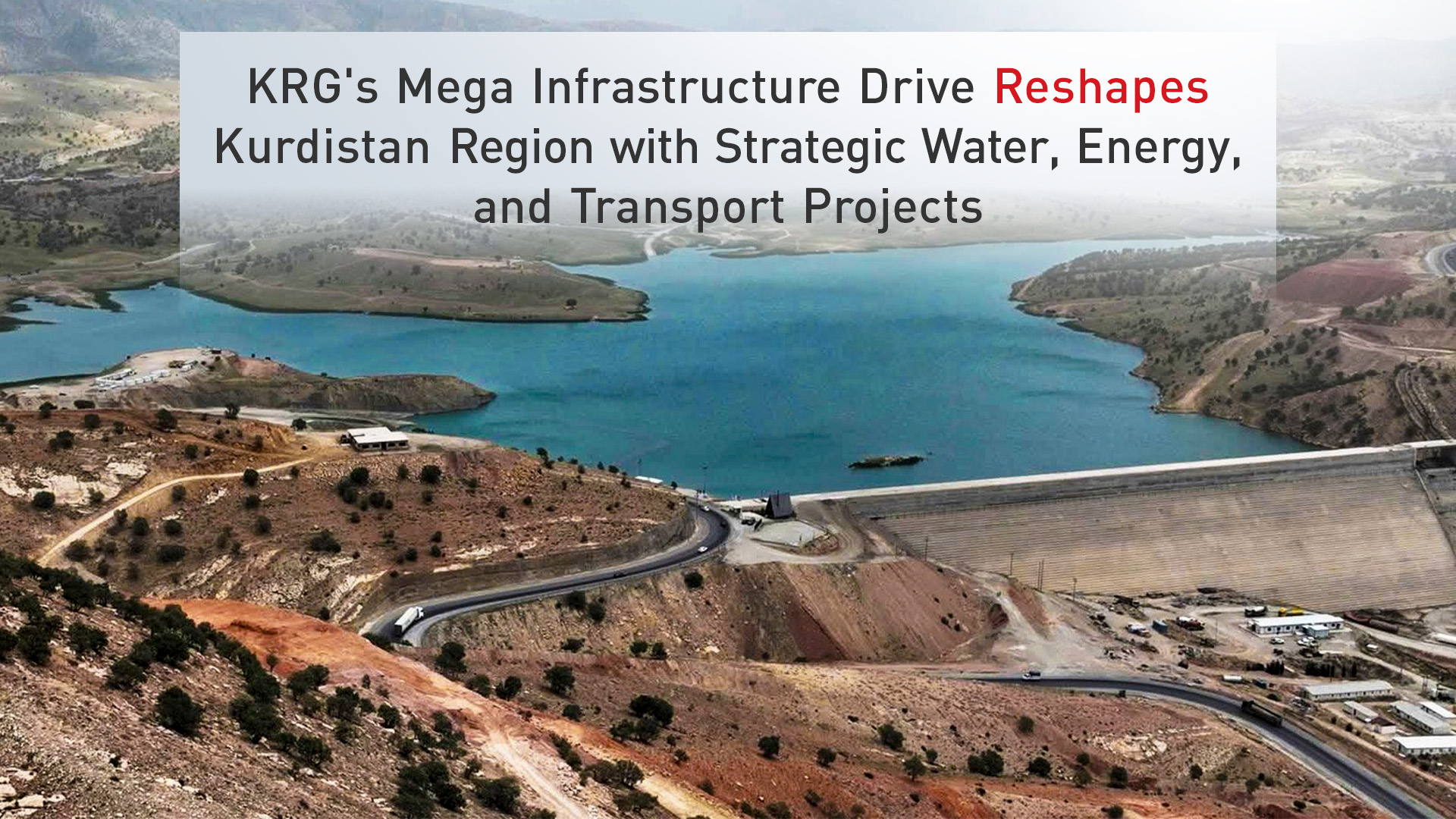
ERBIL (Kurdistan24) – The Kurdistan Region is undergoing one of the most ambitious infrastructure transformations in its history, as the Kurdistan Regional Government (KRG) advances a series of strategic mega-projects designed to strengthen water security, modernize public services, expand transportation networks, and support long-term economic growth.
Under the ninth cabinet led by Prime Minister Masrour Barzani, the KRG prioritized investment in water resources, energy, and transportation, shifting its focus from short-term solutions to sustainable projects intended to serve future generations.
At the heart of this strategy is an expansive water security program aimed at addressing the growing challenges of climate change, drought, and declining groundwater reserves. Combined with the Erbil Emergency and Strategic Water Supply Project, the government's extensive network of dams and water reservoirs stretching from Zakho to Sulaimani forms a long-term plan to safeguard water supplies and support economic development across the Kurdistan Region.
Modernizing Public Services
Since taking office, the ninth cabinet has sought to transform economic and political challenges into opportunities for development by expanding public services and accelerating institutional modernization.
Despite regional instability and global economic pressures, the Kurdistan Region has witnessed a construction boom, with major investments directed toward long-neglected neighborhoods, villages, and districts while promoting balanced development across the region.
The government has also accelerated digital transformation, launching initiatives to improve public services alongside major infrastructure projects. These include the expansion of Erbil's 150-Meter Ring Road, the dual carriageway of Soran’s Khalifan district, the Runaki project to provide 24-hour electricity, and the construction of new schools and hospitals.
Water Security as a Strategic Priority
Prime Minister Masrour Barzani has repeatedly described water security as a matter of national security, emphasizing that drought and falling groundwater levels pose long-term risks to the Kurdistan Region's future.
In response, the government launched a comprehensive strategy centered on constructing dams, rainwater harvesting ponds, and artificial reservoirs to capture seasonal rainfall, replenish underground aquifers, and support agriculture, tourism, and food security.
Despite financial constraints, the ninth cabinet has completed major milestones in water resource management.
According to KRG figures:
- More than 252.8 million cubic meters of freshwater storage capacity have been created.
- Approximately 265.7 billion Iraqi dinars (approximately US$185.8 million) have been invested.
- Nine strategic dams have been completed and are operational.
- Twenty-three water ponds have been finished, while 58 additional ponds are under construction to support villages and farmers.
Nine Strategic Dams Completed
The government's water strategy has resulted in the completion of nine dams across the Kurdistan Region:
- Dwin Dam
- Gomaspan Dam
- Dewana Dam
- Bastora Dam
- Khans Dam
- Aquban Dam
- Turajar Dam
- Shukir Dam
- Chamarga Dam
Among the flagship projects is the Bastora Dam in Erbil Province, inaugurated by Prime Minister Masrour Barzani in October 2024. Built entirely by local engineers and companies, the dam has a storage capacity of 20 million cubic meters and measures 560 meters in length.
Construction is also underway on 12 additional dams, while the KRG is coordinating with the Iraqi federal government on four larger strategic dams— Bakrman, Mandawa, Dalga, and Taq Taq—that are expected to serve both the Kurdistan Region and Iraq.
Record Water Storage and Renewable Energy
Heavy seasonal rainfall has significantly boosted water reserves across the Kurdistan Region.
According to official figures, total water stored in the region's dams reached 8.4 billion cubic meters this year—an increase of 4.8 billion cubic meters compared with the previous year.
The improved water reserves have also increased hydropower generation, with electricity production from dams rising from 61 megawatts last year to 175 megawatts, strengthening the region's renewable energy capacity.
Erbil's Long-Term Water Solution
Alongside the dam program, the KRG has completed the Erbil Rapid Water Emergency Project, valued at nearly $480 million.
The project replaces Erbil's heavy reliance on groundwater—which previously accounted for 65% of the city's water supply—by drawing surface water from the Greater Zab River.
Operating at full capacity, the system delivers 480,000 cubic meters of water per day, enough to meet Erbil's demand for the next 30 years, through 2055.
The project is also expected to allow the closure of approximately 1,200 groundwater wells, giving depleted underground aquifers an opportunity to recover naturally.
Environmental and Economic Impact
The government's water infrastructure program is already producing measurable environmental and economic benefits.
Officials say groundwater levels have risen between 2 and 23 meters in many areas, with some locations recording increases approaching 100 meters, reducing the need for mechanical pumping.
Small dams and water ponds have also helped sustain rural communities by providing reliable water for agriculture, livestock, tourism, and fish farming.
To further promote rainwater harvesting, the KRG has allocated 1.5 billion Iraqi dinars (approximately US$1.05 million) under its Cooperative Ponds Initiative, enabling farmers to construct water storage ponds and reduce dependence on groundwater wells.
Significant Public Investment
The KRG continues to heavily subsidize water services across the Kurdistan Region.
Annual water production costs are estimated at 500 billion Iraqi dinars (approximately US$382 million), while revenue from water services amounts to only 60 billion Iraqi dinars (approximately US$46 million), leaving the government to cover roughly 440 billion Iraqi dinars (approximately US$336 million) each year.
Officials have also urged residents to conserve water, noting that the average daily consumption stands at 350 liters per person, well above the estimated requirement of 181 liters and higher than average usage in neighboring countries such as Türkiye and Egypt.
Built by Local Companies
A defining feature of many of the ninth cabinet's flagship infrastructure projects is their reliance on Kurdish engineering expertise.
Projects including the Bastora Dam and the Erbil Rapid Water Emergency Project were designed and constructed by local engineering firms and Kurdish companies, including Hemn Group, creating thousands of jobs while showcasing the capabilities of domestic contractors.
According to the KRG, the benefits of these investments extend beyond water supply, supporting agricultural production, livestock, tourism, environmental protection, flood prevention, and long-term economic development.
Through its integrated infrastructure strategy, the Kurdistan Region aims to build a more resilient future by strengthening water security, expanding renewable energy, modernizing public services, and developing sustainable infrastructure capable of meeting the challenges posed by climate change for decades to come.