Sanaa Airport Strike Deepens Yemen Crisis as Houthis Threaten Retaliation
A strike on Sanaa International Airport, competing claims over Iranian flights, and Houthi threats of retaliation have intensified tensions around one of Yemen's most strategically sensitive gateways.
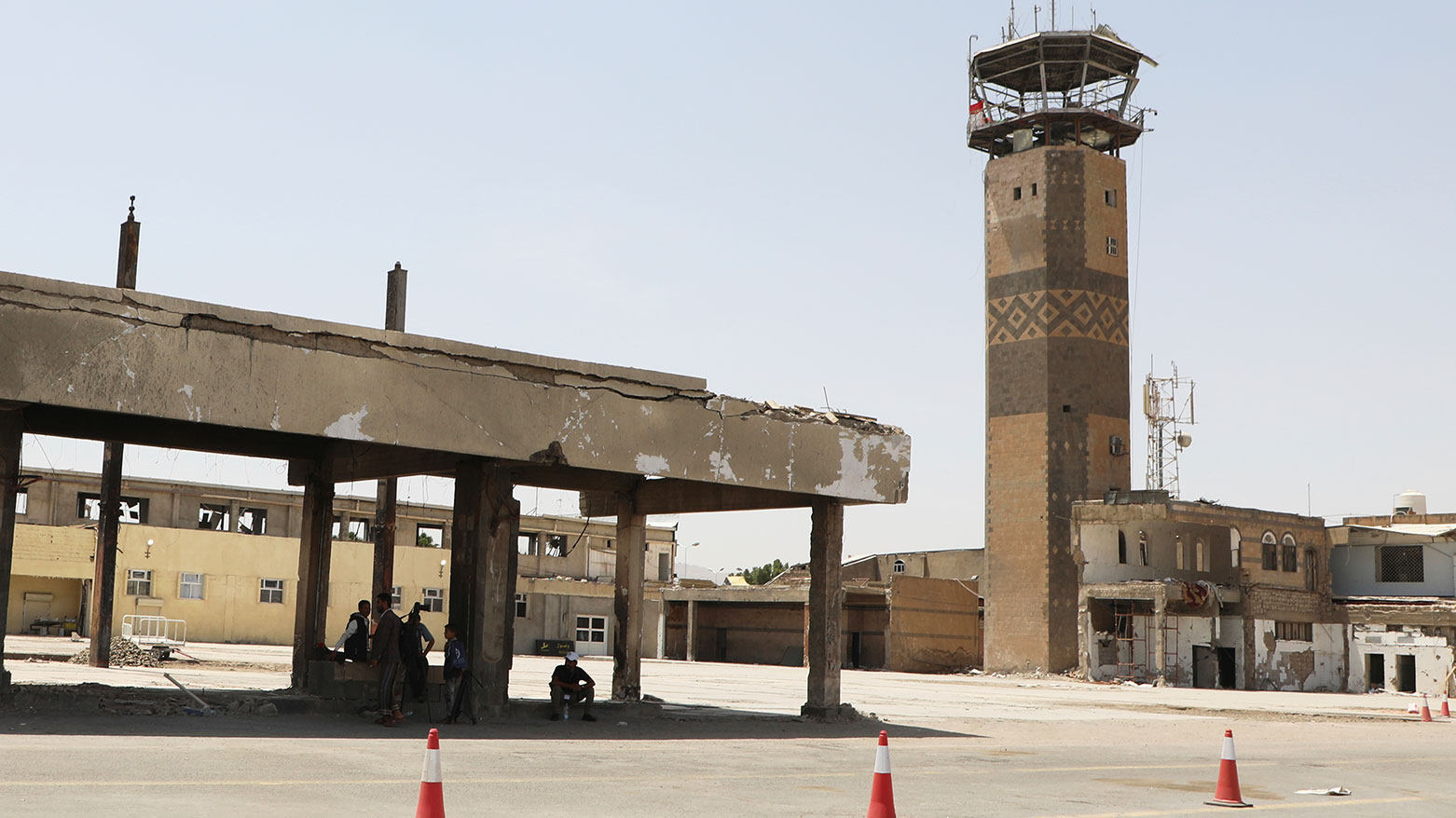
ERBIL (Kurdistan24) - A strike on the runway of Sanaa International Airport has pushed Yemen's conflict into a new phase of confrontation, placing one of the country's most strategically significant civilian facilities at the center of an escalating dispute over sovereignty, regional influence, and access to Yemeni airspace.
Yemen's internationally recognized government said it deliberately targeted the airport runway to prevent an Iranian aircraft from entering Houthi-controlled territory, arguing that repeated unauthorized flights had violated the country's civil aviation regulations and national sovereignty.
Yet the operation failed to stop the aircraft from completing its journey.
According to supporting reporting from Agence France-Presse (AFP), an Iranian plane ultimately landed at Sanaa International Airport, immediately heightening regional tensions and underscoring how military, diplomatic, and political disputes are increasingly converging around the capital's main airport.
AFP reported that the Iranian plane was "carrying a Houthi delegation back from Tehran", adding that, "Yemen's government said it struck Sanaa airport to prevent the aircraft from landing."
Houthi broadcaster al-Masirah quoted the group's transport minister as saying "the Iranian plane has landed on the homeland's soil, carrying a number of medical patients and stranded citizens, accompanied by the official delegation of the Republic of Yemen".
The competing narratives surrounding the incident illustrate how Sanaa Airport has evolved beyond a transportation hub into a focal point of Yemen's broader conflict, where questions of territorial authority, foreign involvement, and regional security increasingly intersect.

Yemen's internationally-recognised government said it struck Sanaa airport on July 13, as the Houthis blamed the government's Saudi backer for the attack, in the biggest escalation in years between authorities and the Iran-backed rebels. (AFP)
The Yemeni Ministry of Defense announced Tuesday that government forces struck the airport's runway after first issuing evacuation warnings and urging civilians to stay away from the facility.
Officials described the operation as a targeted measure intended to deny what they characterized as unauthorized Iranian flights access to Yemeni territory.
Before the strike, Defense Minister Lieutenant General Tahir al-Uqaili declared that the government would no longer tolerate what he described as repeated Iranian violations of Yemeni airspace.
He said authorities were prepared to use all available means to confront what he called hostile Iranian flights, framing the operation as part of a broader effort to protect the country's sovereignty.
President Rashad al-Alimi, who chairs Yemen's Presidential Leadership Council, similarly accused the Houthis of facilitating Iranian flights outside the country's legal aviation framework.
He argued that such operations bypass national laws governing civil aviation and place responsibility for the latest escalation on the Houthi movement.
Al-Alimi also urged the international community to move beyond issuing statements of concern and instead enforce existing United Nations Security Council resolutions, including Resolutions 2140 and 2216, which address the conflict in Yemen and measures against Houthi leaders.
The Houthis rejected the government's account of events, instead accusing Saudi Arabia of carrying out the attack.
Yahya Saree, spokesperson for Ansar Allah, said the strikes represented what he described as an act of aggression by Saudi Arabia and warned that the assault marked the end of the previous period of de-escalation.
Writing on X, Saree vowed that those responsible would face consequences, signaling that the movement intends to respond to the attack and raising fresh concerns that hostilities could intensify after months of relatively reduced tensions.
The incident comes against a backdrop of increasingly sharp warnings from both sides.
Earlier this month, Turki al-Maliki, spokesperson for the Saudi-led Arab Coalition, said the coalition would respond with what he described as unprecedented force to attacks targeting Saudi territory, its citizens, its assets, or actions violating Yemen's sovereignty.
Against that backdrop, the arrival of an Iranian aircraft at Sanaa Airport has taken on significance beyond a single flight.
Control over access to the airport has become intertwined with wider questions surrounding Iranian influence in Yemen, the authority of the internationally recognized government, and the Houthis' administration of territory under their control.
For the Yemeni government, preventing flights it considers unauthorized has become part of asserting state authority over national airspace. For the Houthis, maintaining access to Sanaa Airport carries both practical and political importance, reinforcing their ability to sustain external connections despite years of conflict.
With the aircraft successfully reaching Sanaa despite the reported attempt to prevent its arrival, the dispute has exposed the growing limits of de-escalation efforts while highlighting the airport's central role in the wider regional rivalry.
As competing claims continue over responsibility for the strike and the legality of Iranian flights, Sanaa International Airport is likely to remain a critical flashpoint where Yemen's internal conflict increasingly overlaps with broader regional tensions.
|
Summary Yemen says it struck Sanaa Airport's runway to stop unauthorized Iranian flights, while the Houthis blamed Saudi Arabia and vowed retaliation. AFP reported an Iranian aircraft nevertheless landed, highlighting Sanaa Airport's growing role in the wider Yemen conflict and regional tensions involving Iran and the Saudi-led coalition. |