Iraq, U.S. Sign 48 Agreements as Iraqi PM Advances Broad Economic Agenda
The agreements span energy, technology, education, agriculture and industry, underscoring Baghdad's strategy to diversify its economy, strengthen infrastructure and attract long-term American investment.
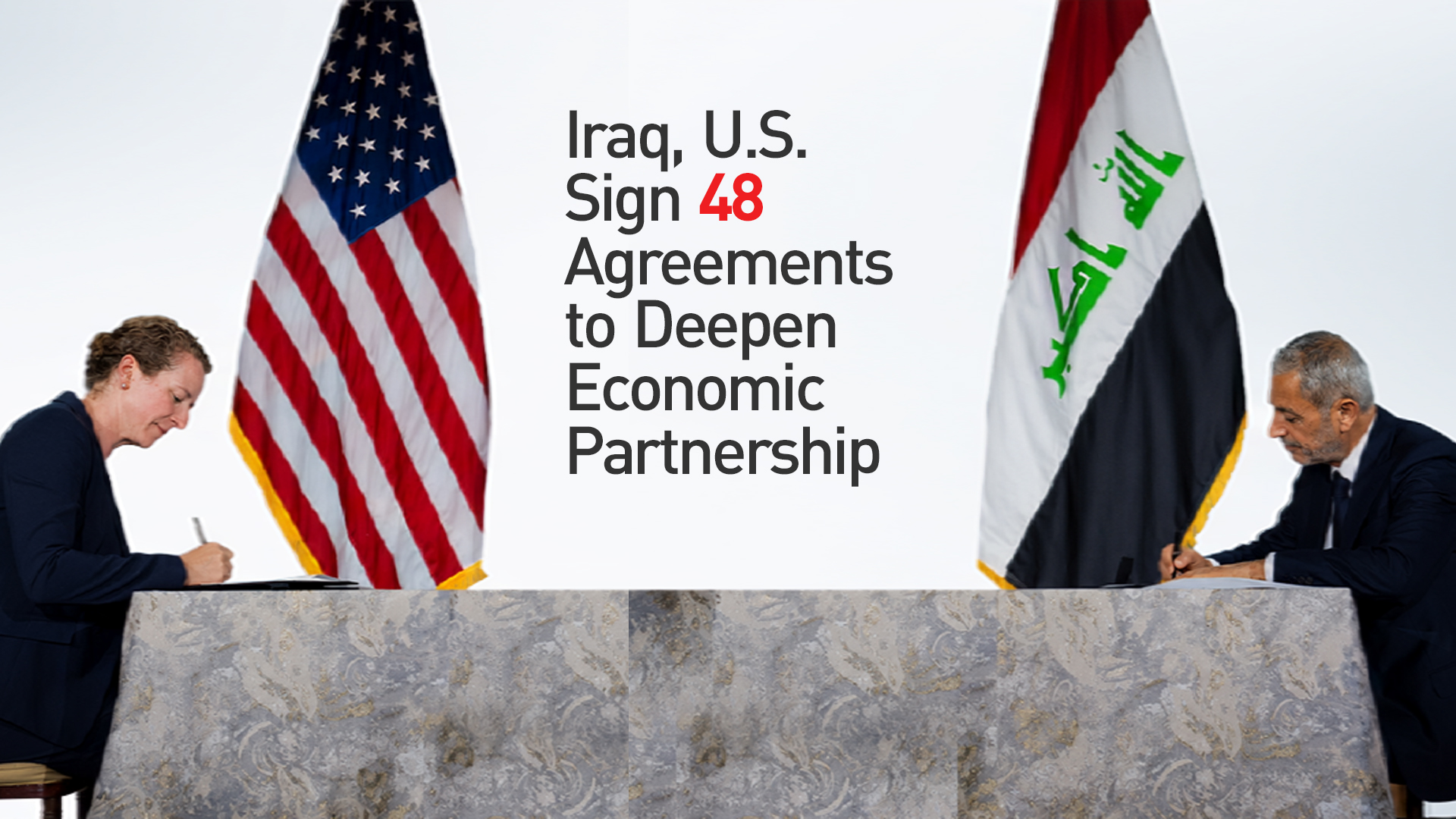
ERBIL (Kurdistan24) - Iraqi Prime Minister Ali Falih al-Zaidi concluded his official visit to Washington by overseeing the signing of 48 agreements, memoranda of understanding and partnership documents between Iraqi and American public and private institutions, marking one of the broadest economic cooperation packages between the two countries in recent years.
According to a statement from the Prime Minister's Office, the agreements establish a framework for expanded commercial and financial cooperation across multiple sectors, reflecting Baghdad's effort to transform its relationship with Washington from one centered primarily on security into a broader partnership driven by investment, industrial development and economic modernization.
The package reaches well beyond Iraq's traditional oil industry.
Alongside agreements involving the Ministries of Oil and Electricity, the signing ceremony included partnerships with major U.S. companies such as ExxonMobil, Shell, Halliburton, GE Vernova and KBR, while also covering telecommunications, education, pharmaceutical manufacturing, agriculture, trade and advanced technologies.

A cooperation agreement was also concluded between Starlink and Iraq's Communications and Media Commission, highlighting the government's interest in expanding digital infrastructure alongside energy investment.
Together, the documents outline Baghdad's strategy to attract international capital across a wider range of sectors while encouraging greater private-sector participation in projects viewed as central to Iraq's long-term economic development.
Energy nevertheless remained the cornerstone of the new cooperation.
Among the most significant initiatives is Chevron's expanding role in Iraq's oil sector.
Earlier discussions between Baghdad and the U.S. energy company laid the groundwork for cooperation on the West Qurna 2 and Nasiriyah oil fields through a memorandum intended to guide negotiations toward a comprehensive development agreement.

Officials have also discussed a technical feasibility study for infrastructure that could provide alternative export routes beyond the Strait of Hormuz, complementing Iraq's broader effort to strengthen the resilience of its energy exports.
The Chevron initiative fits into a wider government strategy that seeks not only to increase crude production but also to modernize supporting infrastructure and diversify export options at a time when regional security concerns continue to influence global energy markets.
Prime Minister al-Zaidi has repeatedly argued that Iraq's next phase of energy development depends on sustained partnerships with leading international companies capable of providing advanced technology, industrial expertise and long-term investment.
During meetings with executives in Houston, he emphasized that Iraq is seeking strategic partners rather than short-term contractors as it reshapes its energy sector.
That strategy also extends beyond crude oil production.

The prime minister has outlined plans to eliminate Iraq's dependence on imported natural gas by expanding domestic gas production, capturing associated gas currently lost through flaring and directing those resources toward electricity generation.
Government officials have likewise identified refinery expansion, increased export capacity and broader industrial modernization as priorities intended to reinforce Iraq's energy independence while creating greater value from domestic resources.
Those objectives are reflected across several of the agreements signed during the visit, particularly those involving companies specializing in oilfield services, refining technologies, engineering and energy infrastructure.
Baghdad's longer-term vision also includes strengthening regional energy connectivity.
Recent agreements concerning the rehabilitation of the Kirkuk-Baniyas pipeline illustrate the government's interest in restoring a strategic export corridor linking Iraqi crude to Mediterranean markets.
U.S. officials have welcomed the initiative, viewing it as an important contribution to regional economic integration and energy security. Chevron is expected to participate in the project as part of a broader international consortium.

Although energy dominated much of the economic agenda, the breadth of Saturday's agreements illustrates a wider effort to diversify Iraq's economy.
Cooperation in communications, education, agriculture, industrial production and pharmaceutical manufacturing reflects a policy aimed at reducing reliance on a single sector while creating new opportunities for investment and technological development.
Foreign Minister Fuad Hussein previously told Kurdistan24 that economic cooperation had become the principal focus of Iraq's discussions in Washington, while security remained closely linked to investor confidence.
He said Baghdad continues to view stability and the protection of investment as essential conditions for sustained economic growth.
Taken together, the 48 agreements represent more than a collection of individual commercial arrangements.

They provide a roadmap for expanding U.S.-Iraq cooperation across multiple sectors while reinforcing Baghdad's broader objective of modernizing infrastructure, strengthening energy security, encouraging private-sector growth and positioning the country as a more attractive destination for long-term international investment.
|
Summary Prime Minister Ali al-Zaidi oversaw the signing of 48 agreements and MoUs between Iraq and the United States, expanding cooperation across energy, technology, communications, agriculture and industry while advancing Baghdad's strategy to modernize infrastructure, attract investment and strengthen long-term economic ties. |