Inside the Popular Mobilization Forces: Why Were Their Bases Bombarded 165 Times in 2026?
From a 40-day regional war to Wednesday's coordinated Saudi-US strikes, Popular Mobilization Forces bases across Iraq have absorbed a mounting campaign of airstrikes in 2026, killing more than 100 fighters and wounding nearly 300 others.
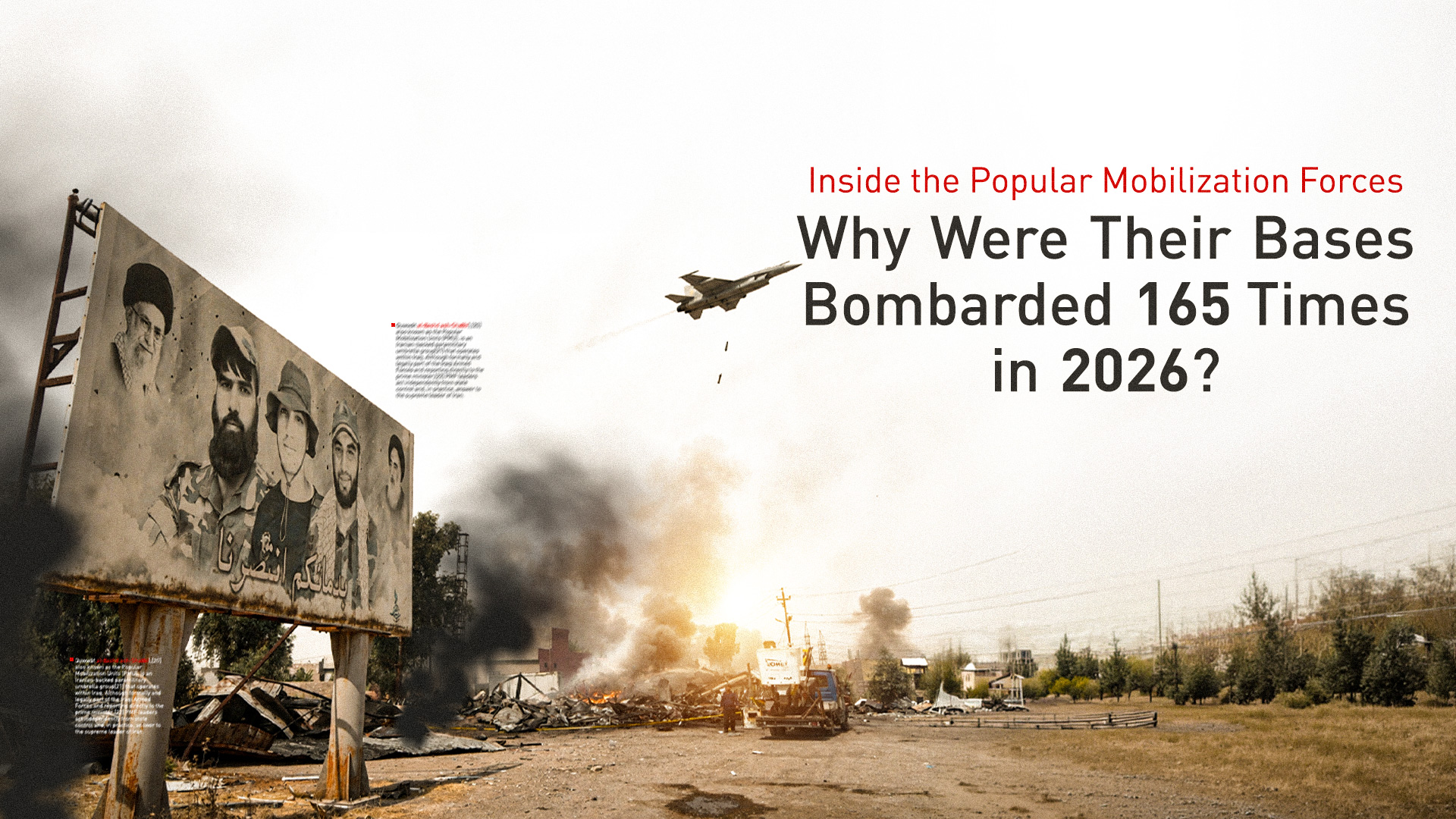
ERBIL (Kurdistan24) - As regional conflict and military tensions have intensified through 2026, official bases and facilities belonging to Iraq's Popular Mobilization Forces in provinces across the country have come under a sustained series of airstrikes and drone attacks.
According to official statements from the Popular Mobilization Forces Commission and government statistics, more than 165 airstrikes had struck the group's forces by the end of July 2026, killing more than 100 fighters and wounding nearly 300 others.
First phase: 145 strikes during the 40-day war
According to a statement issued by the Popular Mobilization Forces Commission on Friday, April 10, 2026, a total of 145 airstrikes and bombardments were recorded against its bases in various parts of Iraq between February 28 and April 8, 2026 — the period of the 40-day war involving the United States, Israel and Iran.
The commission's statement put the toll from that first phase at 80 fighters killed and nearly 270 wounded. The targeted sites included military bases, weapons and ammunition depots, and checkpoints in Anbar, Nineveh, Kirkuk and Salahaddin provinces.
Second phase: joint Saudi-US strikes on July 29
In the latest development, Saudi Arabia coordinated with the United States on Wednesday, July 29, 2026, to strike several Popular Mobilization Forces bases and facilities for the first time. The commission issued an urgent statement disclosing the locations of the strikes and preliminary casualty figures.
According to that statement, the July 29 strikes killed at least 20 fighters and wounded 32 others, in figures described as preliminary. The strikes also caused extensive material damage to buildings, vehicles and military equipment belonging to the commission. The affected provinces were Baghdad, Basra, Nineveh, Wasit, Kirkuk, Karbala and Diyala.
Response from the Iraqi government and the PMF
Following the strikes, Iraq's new Prime Minister, Ali al-Zaidi, oversaw an urgent meeting of the National Security Council; as of this report, the Iraqi government had not issued a formal position. Previously, the office of former Prime Minister Mohammed Shia' al-Sudani repeatedly stated, following the airstrikes of the 40-day war, that targeting official security bases represented a clear violation of Iraq's sovereignty.
For its part, the Popular Mobilization Forces noted in its statement that the casualty figures remain preliminary and that specialized committees continue field work to assess the full extent of the damage and compile comprehensive information.
Why are Popular Mobilization Forces bases being targeted?
Following the turmoil in the Middle East and the war in Gaza, Iraq has become a stage for direct and rapid confrontation between the US military and armed factions known collectively as the Islamic Resistance in Iraq. The latest flashpoint came with Wednesday's early-morning strikes by the United States and Saudi Arabia on Popular Mobilization Forces bases across Iraqi provinces, which killed 20 fighters, wounded 32 others and caused extensive material damage.
The Pentagon's stated rationale
The US Department of Defense has repeatedly said its strikes come in response to continued rocket and drone attacks on American bases and forces in Iraq, Syria and other countries in the region.
Some Popular Mobilization Forces factions — including Kataib Hezbollah, the Nujaba Movement, Kataib Sayyid al-Shuhada, and Asaib Ahl al-Haq — are simultaneously members of the Islamic Resistance in Iraq and, independent of their official duties, carry out attacks on American targets. In most airstrikes, the United States has used drones to target PMF or faction commanders and officials whom Washington's intelligence agencies accuse of planning or carrying out attacks on American soldiers.
CENTCOM said days earlier that armed groups had carried out more than 600 attacks on US bases and facilities.
A US veto on political participation
Before the formation of Iraq's new cabinet, a key American condition was that armed factions affiliated with the Popular Mobilization Forces not participate in government, alongside US insistence that such groups be dissolved and absorbed into Iraq's regular armed forces. To date, three-armed groups have dissolved themselves, while several others have refused to disarm, arguing that weapons remain necessary for self-defense.
Origins: a 2014 fatwa
The Popular Mobilization Forces trace their origin to June 13, 2014, when, after the fall of Mosul and large parts of several Iraqi provinces to the ISIS terrorist group, Grand Ayatollah Ali al-Sistani, the senior Shiite religious authority in Iraq, issued a "sufficiency jihad" fatwa. Under that fatwa, thousands of young Shiite men and members of other communities took up arms to confront ISIS.
In 2016, the Iraqi parliament passed Popular Mobilization Commission Law No. 40, formally establishing the PMF as an official military force under the general command of Iraq's armed forces. However, the commission has continued to maintain independent command and strategic decision-making, and remains outside the full authority of the general command of the armed forces.
Manpower and budget
The number of Popular Mobilization Forces fighters has followed a steady growth trend. According to official figures from Iraq's general budget law, the commission's current personnel and fighters are estimated at between 200,000 and 238,000. Its brigades, regiments and fronts comprise more than 67 to 70 military brigades distributed across Iraq.
Ideology and factional loyalties
The groups within the Popular Mobilization Forces are not a single unified bloc, but are divided among three to four main political and ideological currents.
The first current consists of factions loyal to the concept of wilayat al-faqih, which are close to Iran. These groups regard the Islamic Revolutionary Guard Corps' Quds Force as their direct command reference and form the core of what is known as the Islamic Resistance Front. Most of the sensitive administrative and command levers of the PMF Commission are held by these groups. Among them: the Badr Organization, led by Hadi al-Amiri, which holds the largest number of brigades within the PMF; Asaib Ahl al-Haq, led by Qais al-Khazali; Kataib Hezbollah, described as the strongest and most hardline armed group within this current; the Nujaba Movement, led by Akram al-Kaabi; Kataib Sayyid al-Shuhada, led by Abu Ala al-Walai; and Kataib Imam Ali.
The second current comprises Popular Mobilization Forces groups close to Sistani. These groups consider themselves an extension of Sistani's fatwa and say they have no ties to Iran. Since 2020, they have operationally separated themselves from the PMF Commission's command structure and report directly to Iraq's Ministry of Defense. They include the Ali al-Akbar Brigade, the Abbas Combat Division, the Ansar al-Marjaiya Brigade, and the Forsan al-Taf Brigade.
The third current consists of groups affiliated with the Sadrist movement. Saraya al-Salam, led by Muqtada al-Sadr, oversaw Brigades 313 and 314, but has recently dissolved itself and is joining the ranks of Iraq's regular security forces.
The fourth current comprises PMF units representing Iraq's component communities and minorities — Sunni, Christian, Shabak, Yazidi and Turkmen — which coordinate with the government in their respective areas. These include Sunni tribal mobilization forces, estimated at 40,000 to 50,000 fighters in Anbar, Nineveh and Salahaddin; the Babylon Brigade (Brigade 50), representing Christians under the command of Rayan al-Kildani; Brigade 30, the Nineveh Plain Forces representing the Shabak community, stationed in the Nineveh Plain; the Turkmen Brigades 52 and 53 in Tal Afar and Tuz Khurmatu; and the Lalish Battalion and Sinjar Forces representing the Yazidi community.
Leadership of the Popular Mobilization Commission
Falih al-Fayyadh currently chairs the Popular Mobilization Forces Commission, while Abdul Aziz al-Mohammedawi serves as chief of staff. Mohammedawi, a former senior commander of Kataib Hezbollah, succeeded Abu Mahdi al-Muhandis in the post.
With tens of thousands of trained fighters, heavy weaponry, revenue independent of the state budget, and political influence within parliament and the cabinet, the Popular Mobilization Forces have grown into an institution without whose consent few decisive security or political decisions in Iraq can pass. Despite pressure from Western countries, particularly the United States, to dissolve the force or fully integrate it into the army, the commission has continued to deepen its roots within the structure of the Iraqi state.