Türkiye's New Peace Law Could Affect Up to 75,000 People
DEM Party lawmakers say the proposed framework could alter the legal and social status of tens of thousands, while thousands of prisoners may potentially qualify under its provisions.
ERBIL (Kurdistan24) - Türkiye's proposed peace-process legislation could affect the legal and social status of up to 75,000 people, DEM Party lawmaker Ibrahim Akın said, as Parliament prepares to consider a framework tied to the disarmament and organizational dissolution of the Kurdistan Workers' Party (PKK).
Akın's estimate concerns the broader potential impact of the proposed legislation and should not be equated with the number of people who could be released from prison.
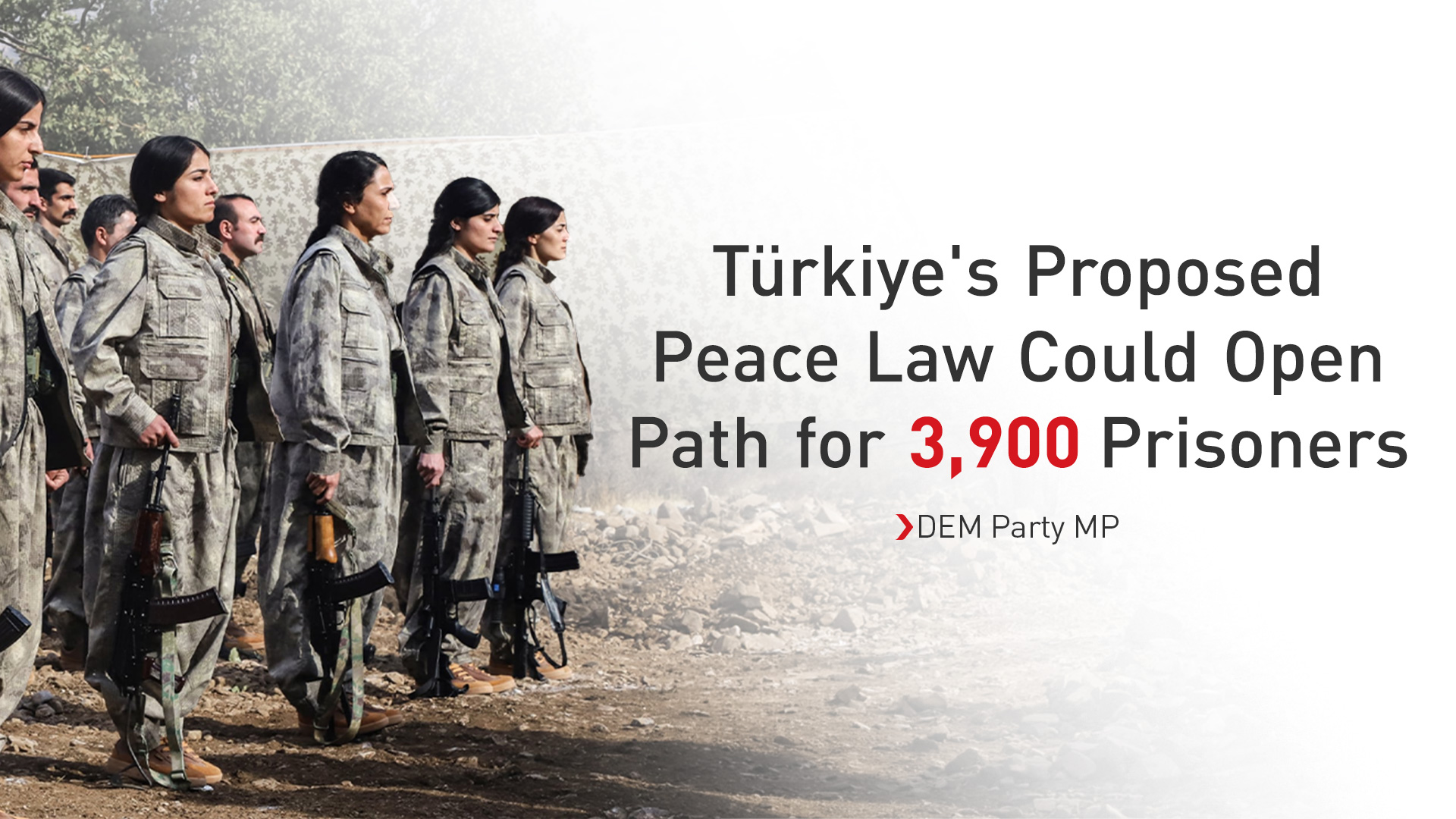
Separately, DEM Party MP Serhat Eren said around 4,800 people are currently imprisoned in Türkiye on charges related to PKK membership or armed activities, of whom approximately 3,900 could potentially benefit from the proposed framework, subject to its conditions.
Around 900 prisoners would remain outside the framework, Eren said, primarily those serving life sentences in cases involving the killing of security personnel.
The Turkish Parliamentary Justice Committee approved the proposed Law on Strengthening National Solidarity and Social Integration on Aug. 8, clearing the way for consideration by the General Assembly. A final vote is expected on Aug. 10, according to the supplied report.
Up to 75,000 could be affected
The 75,000 figure cited by Akın points to the wider legal and social consequences of the proposed framework rather than a blanket measure for prisoners.
The legislation establishes procedures that could affect people facing investigations, prosecutions or sentences for specified offenses connected to the PKK and the Kurdistan Communities Union (KCK).
The proposed law is not a general amnesty, and eligibility would be determined by the relevant judicial authorities.
Its practical implementation would also depend on the Turkish National Security Council (MGK) confirming the PKK's dissolution and disarmament and the relevant decision being published in the Official Gazette.
Eren's estimate provides a narrower picture of the prison population potentially affected.
He said roughly 3,900 of the approximately 4,800 people imprisoned on PKK-related or armed-activity charges could fall within the proposed framework, while others would be excluded.
Who could benefit
The 12-article proposal establishes a legal mechanism covering certain offenses associated with establishing or leading the PKK or KCK, membership, knowingly assisting the organizations, propaganda and organizational activities, as well as terrorism-financing offenses committed on their behalf.
The draft excludes intentional homicide committed within organizational activities.
It also excludes certain crimes committed before June 1, 2005, where the applicable punishment is life imprisonment or aggravated life imprisonment.
For cases carrying maximum sentences of 15 years or less, investigations and prosecutions could be postponed for five years.
Cases involving sentences exceeding 15 years, life imprisonment or aggravated life imprisonment could be deferred for 10 years, subject to the legislation's conditions.
The proposal also provides for the postponement of prison-sentence execution in specified circumstances.
If an eligible individual commits no new offense during the applicable period, the case could ultimately be deemed served under the proposed framework.
These provisions would therefore create possible legal avenues for some individuals, but they would not automatically release every person covered by the law or erase every conviction.
Demirtaş question remains open
The proposed framework has also drawn attention because of its potential implications for imprisoned former HDP co-chair Selahattin Demirtaş.
Türkiye's Justice Minister Akın Gürlek recently denied a report by journalist Abdulkadir Selvi that he had told an AK Party Central Executive Board meeting that neither Demirtaş nor PKK leader Abdullah Öcalan would benefit from the legislation.
Fatih Atik, Ankara representative for TGRT News, contacted Gürlek directly and reported that the minister denied making those remarks.
Gürlek's denial leaves Demirtaş's potential eligibility unresolved. It does not establish that he qualifies under the proposed law or that he will be released. Any application of the framework to his case would depend on the final legislation, its eligibility provisions and subsequent judicial decisions.
Cross-party support, differing views
The legislation has received support from several political parties, although differences remain over its scope and implementation.
AK Party lawmaker Abdurrahim Firat told Kurdistan24 that the proposal represents an important step toward peace and stability and provides a legal foundation for addressing the Kurdish issue.
HUDA-PAR MP Serkan Ramanli also welcomed the parliamentary process while acknowledging that the bill does not fully reflect his party's position. He described the legislative step as important and expressed hope that it would produce further results.
The proposal was advanced with support from multiple parties, including the AK Party, MHP and DEM Party, while HUDA-PAR lawmakers also backed the parliamentary initiative.
What happens next
The proposed law forms part of a broader political process focused on the Kurdish issue and PKK disarmament. Its political origins trace back to October 2024, when MHP leader Devlet Bahçeli called for a new approach to the Kurdish issue and the organization's disarmament.
The immediate legislative step is now the General Assembly's consideration of the framework. But even if Parliament approves it, implementation would depend on the conditions set out in the law, judicial determinations and the MGK's confirmation of the PKK's dissolution and disarmament.
For the estimated 75,000 people cited by Akın, the significance of the legislation therefore lies in its potential to change legal and social circumstances under a new framework—not in an automatic release or blanket amnesty.