Badr Warns Disarming Iraqi Armed Groups Could Trigger Civil War
Mohammad Naji, head of the Badr Organization's political office, says Baghdad's push to place all weapons under state control could trigger internal conflict, as the Sept. 30 deadline and regional pressure intensify.
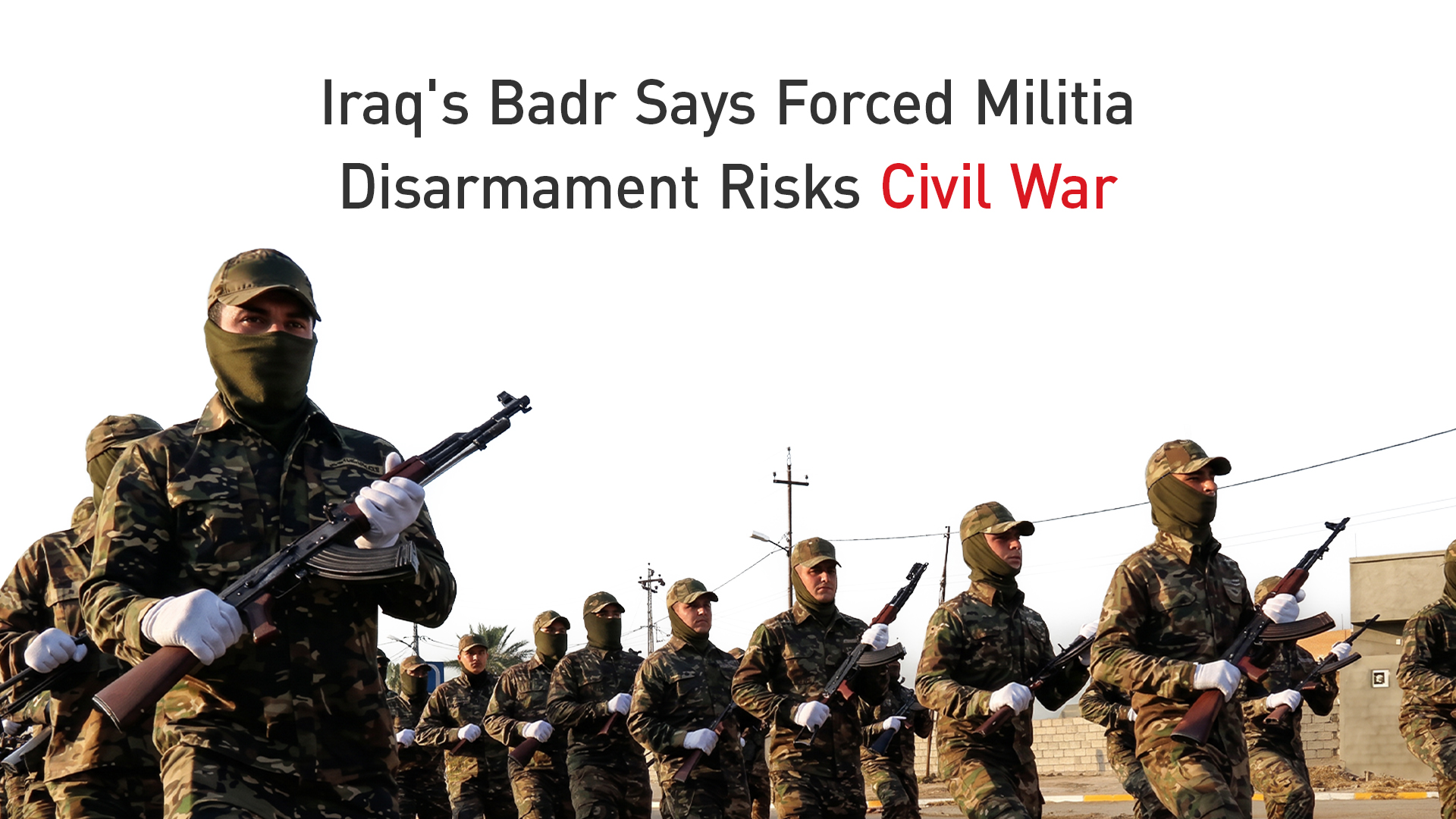
ERBIL (Kurdistan24) - The Badr Organization has warned Iraq's government against using force to disarm armed factions, arguing that a coercive campaign could trigger civil war as Baghdad moves toward a Sept. 30 deadline for bringing all weapons under state control.
Mohammad Naji, head of the Badr Organization's political office, said the use of force against armed groups would deepen internal divisions and serve the interests of foreign powers. His remarks came as Baghdad presses ahead with a new legal and security framework to establish the state's exclusive authority over weapons.
The warning places one of Iraq's most influential Iran-aligned political and armed factions directly at odds with the government's increasingly explicit arms-control policy.
Badr Sets Conditions for Arms Control
In a statement posted on X, Naji argued that the regulation of weapons should not begin with confrontation.
He said any attempt to forcibly disarm armed factions would "ignite civil war," according to his statement, and accused the United States and Israel of benefiting from such a confrontation.
Naji also criticized Prime Minister Ali Falih al-Zaidi, alleging that the government is moving too quickly under pressure from Washington.
He said any arrangement concerning the weapons of the so-called Resistance must be linked to three conditions: the complete withdrawal of U.S. forces from Iraq, the removal of strategic threats facing the country and the full rebuilding of Iraq's armed forces, particularly its air-defense capabilities.
The Badr position contrasts sharply with Baghdad's stated goal of ensuring that weapons and decisions over their use remain exclusively under official institutions.
Baghdad Pushes New Weapons Law
The dispute follows an order from Prime Minister al-Zaidi for officials to prepare a draft law placing all weapons under state control.
The Prime Minister's Office said al-Zaidi considers unauthorized weapons one of the most serious threats to the Iraqi state because they undermine the authority of security institutions and the rule of law.
Read More: Iraqi PM Orders Draft Law to Place Weapons Under State Control
Government spokesperson Haider al-Aboudi has similarly said armed groups operating outside official security structures should return under state authority, while acknowledging that the process requires what he called a "deep and comprehensive dialogue."
The government has maintained that the policy is to be implemented through constitutional and legal procedures rather than arbitrary action.
Read More: Iraq Warns Armed Groups: Disarmament Deadline Cannot Be Ignored
Factions Remain Divided
The response from Badr follows an increasingly public split among Iraq's armed factions over the question of disarmament.
The Nujaba Movement has explicitly rejected surrendering its weapons, with spokesperson Hussein Ali al-Mousawi saying the faction would not hand them over under any circumstances.
Read More: Nujaba Movement: We Will Not Hand Over Our Weapons
Other factions have reportedly attached conditions to any move toward greater state control, particularly the departure of foreign forces.
The Sept. 30 deadline has therefore emerged as a major test for the government, which must reconcile the demands of powerful armed groups with its stated commitment to state sovereignty.
Qaani's Baghdad Visit
The dispute has also coincided with a reported visit to Baghdad by Esmail Qaani, commander of Iran's Islamic Revolutionary Guard Corps Quds Force.
According to an informed source cited by Kurdistan24, Qaani held meetings with Coordination Framework leaders and commanders of several armed groups, including Badr leader Hadi al-Amiri.
The reported discussions focused partly on the future of weapons held by armed factions and came as the deadline for state control approaches.
The source also said talks addressed Iraq's efforts to export oil through the Strait of Hormuz.
Read More: Qaani Holds Baghdad Talks on Future of Iraqi Armed Groups
Qaani's involvement is significant because Iran maintains close political and security relationships with several of the factions affected by Baghdad's policy, although the details of his discussions have not been officially confirmed.
Baghdad Tightens Security and Registration
While political negotiations continue, Iraqi authorities have expanded practical measures aimed at strengthening control over weapons.
Interior Ministry spokesperson Miqdad Miri recently said authorities had closed 71 unauthorized "ghost" or "shadow" bases and registered more than 500,000 weapons as part of a national database intended to cover roughly six million firearms.
Read More: Iraq Shuts 71 Unauthorized PMF Bases as Arms Registration Expands
The PMF Commission subsequently denied responsibility for the unauthorized facilities and said the sites had no formal affiliation with the force.
The commission also warned that individuals or entities using the PMF's name for unauthorized purposes could face legal and administrative action.
The developments illustrate the government's attempt to distinguish officially recognized security institutions from armed groups or facilities operating outside state structures.
Read More: Iraq's PMF Disavows 'Ghost' Bases as Baghdad Tightens Arms Control
Regional Pressure Complicates the Dispute
The arms debate is unfolding alongside heightened tensions involving Iraq, Saudi Arabia, Iran and the United States.
An Iraqi security delegation recently traveled to Riyadh for talks on attacks against Saudi Arabia and wider intelligence cooperation after a series of strikes involving Iraqi armed groups.
Abdul Rahman al-Jazairi, a Coordination Framework figure, told Kurdistan24 that Iranian officials had urged several Iraqi factions to refrain from attacking Saudi Arabia and to pursue diplomatic channels instead.
Read More: Iraq Sends Senior Security Delegation to Riyadh After Recent Attacks
The reported message was directed toward groups including Nujaba and Kata'ib Hezbollah, according to Jazairi.
Baghdad has repeatedly stressed that Iraqi territory must not be used to launch attacks against neighboring states, an objective that directly intersects with the government's demand for centralized control over weapons.
A Difficult Test for the State
Badr's warning underscores the political difficulty facing al-Zaidi's government as the September deadline approaches.
The dispute is no longer simply about whether weapons should be regulated. It involves competing interpretations of sovereignty, the future role of armed factions, the presence of foreign troops and Iraq's position within a wider regional confrontation.
For Baghdad, the challenge is to establish state authority without triggering the very instability it says the policy is intended to prevent.
For factions such as Badr, the demand for disarmament remains inseparable from broader questions about U.S. forces and Iraq's military independence.
With the deadline approaching, the government's reliance on dialogue will be tested against the increasingly explicit resistance from some powerful armed groups.
The warning from Badr suggests that any attempt to force the issue could carry serious political and security risks—and that Baghdad's push for a state monopoly on weapons is likely to remain one of Iraq's most consequential disputes in the weeks ahead.