Iraq's Arms Dispute Takes a 'Quid Pro Quo' Turn in Political Ads
A government campaign urges armed factions to hand over their weapons, while a PMF video projects military strength as Baghdad's push for state control reaches a critical stage.
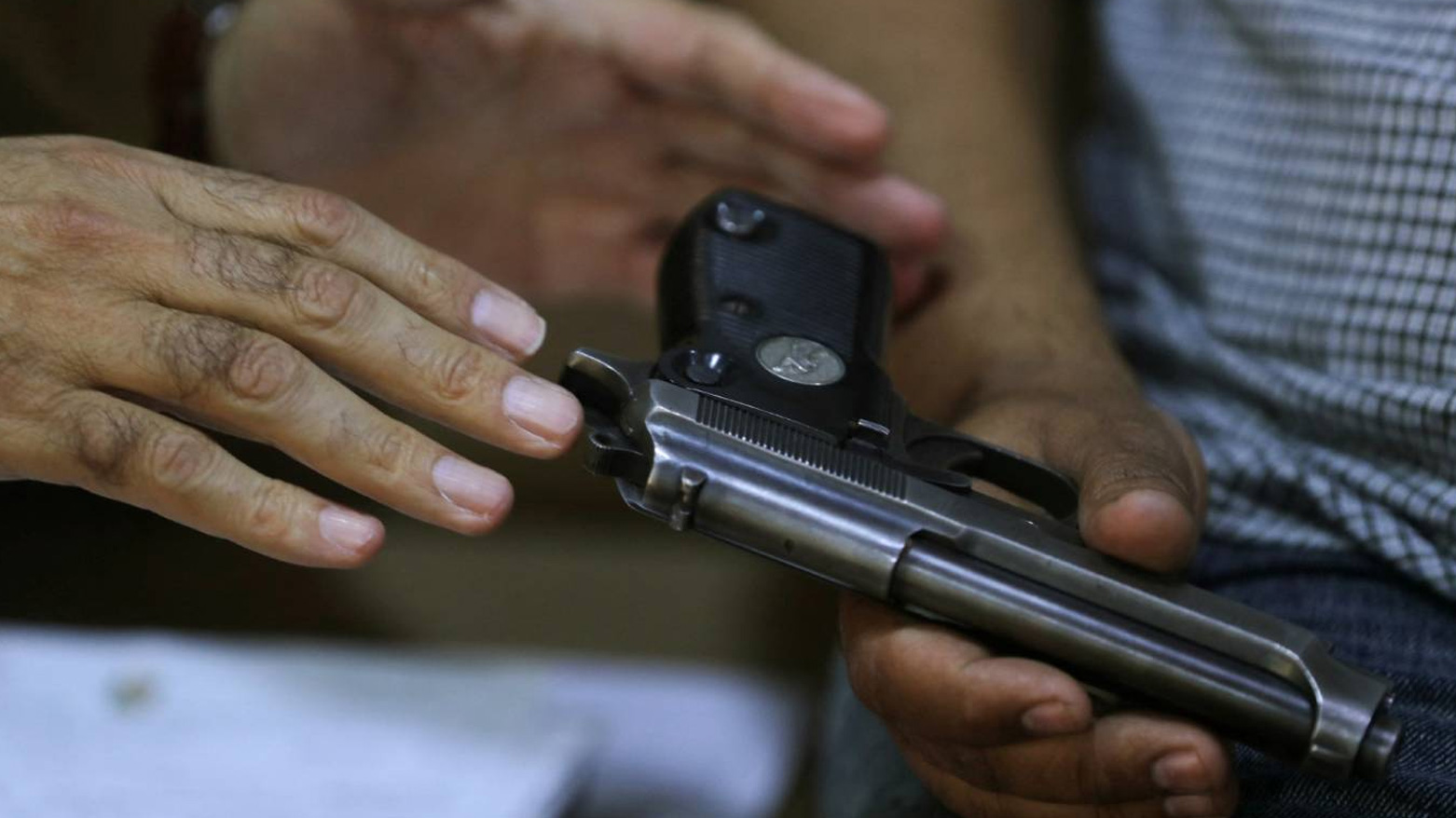
ERBIL (Kurdistan24) - Iraq's increasingly contentious debate over the future of weapons held by armed factions has moved beyond political statements and parliamentary discussions into competing public-awareness campaigns, with the federal government and the Popular Mobilization Forces (PMF) promoting sharply different messages about arms and state authority.
An Iraqi local television channel, Al-Akhbariyah, recently aired a government-backed advertisement urging militia members to surrender their weapons to the state. The PMF later responded with a video published on its official social media platforms that emphasized the force's military strength and determination.
The competing productions offer a striking illustration of the political dispute unfolding as Baghdad works to establish exclusive state control over weapons and faces resistance from some powerful armed factions.
Government Campaign: 'From Weapons to Life'
The federal government's advertisement uses a conversation between a man and a woman to argue that Iraq's regular security forces are capable of protecting the country and that citizens do not need privately held weapons for national defense.
The dialogue centers on a woman whose son, Hamid, refuses to surrender his weapon. The man challenges her assumption that the weapon is necessary for protecting the country and points to the capabilities of Iraq's army and security forces.
At the conclusion, the advertisement delivers a simple message: "From Weapons to Life."
The production presents arms surrender as part of a broader effort to restore stability and strengthen the state's institutions.
The message comes as Prime Minister Ali Falih al-Zaidi has ordered the preparation of legislation aimed at bringing all weapons under state control. Government officials have repeatedly argued that weapons outside official institutions undermine the authority of the state and the rule of law.
Government spokesperson Haider al-Aboudi has said the issue requires a "deep and comprehensive dialogue," while also warning that groups refusing to comply with the government's policy will ultimately be dealt with under Iraqi law.
PMF Response Projects Military Strength
The PMF's response takes a markedly different approach.
Its video, published on Saturday, contains no spoken dialogue. Instead, it depicts armed personnel dressed in tactical uniforms moving through dark surroundings and presenting the force as a disciplined military formation.
The visual language contrasts sharply with the federal advertisement's brighter setting and emphasis on civilian life and state institutions.
Where the government video seeks to persuade viewers that Iraq's army can provide security without private arsenals, the PMF production communicates strength through images of armed formations and military readiness.
The contrasting messages reflect competing ideas about what guarantees Iraq's security: centralized state authority on one side and the continued military capacity of the so-called resistance factions on the other.
Disarmament Debate Grows More Contentious
The advertising confrontation comes as Iraq approaches a Sept. 30 deadline for bringing weapons under state authority, a process that has exposed substantial differences among armed factions.
The Badr Organization, led by Hadi al-Amiri, has warned that using force to disarm armed groups could trigger civil war.
Mohammad Naji, head of Badr's political office, argued that any coercive attempt to confiscate weapons would deepen internal conflict and benefit foreign powers.
He said arms regulation should instead be considered alongside what Badr describes as three conditions: the withdrawal of US forces, removal of strategic threats to Iraq and reconstruction of the country's military capabilities, particularly its air defenses.
Naji's warning places Badr at odds with Baghdad's stated objective of establishing the state's exclusive authority over weapons.
Factions Send Different Signals
Badr is not the only armed faction to express reservations.
The Nujaba Movement has publicly rejected surrendering its weapons, with spokesperson Hussein Ali al-Mousawi saying the group would not hand them over.
Other factions have similarly linked disarmament to the future of foreign forces in Iraq.
At the same time, the government has sought to distinguish between formally recognized security institutions and armed entities operating beyond the state's legal framework.
Interior Ministry spokesperson Miqdad Miri recently said authorities had shut down 71 unauthorized facilities described as "ghost" or "shadow" bases and had registered more than 500,000 weapons as part of a national firearms database.
The PMF Commission subsequently denied that the closed facilities were formally affiliated with it, saying unauthorized individuals or entities had improperly used the organization's name.
The competing positions point to one of the central complications in Baghdad's campaign: determining where the officially recognized PMF ends and unauthorized armed activity begins.
Security Policy and Regional Pressure
The dispute is also unfolding against a backdrop of heightened regional tensions.
Baghdad has sought to prevent Iraqi territory from being used to launch attacks against neighboring states, particularly amid tensions involving Saudi Arabia, Iran and the United States.
An Iraqi security delegation recently traveled to Riyadh for talks on attacks involving Iraqi armed groups and ways to strengthen intelligence and security coordination.
Abdul Rahman al-Jazairi, a Coordination Framework figure, told Kurdistan24 that Iranian officials had urged several Iraqi factions to refrain from attacking Saudi Arabia and pursue diplomatic channels instead.
The reported intervention highlights how Iraq's internal weapons debate has become intertwined with regional security calculations.
For Baghdad, stronger state control over weapons is presented not only as a domestic issue but also as a requirement for preventing Iraq from becoming a launchpad for regional attacks.
A Political Battle Over Sovereignty
The competing advertisements are unlikely to resolve the dispute, but they reveal how the argument is increasingly being taken directly to the public.
The government's production frames disarmament as a transition from armed confrontation to normal civilian life, using the country's military and security institutions as the central source of protection.
The PMF's video, by contrast, relies on imagery of armed strength and disciplined formations, reinforcing the political message that these groups continue to regard their military capabilities as an important component of Iraq's security.
That contrast mirrors the broader political disagreement.
Baghdad argues that a sovereign state cannot have competing centers of military power. Armed factions opposing the policy argue that their weapons remain necessary because of unresolved threats, the presence of foreign forces and what they describe as gaps in Iraq's military capabilities.
The issue is therefore no longer confined to legal texts or closed-door negotiations. It is becoming a public contest over how Iraq defines security, sovereignty and the legitimate use of force.
September Deadline Looms
With Sept. 30 approaching, Prime Minister al-Zaidi's government faces the difficult task of turning its state-control policy into a practical reality without provoking an armed confrontation.
The competing advertisements demonstrate that the political battle has already begun in earnest.
For Baghdad, the message is that Iraq's security should rest with state institutions.
For the PMF and factions resisting disarmament, the message is that their military role remains indispensable.
How those competing narratives are reconciled may determine whether Iraq's weapons-control campaign develops into a negotiated political transition—or becomes another source of confrontation in a country already navigating intense regional pressures.