President Barzani Turns 80 as KDP Marks 80 Years of Kurdish Politics
August 16 marks both the founding of the Kurdistan Democratic Party and the 80th birthday of President Masoud Barzani, whose career spans the Kurdish revolution, the creation of the Kurdistan Region and decades of international diplomacy.
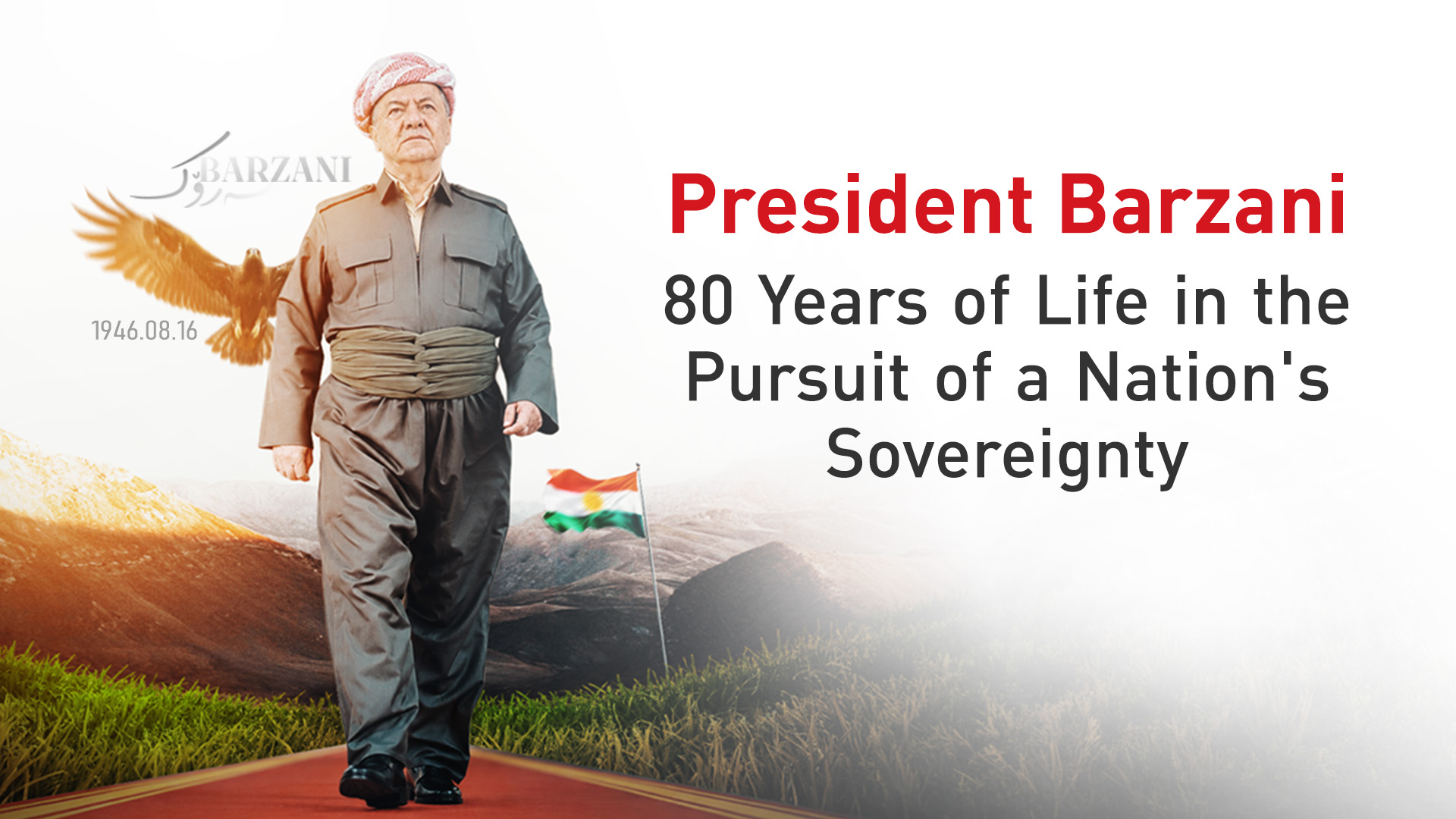
ERBIL (Kurdistan24) - August 16 holds a dual significance in modern Kurdish political history: it marks the founding anniversary of the Kurdistan Democratic Party (KDP) and the 80th birthday of President Masoud Barzani, a political and military figure whose life has closely followed the major turning points of the Kurdish struggle in Iraq.
Born in 1946 in Mahabad, the capital of the Republic of Kurdistan, President Barzani grew up in the political environment of the Barzani family and under the influence of his father, the late Kurdish leader Mulla Mustafa Barzani.
His life became intertwined with the Kurdish movement from an early age. At 16, he joined the Peshmerga, beginning a political and military career that would span decades of conflict, negotiations and institution-building.
From the Peshmerga to Political Leadership
President Barzani emerged as an important figure in negotiations between Kurdish leaders and Baghdad during the 1970s. Following the collapse of the Kurdish revolution in 1975, he and his elder brother, the late Idris Barzani, worked to reorganize the movement and rebuild its political and military structures.
After Mulla Mustafa Barzani passed away in 1979, Masoud Barzani assumed the leadership of the KDP during a period marked by intense pressure and repeated threats.
His political career also included significant personal losses. Members of his family disappeared during the Anfal campaign, while President Barzani himself survived an assassination attempt in Vienna.
Those experiences reinforced his role as one of the leading figures of the Kurdish movement during a particularly turbulent period in Iraq's modern history.
The 1991 Uprising and a New Political Order
One of the defining chapters of President Barzani's career came in 1991, when the Kurdish uprising known as the Raperin swept across Kurdish cities following the Gulf War.
President Barzani played a prominent role in the Kurdistan Front during the political and military developments that followed. In Koya, he advocated elections and the establishment of a parliament, helping articulate a vision of Kurdish self-government that later shaped the institutions of the Kurdistan Region.
The establishment of the Kurdistan Regional Government marked a fundamental transformation in Kurdish political life.
In 2005, President Barzani became the first president of the Kurdistan Region, beginning a presidency that coincided with the expansion of the Region's institutions, international ties and economic development.
A Broader International Role
Under President Barzani's leadership, the Kurdistan Region developed a significantly broader diplomatic presence.
His political engagements included repeated meetings with senior American officials and presidents, as well as visits and official receptions in major international capitals.
His international diplomacy became particularly important as the Kurdistan Region sought to strengthen its relations with the United States, European countries and regional powers.
President Barzani also became a prominent advocate for Kurdish political aspirations on the international stage, presenting the Kurdistan Region as a partner in regional security and a representative of Kurdish national interests.
The Peshmerga and the Fight Against ISIS
President Barzani's military role returned to prominence with the rise of ISIS in 2014.
As commander-in-chief of the Peshmerga, he oversaw military operations during a period in which ISIS captured large areas of Iraq and Syria and posed a direct threat to the Kurdistan Region.
The Peshmerga became a central component of the international campaign against ISIS, working alongside the US-led Global Coalition in battles across contested areas.
For President Barzani, the war against ISIS also reinforced a longstanding argument for the importance of Kurdish security institutions and international recognition of the Peshmerga's role.
The 2017 Independence Referendum
Following the territorial defeat of ISIS in much of Iraq, President Barzani turned his attention toward what became his most consequential political initiative: the 2017 independence referendum.
The vote, held on Sept. 25, 2017, was intended to demonstrate Kurdish public support for independence and place the question of self-determination before the international community.
The referendum produced an overwhelming vote in favor of independence but was rejected by Baghdad and opposed by neighboring states and major international powers.
The aftermath resulted in the loss of disputed territories previously controlled by Kurdish forces and a significant political crisis between Erbil and Baghdad.
Despite the setback, the referendum remains one of the defining political events of President Barzani's career.
Beyond Politics
President Barzani's public profile has also extended beyond military and political affairs.
He has written historical works and has spoken publicly about Kurdish history, coexistence and political development.
His public role has also been associated with support for religious coexistence and the protection of Kurdistan's natural environment.
The Barzan region, closely associated with his family and political legacy, has become known for its protected landscapes and environmental conservation efforts.
His political career has therefore combined military leadership, party organization, regional governance and international diplomacy.
Eighty Years After the KDP's Founding
The anniversary also places President Barzani's life alongside the longer history of the KDP itself.
Founded in 1946, the party has remained one of the central institutions of Kurdish politics in Iraq for eight decades, surviving revolutions, armed conflict, political repression and profound changes in Iraq's political system.
For supporters, President Barzani's eight decades represent a lifetime spent within that history rather than simply observing it.
At 80, he remains a major political authority in the Kurdistan Region and a prominent figure within the KDP, while continuing to describe himself in the language of the movement that shaped his life: that of a Peshmerga.
August 16 thus carries two overlapping legacies. It recalls the creation of a party that became one of the pillars of modern Kurdish political organization, while marking the birthday of a leader whose life has unfolded through many of the defining moments of the Kurdish struggle.
For Kurdistan, the anniversary is both a commemoration of political history and a reflection on a leadership career that has extended from the Peshmerga ranks to the presidency, diplomacy and the international arena.