Qalibaf to Visit Baghdad as Iraq's Arms Dispute Enters Critical Phase
Iranian Parliament Speaker Mohammad Baqer Qalibaf is expected in Baghdad on Wednesday for talks on bilateral ties and regional security as Iraq approaches a key deadline on armed groups.
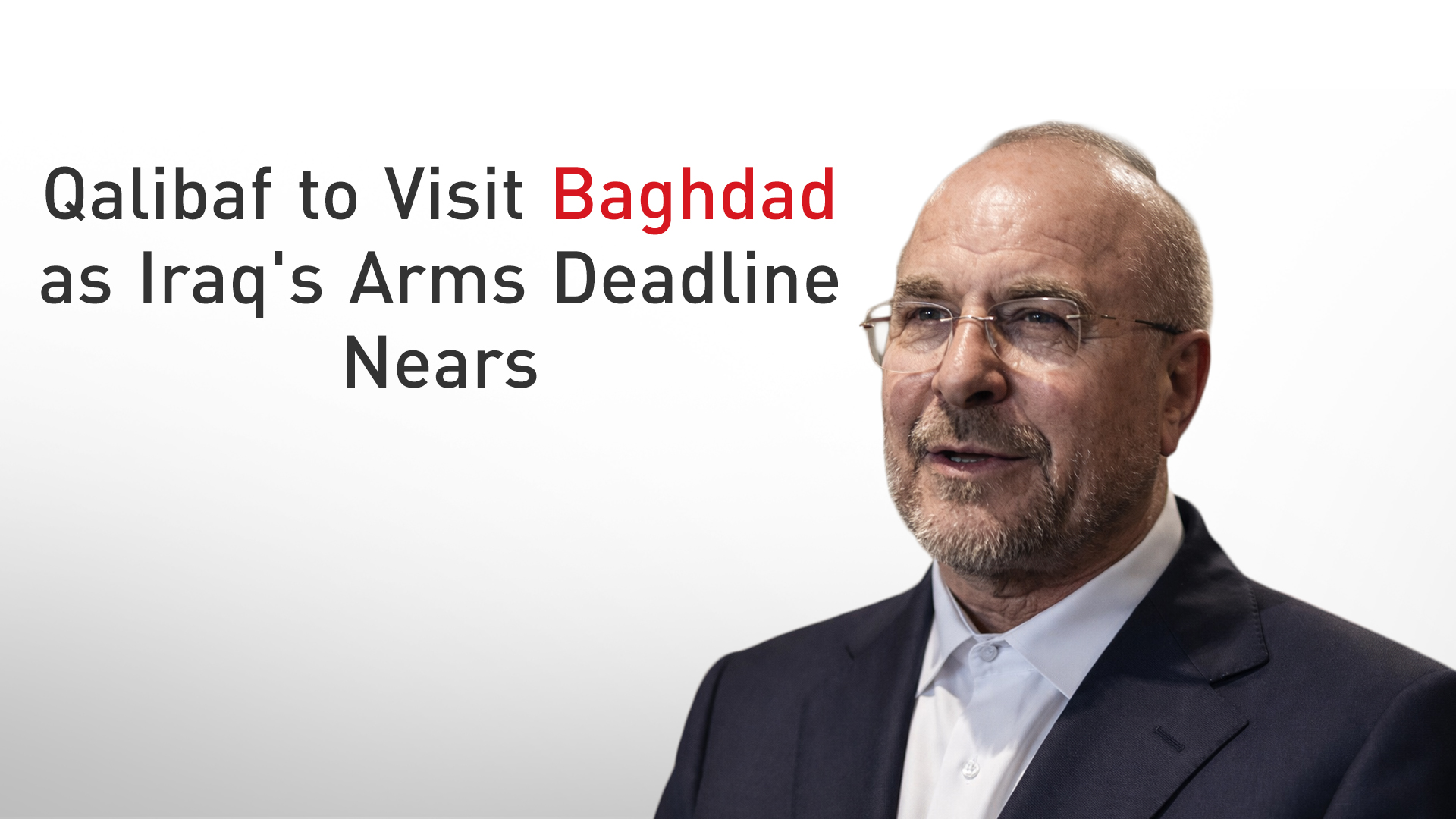
ERBIL (Kurdistan24) - Iranian Parliament Speaker Mohammad Baqer Qalibaf is scheduled to visit Baghdad on Wednesday at the head of a senior parliamentary delegation, with regional developments, security cooperation and bilateral relations expected to feature prominently in his talks with Iraqi officials.
According to Iranian media reports, Qalibaf will arrive in Baghdad on Aug. 19, 2026, where he is expected to meet senior Iraqi officials and political figures.
The visit comes at a particularly sensitive moment for Baghdad as the government seeks to bring all weapons under state authority while navigating growing regional tensions and its relationship with Iran-aligned armed factions.
Iranian reports said Qalibaf's discussions will cover strengthening strategic cooperation between Tehran and Baghdad, regional security and stability, border security, counterterrorism, economic cooperation and implementation of agreements between the two countries.
The timing of the visit is likely to give the talks added significance. Iraq's government has set Sept. 30 as the deadline for bringing weapons exclusively under the authority of the state and its official institutions, a policy that has encountered differing responses from armed factions closely connected to Iran.
Qalibaf's trip follows a recent visit to Baghdad by Esmail Qaani, commander of Iran's Islamic Revolutionary Guard Corps Quds Force, whose reported meetings with Iraqi political and armed-group leaders focused in part on the future of factional weapons.
An informed source previously told Kurdistan24 that Qaani met leaders of the Coordination Framework and commanders of several armed groups, including Badr Organization leader Hadi al-Amiri. The talks reportedly centered on the fate of weapons held by factions outside the conventional state security structure, as well as arrangements concerning Iraqi oil exports through the Strait of Hormuz.
Read More: Qaani Holds Baghdad Talks on Future of Iraqi Armed Groups
The Qaani visit took place as Baghdad intensified efforts to establish a state monopoly over weapons and prevent Iraqi territory from being used in regional conflicts.
Iraqi government spokesperson Haider al-Aboudi has said that no organization should control weapons outside the framework of the state, arguing that bringing armed groups under state authority requires what he called a "deep and comprehensive dialogue."
The government's push, however, has encountered resistance from several factions. Kata'ib Hezbollah, Harakat al-Nujaba and Kata'ib Sayyid al-Shuhada have either rejected disarmament or attached conditions to any move toward surrendering or regularizing their arsenals, particularly the complete withdrawal of foreign forces from Iraq.
The issue has consequently become one of Baghdad's most consequential political and security challenges.
Qalibaf's visit could therefore provide another channel for discussions involving Iran's position toward Iraq's armed factions, although Iranian media reports did not specify whether the issue of militia disarmament would be directly addressed during his meetings.
The visit also comes amid efforts by Baghdad to reassure neighboring states that Iraq will not be used as a platform for attacks. Iraqi officials have recently held security discussions with Saudi Arabia following attacks linked to armed groups, while Tehran has reportedly urged several Iraqi factions to refrain from military action against Riyadh and pursue diplomatic channels.
Abdul Rahman al-Jazairi, head of the political bureau of the Iraqi National Current and a leading Coordination Framework figure, previously told Kurdistan24 that senior IRGC officials had conveyed such a message to al-Amiri, urging factions including Nujaba and Kata'ib Hezbollah to avoid escalation with Saudi Arabia.
Qalibaf's delegation is also expected to discuss broader economic relations. Iraq and Iran maintain extensive commercial ties, while both governments face pressure from regional instability affecting trade, energy and transportation routes.
For Baghdad, maintaining its relationship with Tehran while asserting that security and military decisions ultimately belong to the Iraqi state remains a delicate balancing act.
Qalibaf's previous official visit to Baghdad was in 2024, although he has also traveled to Iraq for funeral ceremonies following the death of an Iranian president. During his 2024 visit, he said he was following up on legal proceedings concerning the killing of Qasem Soleimani, the former commander of the IRGC Quds Force who was killed in a US strike near Baghdad International Airport in January 2020.
His return to Baghdad now comes in a substantially different political environment.
Iraq is preparing for the planned completion of the US-led International Coalition's military mission by the end of September, while simultaneously attempting to resolve the status of armed factions that have maintained significant political and military influence.
The convergence of these issues has created a narrow diplomatic space for Baghdad. The government wants to strengthen state institutions without provoking a confrontation with powerful factions, while Iran has a longstanding interest in maintaining close political and security ties with many of those same groups.
Qalibaf's meetings may therefore be closely watched for indications of how Tehran views Baghdad's current transition.
At stake is not only the future of Iraq's armed groups but also the broader balance between Iraqi sovereignty, Iran's regional influence and the changing role of US forces.
With the Sept. 30 deadline approaching, the Iranian parliament speaker's visit provides another high-level opportunity for Tehran and Baghdad to discuss how those competing pressures can be managed without allowing Iraq to become the arena for another regional confrontation.