Vatican Honor for President Barzani Puts Kurdistan's Coexistence Model in Global Focus
The presentation of the Order of Pope Pius IX to President Masoud Barzani highlights the Kurdistan Region's long-running emphasis on religious freedom, minority protection and peaceful coexistence.
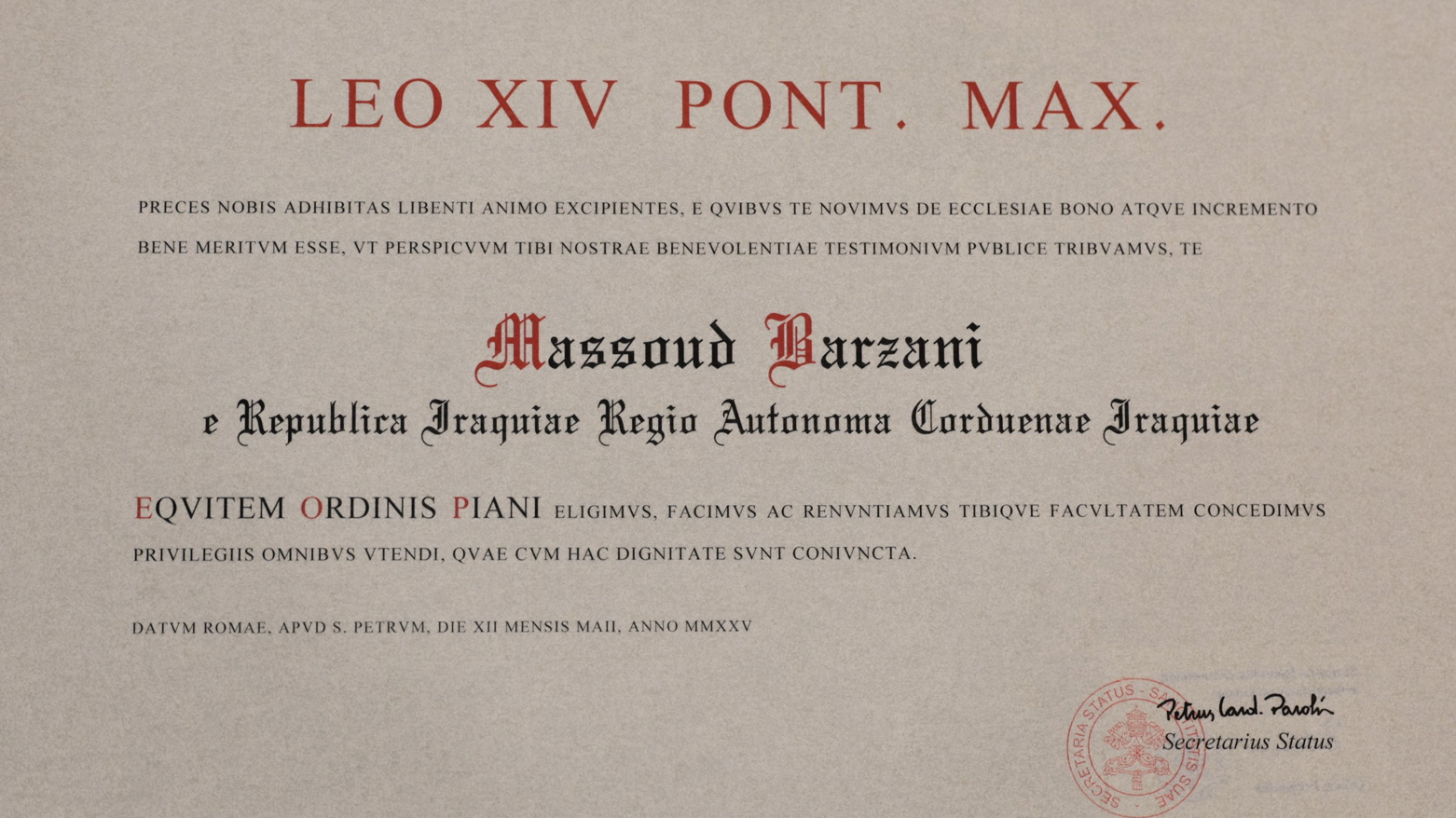
ERBIL (Kurdistan24) - The Vatican's presentation of the Order of Pope Pius IX to President Masoud Barzani is more than a ceremonial distinction. It places an international spotlight on a political discourse that has become increasingly central to the Kurdistan Region's identity: coexistence among Muslims, Christians, Ezidis and other communities as a pillar of political stability and public life.
The distinction, presented at the request of the Chaldean Church, carries particular resonance because it comes from the Holy See and recognizes a Kurdish leader whose political message has repeatedly emphasized religious freedom, mutual respect and the protection of vulnerable communities.
The Order of Pope Pius IX, established by Pope Pius IX in 1847, is the highest papal order currently actively conferred, with the Collar at its apex. The order has historically been awarded to heads of state and senior diplomatic figures, while its higher distinctions can also recognize exceptional service to the Holy See and society.
For the Kurdistan Region, the honor therefore carries a message extending beyond President Barzani personally. It comes after years in which Kurdish officials have sought to present Kurdistan as a place where religious diversity is not simply tolerated, but incorporated into the region's political and social identity.
From refuge to a political doctrine
That message became particularly visible after the rise of ISIS in 2014, when hundreds of thousands of displaced people reached the Kurdistan Region, including Christians from Mosul and the Nineveh Plains and Ezidis fleeing genocide in Sinjar.
Previous Kurdistan24 reporting has documented how the region became a principal refuge for Iraq's Christian population. In Duhok province alone, more than 50,000 Christians have lived amid a network of churches and communities where religious ceremonies continue openly.
The contrast with other parts of Iraq has been stark. In Mosul, once home to one of Iraq's oldest Christian communities, violence and displacement reduced entire Christian neighborhoods to near-empty districts.
For Sam Darmo, president of the Assyrian Foundation for Justice in the United States, the difference is fundamental.
He previously told Kurdistan24 that the vast majority of Iraq's Assyrians had either left the country or moved to the Kurdistan Region, adding that the absence of attacks against churches in the Region was evidence of the security available to the community.
That experience has increasingly become part of Kurdistan's political narrative.
At the height of the ISIS crisis, President Barzani told displaced Christians: "You are not guests here, you are in your own homes and land. Your situation is our situation; we live together and we die together."
The statement has endured because it framed minority protection not as temporary humanitarian assistance, but as a principle of shared citizenship.
Coexistence as governance
President Barzani has repeatedly reinforced that message.
At Kurdistan's first National Prayer Breakfast in April 2025, he described the Region as a place of "coexistence, mutual acceptance, and freedom of belief, religion, and faith," arguing that the culture was deeply rooted in Kurdish history.
"The culture of peaceful coexistence and mutual respect is something we are proud of and determined to preserve," he said.
Months later, at a major interfaith gathering held under the theme "Kurdistan, the Land of Coexistence," President Barzani again described religious diversity as part of Kurdistan's historical inheritance.
"The culture of coexistence is an inheritance from our ancestors," he said, urging religious leaders to strengthen social harmony and a sense of shared belonging.
The distinction from the Vatican gives that rhetoric a wider international dimension. It signals that the language of coexistence has moved beyond domestic political messaging and has become part of how Kurdistan seeks to define itself internationally.
A church, a mosque and a broader message
The KRG has also sought to translate that discourse into visible institutions.
In October 2025, Prime Minister Masrour Barzani inaugurated the Umm al-Nour Cathedral in Ankawa, describing it as a gift to Christians displaced by ISIS. The KRG funded the 6,000-square-meter cathedral, which can accommodate about 1,000 worshippers.
Prime Minister Barzani said the cathedral should become a center for "the further development of brotherhood and friendship among religions and for fostering the culture of coexistence in the Kurdistan Region."
The symbolism was reinforced by the government's simultaneous support for Islamic institutions. The same broader program included work on the Al-Azhar Religious Institute in Erbil.
The message was deliberate: religious freedom was being presented as something that should apply across faiths rather than as protection offered to one minority alone.
That principle is reflected in another major project now taking shape in Erbil, the Barzani Grand Mosque. Envisioned as a vast religious, cultural and environmental complex, the project combines Islamic architecture with Kurdish cultural motifs and public spaces.
Taken together, the cathedral, mosque, interfaith gatherings and minority cultural institutions present coexistence as part of the Region's civic infrastructure rather than simply a slogan.
Ezidis and the politics of cultural protection
The same approach extends beyond Christianity.
In May, President Barzani marked the 33rd anniversary of the Lalish Cultural and Social Center, praising its role in preserving Ezidi traditions and strengthening the cultural life of the community.
The center has supported research, education, student assistance and cultural preservation, while maintaining a close relationship with regional institutions.
Such support has acquired particular significance following the ISIS genocide against the Ezidis.
For the Kurdistan Region, preserving Ezidi religious and cultural identity has become another component of a broader argument: that communities should not have to abandon their identities to achieve safety.
That argument has also found international support.
Former US Ambassador to Iraq Zalmay Khalilzad has praised what he called the Region's "uniquely impressive record of positive interfaith relations," pointing to the decision during the ISIS crisis to use schools as temporary shelters for displaced Christians.
A regional model?
The Vatican honor arrives at a time when the Middle East continues to face sectarian tensions, forced displacement and the erosion of historic religious communities.
In that environment, the Kurdistan Region's model remains imperfect and its institutions continue to face criticism and challenges. But its leadership has increasingly sought to distinguish Kurdistan through a political vocabulary centered on coexistence, religious liberty and the protection of pluralism.
The potential significance of the Vatican recognition lies precisely there.
By presenting a major papal honor to President Barzani, the Holy See is not simply recognizing an individual with a long political career.
The gesture can also be read as reinforcing the importance of the principles associated with his public discourse and the Kurdistan Region's treatment of religious communities.
The Order of Pius IX itself has a long diplomatic tradition and is not limited exclusively to Catholics; it can, in exceptional circumstances, recognize non-Catholics for diplomatic or distinguished service.
That makes its presentation to a Kurdish Muslim leader especially significant in the context of a region where religious identity has often been turned into a source of division.
From Kurdistan to a wider audience
The deeper test, however, is whether coexistence can remain more than a political narrative.
The Kurdistan Region's experience suggests that the protection of diversity requires more than statements. It requires security, functioning institutions, religious infrastructure, cultural preservation and a political willingness to recognize communities as permanent parts of society.
That is the broader significance of the Vatican presentation.
President Barzani has frequently described coexistence as part of Kurdistan's heritage. The Region's policies toward Christians and Ezidis have attempted to turn that heritage into a governing principle.
The Order of Pope Pius IX now places that principle on an international stage.
At a time when much of the Middle East continues to struggle with sectarian polarization and the disappearance of ancient communities, Kurdistan is seeking to offer a different proposition: that religious diversity can be treated not as a vulnerability to be managed, but as an asset to be protected.
The Vatican's recognition gives that proposition an unusually powerful international endorsement.