Erbil Illuminates Citadel for Mawlid Amid Kurdistan's Coexistence Tradition
Erbil is preparing for Mawlid with lights, prayers and charity as the Kurdistan Region highlights its longstanding emphasis on religious coexistence.
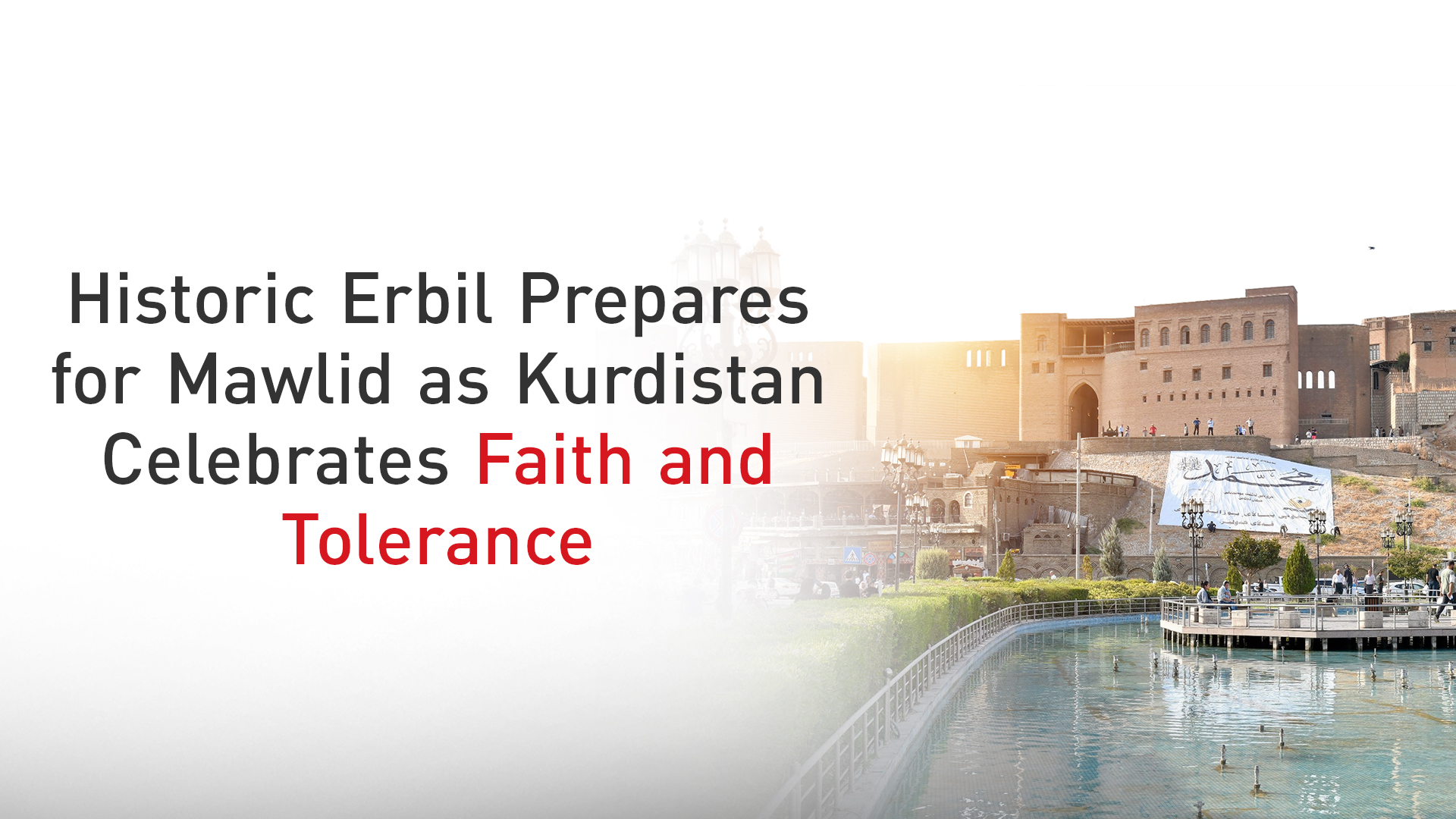
ERBIL (Kurdistan24) - The streets around Erbil's historic Citadel are beginning to glow with colored lights, bazaars are being decorated with Islamic calligraphy and prayers, and mosques and takayas are preparing for nights of recitation as the Kurdistan Region's capital readies to commemorate the birth of the Prophet Muhammad.
Preparations began over the weekend ahead of celebrations culminating on Tuesday, Aug. 25, when Muslims mark the 12th day of Rabi' al-Awwal, traditionally observed as the Prophet's birthday, or Mawlid.
Across central Erbil, the occasion brings together religious devotion, charity and public celebration.
Shopkeepers, restaurant owners and volunteers are preparing hot meals and sweets for distribution, including baklava, lokum and chocolates, while religious gatherings will feature the recitation of the Mawlidnama, dhikr and sermons.
The observance also carries a significance particular to Erbil.
The city has a long association with organized Mawlid celebrations dating to the medieval period, when large public commemorations were held under Muzaffar al-Din Gökböri, the ruler of Erbil.
The tradition remains woven into the identity of a city whose Citadel, mosques, churches and surrounding communities reflect centuries of religious and cultural continuity.
Today, that history is also being placed within a broader political and social message promoted repeatedly by the Kurdistan Region's leadership: that religious faith and communal identity can be expressed openly while different communities continue to share the same civic space.
Faith in a city of many communities
On Mawlid, many residents are expected to attend celebrations in traditional Kurdish dress, while mosques and religious lodges host prayers, devotional recitations and gatherings centered on the life and teachings of the Prophet.
Charitable giving is central to the occasion. The distribution of meals and sweets is intended not merely as celebration but as an expression of generosity and social solidarity associated with the religious observance.
That public character distinguishes Mawlid in Erbil from a ceremony confined to mosques. Streets, markets and historic spaces become part of the commemoration, bringing religious observance into the shared life of the city.
It is within that public space that Erbil's wider religious landscape is especially visible.
The Kurdistan Region is predominantly Muslim, but it is also home to Christian, Ezidi and other religious communities whose places of worship, institutions and cultural traditions form part of its social fabric.
Regional leaders have increasingly described coexistence among those communities not simply as tolerance, but as a defining element of Kurdish society.
President Masoud Barzani has repeatedly framed that principle as an inherited cultural value.
At the Kurdistan Region's first National Prayer Breakfast in April 2025, he described the Region as a place of "coexistence, mutual acceptance, and freedom of belief, religion, and faith."
"The culture of peaceful coexistence and mutual respect is something we are proud of and determined to preserve," Barzani said.
He reinforced the same message at an interfaith gathering held under the banner "Kurdistan, the Land of Coexistence," describing coexistence as an inheritance passed down through generations.
The Mawlid celebrations offer an Islamic expression of that wider social principle: a major Muslim religious occasion observed openly and collectively within a city that also contains some of Iraq's most prominent Christian communities and institutions.
Vatican honor puts coexistence in focus
That narrative received fresh international attention this month when the Vatican presented President Barzani with the Order of Pope Pius IX, at the request of the Chaldean Church.
The papal distinction, established in 1847, is among the Holy See's senior honors and has historically been associated with heads of state, senior diplomats and individuals recognized for distinguished service.
Its presentation to a Kurdish Muslim leader carried particular symbolic weight because it followed years in which Barzani and the Kurdistan Regional Government have emphasized the protection of religious minorities and the principle of freedom of belief.
The Kurdistan Region's coexistence narrative became especially prominent after ISIS swept across large areas of Iraq in 2014. Hundreds of thousands of displaced people sought refuge in the Region, including Christians fleeing Mosul and the Nineveh Plains and Ezidis escaping the ISIS assault on Sinjar.
At the height of that crisis, Barzani told displaced Christians that they were not guests in Kurdistan but were "in your own homes and land," framing their protection as a matter of shared belonging rather than temporary hospitality.
The KRG has since backed projects intended to give institutional form to that approach.
Prime Minister Masrour Barzani inaugurated the Umm al-Nour Cathedral in Ankawa in October 2025, describing the church as a center for strengthening friendship among religions and the culture of coexistence.
Regional authorities have also supported Islamic institutions and projects, including the Al-Azhar Religious Institute and the planned Barzani Grand Mosque in Erbil.
Support for Ezidi cultural institutions, including the Lalish Cultural and Social Center, has further broadened that policy beyond Muslim-Christian relations.
The Vatican honor therefore arrived as external recognition of a political idea the Kurdistan Region has sought to cultivate internally: that religious identity need not produce political exclusion.
That message is particularly relevant in a Middle East where sectarian conflict, displacement and the erosion of ancient religious communities have transformed the demographic character of entire cities and regions.
Erbil's Mawlid celebrations are rooted in a specifically Islamic tradition and carry their own history and meaning. Yet the ability to celebrate that tradition publicly alongside the visible presence of churches, Ezidi institutions and other communities gives the occasion a broader civic context.
As lights illuminate the Citadel and worshippers gather for prayers, sermons and charitable distributions, Mawlid will again place faith at the center of public life in Erbil.
For the Kurdistan Region, the celebrations also illustrate the principle its leadership has increasingly sought to project beyond its borders: that a society can remain deeply attached to its religious and cultural traditions while making space for others to preserve theirs.