Kirkuk Court Fines Kurdish Farmer Mohammed Amin One Million Dinars
Kirkuk court fined Kurdish farmer Mohammed Amin one million dinars while his complaints against Iraqi military personnel remain frozen and subject to dispute.
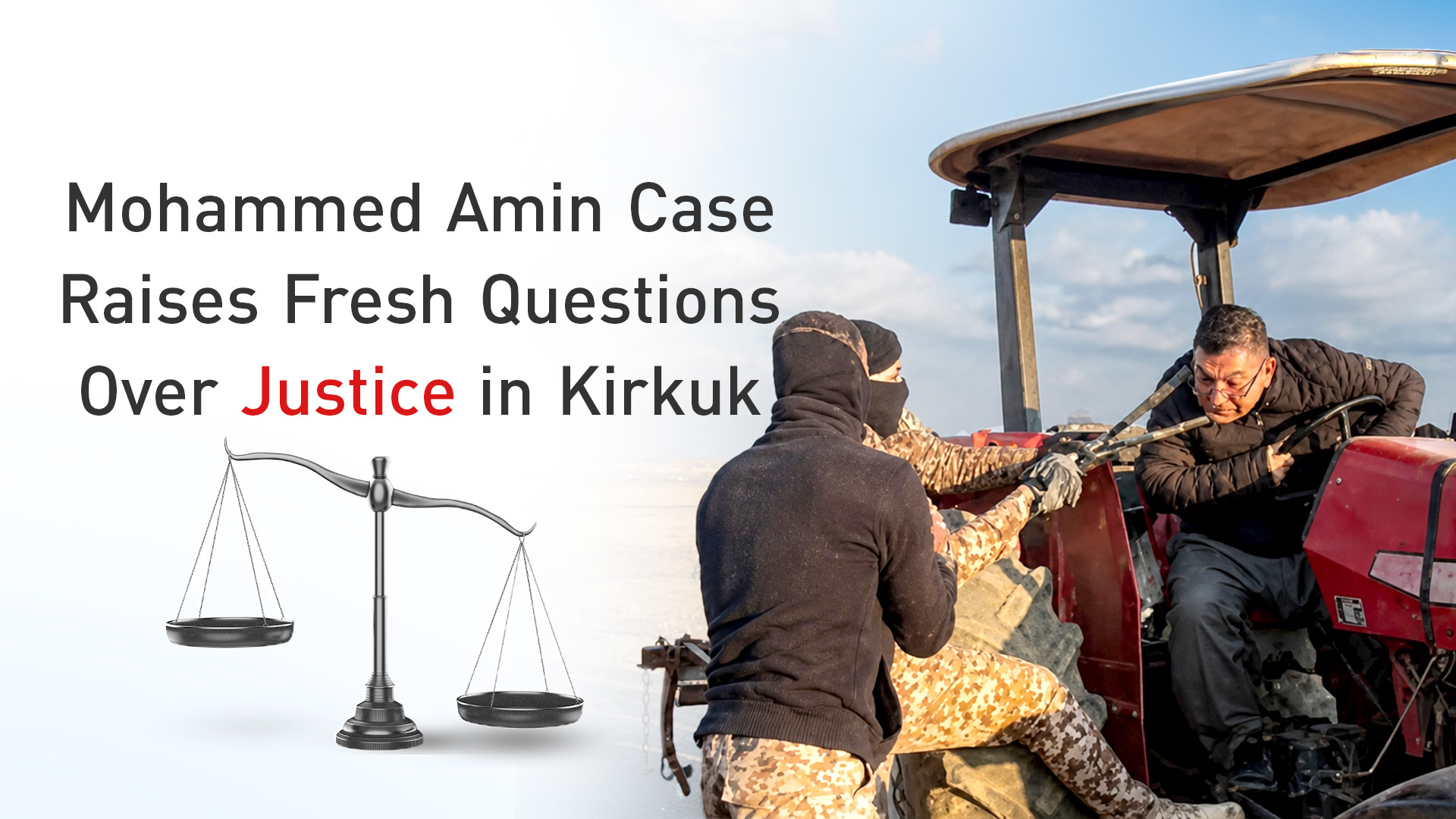
ERBIL (Kurdistan24) - A Kirkuk court on Sunday fined Mohammed Amin, the representative of Kurdish farmers in Sargaran, one million Iraqi dinars in a case brought by the soldier filmed pulling him by his neck-wrap during a confrontation on farmland last year, while Amin's own complaints arising from the same incident remain frozen.
An official decision issued by the Kirkuk Misdemeanor Court on Aug. 23 and signed by Judge Ahmed Hamoud Atiya convicted Mohammed Hamid Amin under Article 229, first part, of Iraq's amended Penal Code No. 111 of 1969.
The court imposed a fine of one million dinars and ruled that failure to pay would result in four months of simple imprisonment.
The decision also grants complainant Karar Shakir Tamer the right to pursue compensation before the civil courts once the ruling becomes final and binding. The judgment itself remains subject to cassation.
"The court convicted and sentenced me based on the complaint filed by the soldier, Karrar Shakir," Amin said after the ruling. "I am now awaiting the outcome of the second complaint filed against me by the Operations Command."
The judgment brings one part of a prolonged legal battle to a conclusion, but it also sharpens questions surrounding the treatment of Amin since the Feb. 17, 2025 confrontation in Shanakha village.
A Kurdistan24 news team recorded that incident while Amin was working his agricultural land on a tractor. The footage showed an Iraqi soldier pulling him by the cloth around his neck during an intervention by an army unit. Amin has said he was also insulted.
Amin subsequently filed two complaints of his own, one against the operations commander and another against the soldier involved, but according to the reporting supplied to Kurdistan24, those cases were frozen.
The commander and soldier, by contrast, filed two complaints against Amin. He was summoned before the courts dozens of times, with repeated hearings postponed when the opposing parties failed to appear.
Sunday's conviction therefore creates a striking legal contrast: Amin, whose confrontation with the military was recorded and publicly documented, has now been sentenced in one of the cases filed against him, while the complaints he brought over the same episode have yet to move forward.
From filmed confrontation to conviction
The video of the Shanakha encounter became one of the most recognizable images associated with Kurdish farmers' disputes over agricultural land in Kirkuk.
Amin has repeatedly said the recording supports his account and that he has faced pressure to abandon his legal complaints.
The court's judgment does not resolve those allegations, nor does it determine the merits of Amin's frozen complaints against the military personnel. It concerns the separate criminal complaint brought against him by Karar Shakir Tamer.
Yet the sequence of events has acquired broader significance because Amin is not the only Kurdish farmer in the Kurdistani territories outside KRG administrative control to face lengthy legal proceedings connected with access to agricultural land.
The underlying disputes reach back decades.
Under Iraq's former Ba'ath government, agricultural lands belonging to Kurdish and Turkmen families in Kirkuk, Khurmatu, Khanaqin and other areas were confiscated as part of demographic policies commonly associated with Arabization. State-issued contracts subsequently transferred the use of some of that land to Arab families relocated from elsewhere in Iraq.
The fall of the Ba'ath government in 2003 did not settle many of the resulting ownership claims.
Article 140 of Iraq's 2005 Constitution established a process of normalization, census and referendum intended to address the consequences of demographic alteration in these territories. Its implementation has remained incomplete, leaving many farming communities to confront competing ownership claims through administrative offices and courts.
For those farmers, the unresolved past continues to determine who can plow, harvest and remain on agricultural land in the present.
Has the underlying problem changed?
Recent cases suggest that the legal and administrative pressures surrounding Kurdish agricultural land remain far from resolved.
In July, 20 Kurdish farmers from Tapa Sawz in Khurmatu appeared before a local court after Arab settlers filed lawsuits over agricultural property currently cultivated by Kurdish families.
The dispute involved land affected by Ba'ath-era contracts, with the Kurdish farmers contesting the settlers' claims.
Previous Kurdistan24 reporting documented attempted seizures of around 1,800 dunams in the same village and arrest warrants against Kurdish landowners. Farmers there said the properties belonged to their families before they were displaced under the former government.
Ahmed Jumaa, a representative of the Tapa Sawz farmers, previously told Kurdistan24 that residents were displaced in 1987 and their villages destroyed. He said Arab settlers later received agricultural contracts covering the land.
The farmers have also cited correspondence from Iraq's Agriculture Ministry stating that the area falls within the Article 140 process and that contracts should not be renewed pending a parliamentary decision.
A similar concern surfaced this month in Topzawa, where residents protested against a proposed Kirkuk master plan they said could convert agricultural land into residential plots before longstanding ownership claims are settled.
The farmers demanded implementation of Law No. 3 of 2025, which they say repealed former Ba'ath-era decisions governing confiscated agricultural land and provides for restitution to original owners.
Those cases differ in their legal facts, and Amin's conviction should not be treated as proof that the judiciary is systematically deciding cases against Kurdish farmers.
But taken together, they leave an unavoidable question over how much has changed for agricultural communities whose land rights remain tied to unresolved policies from an earlier era.
More than two decades after the fall of the Ba'ath government, farmers in Kirkuk and other Kurdistani territories outside KRG administrative control are still contesting access to land, challenging older contracts, appearing repeatedly before courts and waiting for constitutional and legislative remedies to be implemented.
Amin's case gives that broader problem a particularly visible human face.
The footage from February 2025 showed him on his tractor during a forceful confrontation with an Iraqi soldier. Eighteen months later, he has become the convicted party in one of the cases arising from that episode.
His remaining legal battle is not over. The court document makes Sunday's ruling subject to cassation, while Amin is still awaiting a decision in the second complaint filed against him by the Operations Command.
His own complaints, according to the supplied reporting, remain frozen.
That imbalance does not by itself answer whether justice has failed Mohammed Amin. The courts will ultimately determine the outstanding cases and any appeal.
But for Kurdish farmers who continue to navigate land disputes inherited from decades of demographic engineering, the case reinforces a deeper concern: whether legal change on paper has yet translated into equal and effective protection on the ground.