'Even if They Choke Me Again': Mohammed Amin Vows to Continue Land Fight
Mohammed Amin vowed to appeal two Kirkuk court rulings fining him two million dinars, saying he will continue defending Kurdish farmers’ land rights.
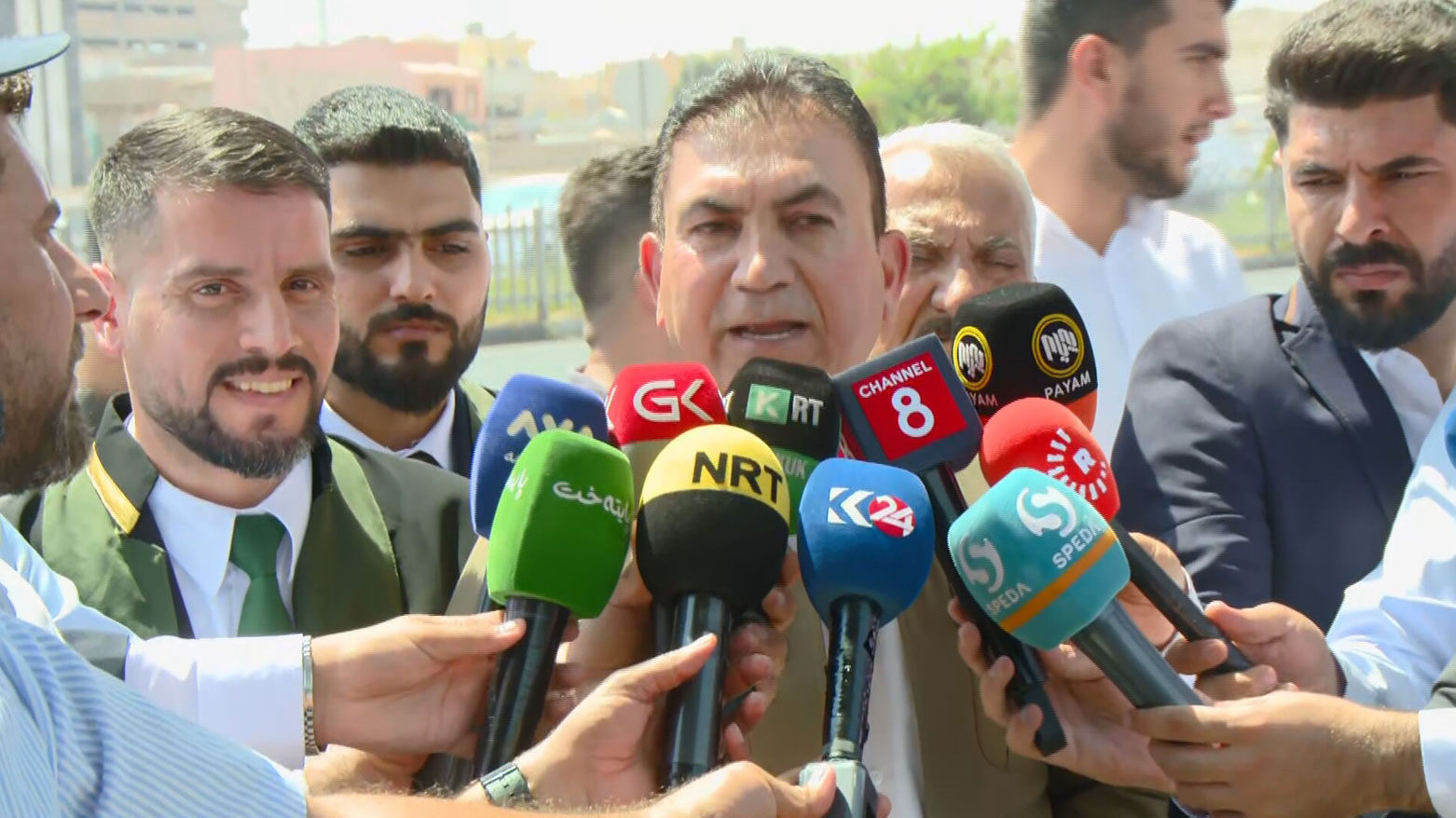
ERBIL (Kurdistan24) - Mohammed Amin, the representative of Kurdish farmers in Kirkuk's Sargaran sub-district, vowed Sunday to appeal two court rulings fining him a total of two million Iraqi dinars, declaring that neither legal pressure nor another physical confrontation would make him abandon his campaign over Kurdish agricultural land.
"Even if they try to choke me 10 more times, I will continue with this case and defend our people," Amin told a press conference shortly after the Kirkuk Misdemeanor Court issued judgments against him in two separate cases.
The rulings mark the latest turn in a case that began with a confrontation on Feb. 17, 2025, when Kurdistan24 cameras recorded an Iraqi soldier pulling Amin by his neck-wrap as he sat on a tractor while attempting to cultivate farmland in Shanakha village.
On Sunday, Judge Ahmed Hamoud Atiya fined Amin one million dinars in Case No. 1405, brought following a complaint by soldier Karar Shakir Tamer, and another one million dinars in Case No. 1404, stemming from a complaint by the Ministry of Defense.
Both judgments were issued under Article 229, first part, of Iraq's amended Penal Code No. 111 of 1969.
According to the court decisions, failure to pay the fines would expose Amin to four months of simple imprisonment in each case, or eight months in total. The decisions remain subject to cassation or appeal.
Amin rejected the accusations against him and said his legal team would challenge both rulings.
"They tried many times to make me drop my lawsuit, but I refused," he said. "Unfortunately, today I was fined two million dinars across both cases. I believe the ruling is unjust, and we will appeal it."
'Instead of receiving justice, I was sued'
Amin said the legal proceedings had reversed the roles arising from the original confrontation.
He maintains that he was attempting to exercise his right to cultivate agricultural land when Iraqi security forces intervened.
"When we tried to plow our own lands, which is our right under Law No. 3 passed by the Iraqi Parliament, armed forces blocked us," Amin said. "During that confrontation, they attacked me and attempted to choke me on my tractor using my neck-wrap."
Kurdistan24 footage from the incident showed a soldier forcefully pulling Amin by the cloth around his neck while he remained on the tractor.
Amin subsequently filed two complaints of his own against the operations commander and the soldier involved. According to Kurdistan24 reporting, those complaints have remained frozen.
The soldier and military authorities, meanwhile, brought separate cases against Amin.
"The soldier who assaulted me, Karrar Shakir, and the Kirkuk Operations Commander both filed separate complaints against me, alleging that I insulted the armed forces and threw stones at them," Amin said. "Both accusations are baseless and entirely false."
The court's rulings constitute legal judgments on the complaints brought against Amin; they do not resolve his separate allegations against security personnel or establish his claim that officials sought to pressure him into withdrawing those complaints.
Amin has nevertheless repeatedly described the unequal progress of the cases as evidence that he has been placed under pressure since the Shanakha confrontation.
His lawyer, Yousef Hassan, said the defense had expected a different outcome because the court had repeatedly reviewed footage recorded by Kurdistan24 reporter Hemin Dalo.
"We did not expect this ruling, especially since the court reviewed the video footage from Kurdistan24 reporter Hemin Dalo as evidence multiple times," Hassan said.
He said the legal team intended to take the judgments to the appeals process in the coming days.
The video has become an important element in Amin's public campaign, capturing a confrontation that might otherwise have depended primarily on competing accounts from the farmer and security personnel.
A case larger than one farmer
Amin framed Sunday's rulings not simply as a personal legal dispute but as part of the continuing struggle over Kurdish agricultural land in the Kurdistani territories outside KRG administrative control.
"This land belongs to the Kurds and must be returned to its original owners," he said.
His case unfolds against decades of unresolved disputes over farmland in Kirkuk and surrounding areas.
Under Iraq's former Ba'ath government, Kurdish and Turkmen families were displaced from agricultural areas as part of Arabization policies, while land and cultivation contracts were transferred in various locations to Arab families resettled from other parts of Iraq.
Although the Ba'ath government fell in 2003, disputes over ownership, agricultural contracts and restitution remain unresolved in numerous communities.
Article 140 of Iraq's Constitution established a process intended to address the consequences of demographic alteration, but its implementation remains incomplete.
More recent legislation has sought to reverse some former-regime decisions affecting agricultural property. Yet Kurdish farmers continue to report disputes over whether they can access and cultivate land they consider ancestral property.
Recent court proceedings involving farmers in Tapa Sawz in Khurmatu, alongside protests over proposed land development in Topzawa, have kept the wider issue before courts and government institutions.
Against that background, Amin's case has become particularly visible because the original confrontation was captured on camera.
The footage showed the Kurdish farmers' representative physically confronted while on his tractor. Eighteen months later, two complaints arising from that episode have resulted in criminal fines against him, while the complaints Amin says he filed against those involved in the confrontation remain unresolved.
Amin insisted Sunday that the outcome would not cause him to retreat.
"I do not regret what I did," he said.
His immediate legal avenue is now the appeals process, where his lawyers say they will challenge both convictions.
The broader land dispute, however, remains unresolved. For Amin and other Kurdish farmers, the central issue continues to be whether legislation intended to address historic confiscations will translate into enforceable protection for those seeking to cultivate the land.
For now, Amin says the two-million-dinar penalty has strengthened rather than ended his determination to pursue the case.